49 works in this view — arrow keys or swipe to move between them.
Dance in Art
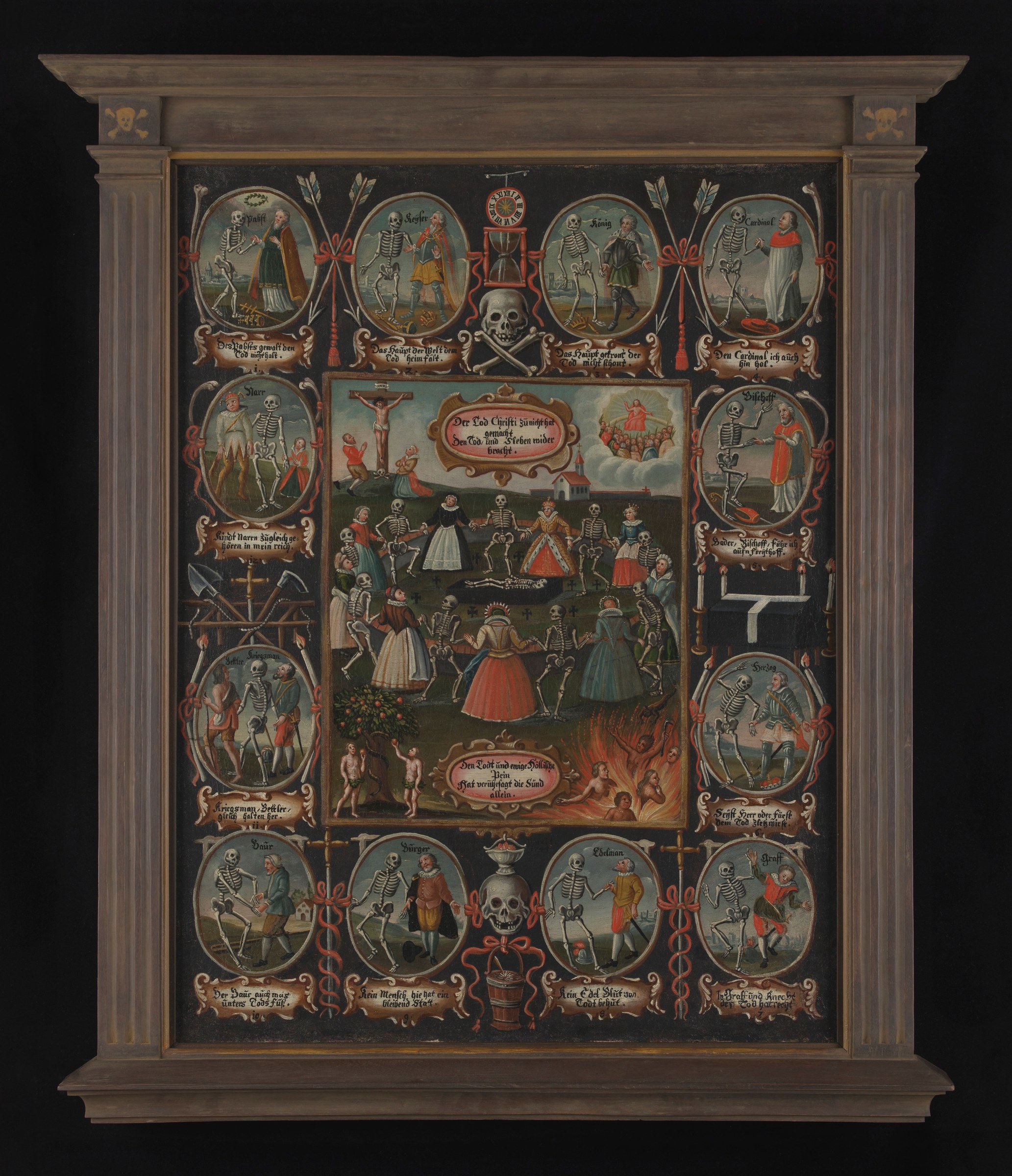
The dance of death. Oil painting.
Unknown artist
- Source:
- Wellcome Collection
- Rights:
- Public domain — free to use, share and adapt.
- Recorded as:
- Public Domain Mark
The Dance of Death is foundational to how Western art represents mortality and social equality; this image exemplifies the genre at its most complex and didactic. For historians of dance, it demonstrates that 'dance' in art history is not always about actual movement or technique—the Danse Macabre uses dance as allegory, a visual language for inevitability and powerlessness. The image also documents Renaissance attitudes toward the body, death, and social order, making it essential to understanding both visual culture and early modern thought.
What you are looking at
This is a memento mori panel, a northern European print or painting depicting the Dance of Death (Danse Macabre). The composition is framed in a wooden architectural surround with classical columns and carved ornaments. The central panel shows a gathering of living figures—men, women, and children in 16th-century dress—dancing or being drawn into motion by skeletons and cadaverous figures among them. A crucifix dominates the center-top, with a skull-faced figure below it. Surrounding this central scene are twelve oval vignettes, arranged in three rows of four, each showing a skeleton paired with a living person of different social rank: a pope, emperor, king, cardinal, knight, merchant, peasant, and others. Each vignette is labeled with explanatory text in German. The lower register depicts hellfire and damnation, with demons and the damned writhing in flames. The palette is muted—ochre, grey-green, black, and russet—on a dark ground, creating a somber, cautionary mood. Gold leaf accents the frames and some details. The style suggests 16th-century German or Low Countries origin.
The dancing
The living figures in the central dance show little coordinated movement; most stand or move stiffly, some with hands raised in alarm or resignation, others already grasped or embraced by skeleton figures. The skeletons are rendered in anatomical detail—visible ribs, joints, and hollow sockets—and adopt active postures: pulling, leading, or dancing with their living partners. There is no balletic grace or courtly hold; instead, the interaction suggests compulsion and struggle. The couples do not form a unified spatial composition but are scattered across the scene, each isolated in their confrontation with death. Children cling to adults; a woman in red appears to resist. The overall effect is of panic and inevitability rather than choreographed dance.
The dance depicted
This is not a depiction of an actual social dance but rather a visual sermon on human mortality using the Dance of Death as metaphor. The Danse Macabre was a late medieval and Renaissance artistic and literary tradition, most prominent in Germanic and Scandinavian regions from the 14th to 17th centuries. It uses the conceit that Death (personified or depicted as skeletons) dances all living people away, regardless of rank, wealth, or piety. The 'dance' here is allegorical—a procession toward death and judgment—performed through forced bodily contact and movement rather than structured step or figure. The individual vignettes illustrate the memento mori theme: every station in life, from pope to pauper, is subject to death. This is religious instruction art, not documentation of an actual dance practice.
How it was made
The work appears to be oil painting on panel, executed in the tradition of German or Netherlandish panel painting. The careful architectural framing, the repetitive oval vignettes with text cartouches, and the didactic arrangement suggest this may be a copy or variant of a well-known print design, adapted into painted form for a chapel, guild hall, or wealthy collector's cabinet. The technique allows for rich color and gold-leaf gilding while maintaining the legibility of small narrative scenes—each vignette can be read independently. The panel format and portable size suggest it was made for private devotional or moral instruction rather than public display. The style and composition indicate knowledge of both print design and panel painting conventions of the 16th century.
About this work
This is a Dance of Death (Danse Macabre) panel painting or work in mixed technique, a moralizing image that uses the metaphor of enforced dancing with skeletal Death to illustrate Christian teaching on mortality and the equality of all humans before death. The central scene shows the chaos of the Dance of Death among living figures in Renaissance dress, surrounded by twelve labeled vignettes showing Death paired with individuals of different social rank. Below, hellfire awaits the damned. The work belongs to a strong German and Low Countries tradition of memento mori imagery that flourished in the 16th century, serving both religious instruction and artistic ambition. It is a major theme in the visual culture of the Renaissance and Reformation, appearing in woodcuts, engravings, frescos, and panel paintings across northern Europe.
How to look at it
Attend first to the central scene as a chaos of encounter: note how each figure responds differently to the skeleton's approach—some resist, some seem hypnotized, some already seem half-dead themselves. Then read the oval vignettes as a visual sermon, moving across and down; the German text labels reinforce the lesson that death comes for all, regardless of station. Notice the anatomical precision with which the skeletons are rendered, their joints and ribs detailed and distinct from the clothed, fleshy bodies of the living. Finally, observe how the lower register—the hell-mouth and flames—anchors the moral teaching: this is not merely memento mori (remember you will die) but also a warning of what awaits the sinful. The 'dance' is not graceful or voluntary; it is a seizure.
The period
The Dance of Death emerged in 14th-century Europe during and after the Black Death, when mortality was endemic and theological focus on death, judgment, and the afterlife intensified. By the 16th century, when this work was likely made, the Danse Macabre had become a standard subject in prints, paintings, and public art across the German-speaking lands and the Low Countries. The Reformation reinforced the tradition: Protestant and Catholic artists alike used the Dance of Death to drive home messages about human sinfulness, the vanity of earthly wealth and rank, and the imminence of divine judgment. Hans Holbein the Younger's famous series of woodcuts (1538) established the iconography that influenced countless later versions. This panel likely dates to the mid-to-late 16th century and reflects the anxieties and religious intensity of the age.
Where it lives
The work is recorded in the Wellcome Collection, a major holding of art, artifacts, and documents related to medicine, science, and the history of human experience. The Wellcome houses numerous Dance of Death images, reflecting the tradition's prominence in Renaissance and early modern visual culture.
Questions about this work
Is this actually depicting a dance that people performed?
No. The Dance of Death (Danse Macabre) is an allegorical concept, not a choreographed social dance. It uses the metaphor of involuntary dancing with Death to represent mortality and the powerlessness of the living. The 'dance' is a theological idea made visible through the forced contact between living and skeletal figures. However, the tradition did inspire some theatrical performances and processions in Renaissance Europe, so the boundary between allegory and embodied practice is not absolute.
Why are the figures dressed in 16th-century clothes if this is about a medieval tradition?
The Dance of Death tradition persisted and evolved from the 14th century through the 17th. This work updates the medieval concept in contemporary dress, making the moral lesson immediate and recognizable to its viewers: these are people like you, in your own time, and Death will come for you too. The use of current fashion strengthens the didactic impact.
What are the German inscriptions in the vignettes?
Each cartouche below a vignette likely identifies the figure's rank or profession and offers a brief moral or cautionary verse. The Danse Macabre tradition used text to reinforce the message: reminders that death spares no one, that worldly power and wealth are vanity, and that the soul's state at death determines the afterlife. The full inscriptions would require paleographic expertise to read with certainty from this image.
Is the crucifix in the center significant?
Yes. The crucifix, flanked by a skull-faced figure, anchors the theological meaning: Christ's sacrifice and the promise of salvation frame the memento mori scene. The image is not despair alone but also a call to penance, faith, and preparation for death. The crucifix reminds the viewer that death, while inevitable, is not the final word for Christians.
More dance artwork





