49 works in this view — arrow keys or swipe to move between them.
Dance in Art
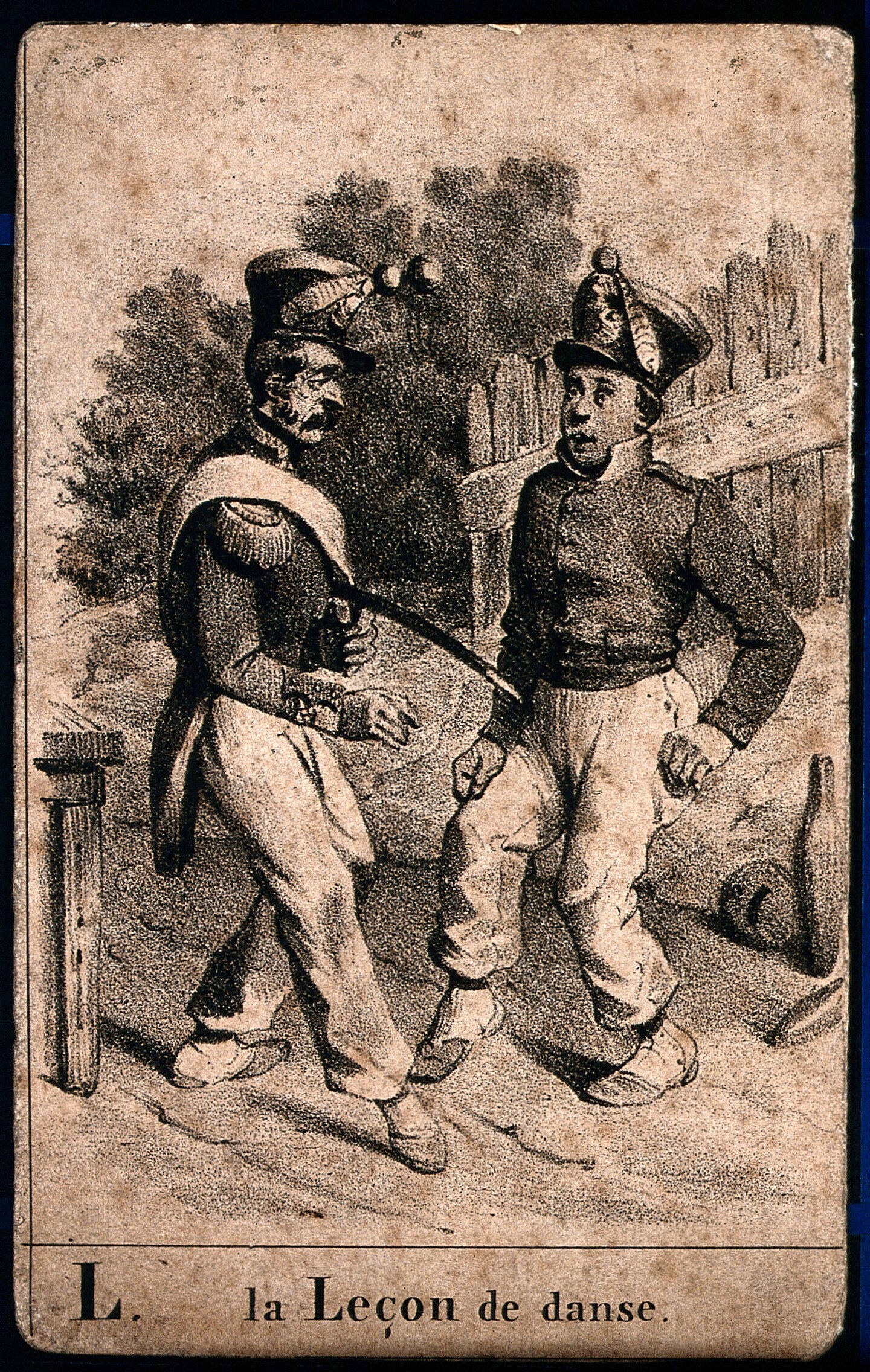
Two soldiers perform a dance. Lithograph.
Unknown artist
- Source:
- Wellcome Collection
- Rights:
- Public domain — free to use, share and adapt.
- Recorded as:
- Public Domain Mark
This image is one of few surviving visual records of how ordinary soldiers actually danced in the early 19th century—not formalized or choreographed, but playful and vigorous. It documents a social practice and a physical culture that is otherwise nearly invisible in dance history, which tends to focus on theatrical or courtly forms. The print's very informality and comic tone make it valuable: it shows movement as lived practice rather than as an art form to be elevated or refined.
What you are looking at
Two military figures in early 19th-century dress occupy the foreground of this lithograph, set in an urban street with walls and vegetation sketched in the background. The soldier on the left wears a dark military coat with epaulettes and a bicorne hat; he stands with one leg extended in a high kick, his body angled dynamically, while his companion on the right—similarly uniformed—watches or participates with arms akimbo. The composition captures a moment of exuberant, physical play rather than formal ceremony. The street setting and casual grouping suggest this is a scene of soldiers dancing or carousing in leisure time, not a parade or official occasion. The lithograph's tonal range moves from dark blacks in the figures to lighter washes in the architectural and natural elements, creating depth and atmosphere.
The dancing
Both soldiers are rendered with pronounced musculature and exaggerated movement. The left figure's extended leg kick is the dominant gesture—high, straight, and emphatic—with his torso tilted to counterbalance. His companion stands more upright, weight distributed evenly, with arms raised in an attitude of encouragement or mirroring. The artist has captured a moment of release and physical abandon: these are not posed, controlled movements but rather the kind of vigorous, improvisational motion associated with popular dancing among enlisted men.
The dance depicted
This appears to depict a folk or popular military dance of the early 19th century—likely a galopade, galop, or variant of quick-stepping social dance popular among soldiers of the Napoleonic era and after. The high leg kick and the street setting are consistent with the informality of garrison or off-duty dancing. The exaggerated rendering of the bodies suggests the artist was capturing the energetic, sometimes comical character of such dances as they were performed by ordinary soldiers rather than professional dancers or courtiers. Without identifying marks or context, the specific dance cannot be named with certainty, but the vocabulary of movement points to the folk-regional or historic-gilded-age repertoire of European military culture.
How it was made
This is a lithograph, a technique that allowed fine detail and tonal gradation through the oil-and-water properties of stone. The handling is assured: the artist has used crayon and perhaps scraping to build form in the figures while keeping the background atmospheric and loose. Lithography was a relatively new medium in the early 19th century and was well-suited to rapid production and wide distribution, suggesting this image was intended for a popular or military audience rather than the fine-art market. The worn condition of the print and its housing in a collection suggest it circulated as a broadside or part of a series.
About this work
This lithograph documents a moment of popular military dancing in early 19th-century Europe. Two soldiers in full uniform perform or dance in a street setting with infectious energy and physicality. The print is a record of how ordinary soldiers danced in their off-duty hours—not the refined, choreographed movements of the ballroom or theatre, but the vigorous, improvised motion of garrison life and urban leisure. The exaggerated rendering and comic energy suggest the artist was both documenting a real social practice and satirizing or celebrating the somewhat rough, unpolished character of soldiers' amusements.
The work belongs in a dance history collection because it captures a social and cultural moment that elite dance records often ignore. Soldiers' dances, garrison culture, and the physicality of working-class recreation were part of the lived experience of dance in this period, yet they appear rarely in formal histories or in the artistic record. This print is evidence of a world of movement and play that existed outside the academy and the court.
How to look at it
Attend to the moment of maximum extension in the left figure's leg kick—the artist has frozen him at the apex of the movement, one leg high and straight, the other planted for balance. This is not a realistic freeze-frame but a graphic exaggeration designed to convey energy and physical abandon. Notice also how the companion's posture and the looseness of the composition (the placement of the two figures, the informal street setting) contrast with the stiffness and formality of contemporary ballroom dance images. The artist is celebrating a kind of movement and a social space that was considered rough and unrefined by the polite standards of the day.
The period
The early 19th century saw the consolidation of the galop, polka, and other quick, energetic social dances that appealed to both respectable society and working-class and military populations. The Napoleonic Wars and their aftermath created large standing armies across Europe, and soldiers' culture—including their leisure and dance practices—became a visible part of urban life. At the same time, lithography was emerging as a mass-market medium for satirical prints, news images, and scenes of contemporary life. The combination of subject (soldiers dancing) and medium (lithography) suggests this print was made for a broad audience interested in scenes of everyday military or garrison life, possibly with a satirical or comic intent.
The style and costume place the image in the post-Napoleonic period, roughly 1815–1830. At this moment, European dance was in transition: the formal court dances of the ancien régime were giving way to more energetic, popular forms—polkas, galops, quadrilles—that appealed across social classes. Soldiers, who were often young, unmarried, and without regular access to formal ballrooms, would have danced the vernacular versions of these dances in streets, taverns, and barracks.
Where it lives
The work is held in the Wellcome Collection, which houses images related to the history of medicine, science, and social life. Its presence in this collection suggests it may have been catalogued as a document of military life or social customs rather than as a work of fine art or dance history.
Dance in this work
Questions about this work
What dance are these soldiers performing?
The specific dance cannot be identified with certainty from the image alone. The high leg kick and energetic style are consistent with popular military dances of the early 19th century, such as a galop or quick-stepping folk variant. The exaggeration of the movement suggests the artist was more interested in capturing the spirit of soldiers' recreation than in documenting a formal choreography.
Why are soldiers featured in a dance image?
Soldiers were a visible and lively part of urban and garrison culture in the early 19th century, and their leisure activities—including dancing—were subjects of popular interest and satire. Military populations had their own dance traditions that differed from refined ballroom culture, and prints like this documented and often gently mocked those practices for a broad public audience.
What does the lithography tell us about this print?
Lithography was a relatively new mass-production technique in the early 19th century, suited to rapid printing and wide distribution. The fact that this image was made as a lithograph suggests it was intended for a popular audience—soldiers, civilians interested in military life, tavern-goers—rather than collectors of fine art. The technique allowed the artist to achieve tonal range and detail while remaining affordable and reproducible.
More dance artwork





