49 works in this view — arrow keys or swipe to move between them.
Dance in Art
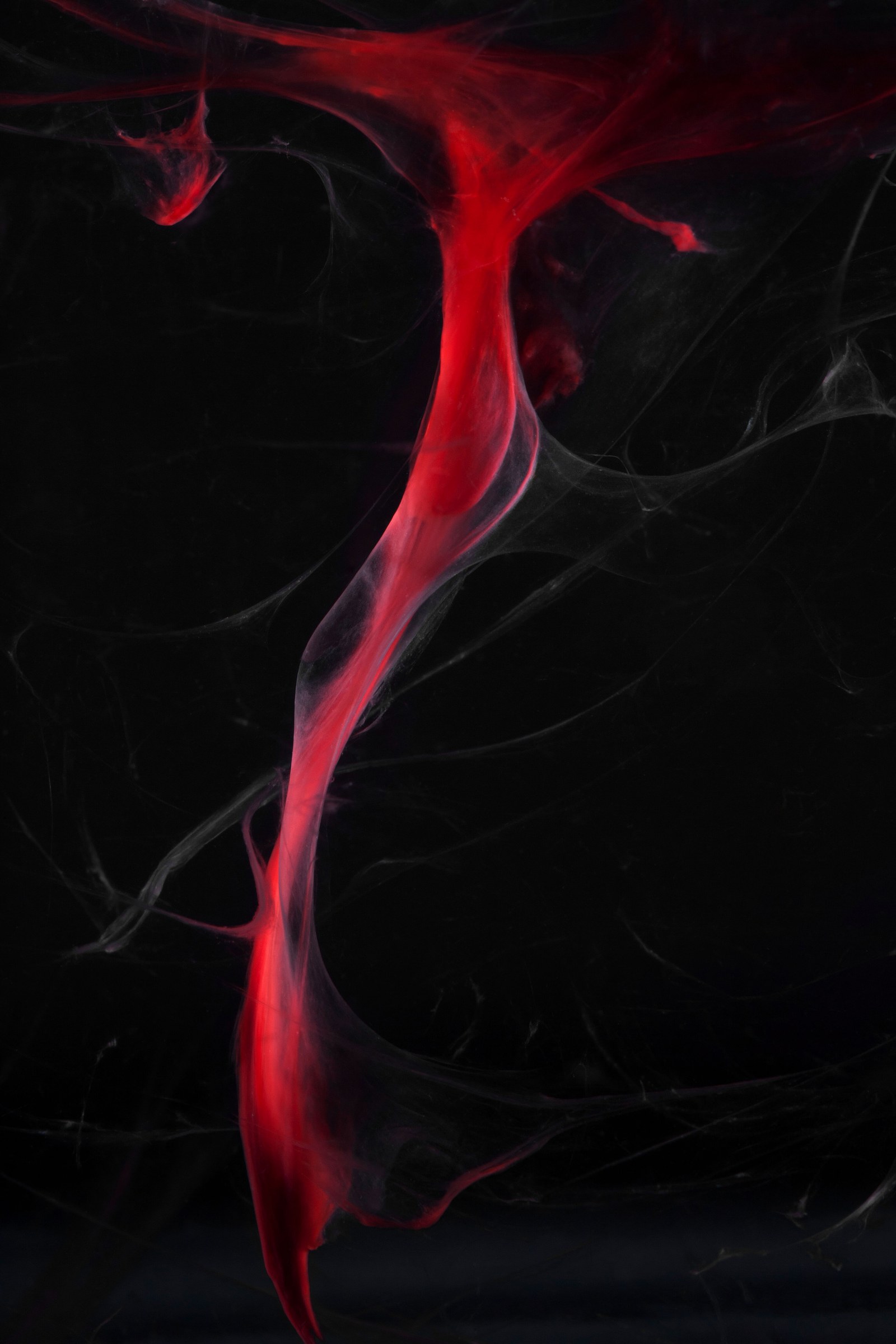
Menstrual blood, artwork title "Slow Dance"
Unknown artist
- Source:
- Wellcome Collection
- Rights:
- Reusable with conditions: credit the creator. Source record ↗
- Recorded as:
- Attribution 4.0 International (CC BY 4.0)
The work raises a crucial question for any gallery of dance in art: does 'dance' require a dancing body, or can the concept and aesthetics of dance inhabit abstract phenomena? It represents a shift toward conceptual and post-representational engagement with dance as a principle of movement and transformation rather than as a codified practice performed by identifiable bodies.
What you are looking at
Against a black background, a vivid red luminous form descends vertically through the center of the composition, its edges diffusing into the surrounding darkness. The form has an organic, almost vascular quality—it could suggest a vessel, a ribbon, or a bodily fluid captured in motion. Branching, thread-like gray structures surround it, creating a network reminiscent of nerve fibers, capillaries, or abstract lines of force. The red glow intensifies at the top, where it spreads into more diffuse, cloud-like formations, and tapers as it descends. There is no figure, no dancer, no spatial setting—only this floating, internal landscape rendered in high contrast. The work appears to be a medical or scientific visualization, or a photograph of a fluid or light medium against darkness.
The dancing
No human figures or dancers are present. The composition is entirely non-representational in the traditional sense; there are no bodies, limbs, or postures. If the red form is meant to suggest movement or flow, it reads as a vector or trajectory rather than a choreographed gesture.
The dance depicted
This image does not depict dance in any recognizable sense. The catalogue record claims the title is 'Slow Dance' and that the subject is 'Menstrual blood,' but the image itself shows no dancer, no movement vocabulary, and no body in any visible state. The title may invoke metaphorical or conceptual associations with the word 'dance'—the slow descent and flow of the red form, the organic branching patterns—but no actual dance practice or style is represented.
How it was made
This appears to be a photograph or digital capture of a luminescent or fluid medium—possibly dye, light, or a biological specimen—recorded against a dark background. The high contrast and the soft diffusion at the edges suggest either long-exposure photography, macro photography, or digital enhancement. The technique allows the capture of transient, ethereal phenomena not easily visible to the naked eye, and implies a scientific or experimental artistic practice concerned with making the invisible visible.
About this work
This is a non-representational work that uses the title 'Slow Dance' and an evocation of bodily substance to create a conceptual link to dance without depicting dance itself. It belongs in a gallery about dance in art as an example of how contemporary artists invoke dance metaphorically—through language, through rhythm and flow—rather than through figuration. It challenges what counts as 'dance imagery' and invites viewers to find choreography in light, time, and the movement of matter itself.
How to look at it
Approach this as an invitation to see movement and rhythm in a form that does not move and has no rhythm in the traditional sense. The slow descent of the red luminosity and the patient branching of the gray filaments suggest a temporal unfolding—a 'slowness' that the title names. The work asks viewers to project choreographic meaning onto abstract matter, making visible the ambiguity between scientific documentation and poetic vision.
The period
If the work dates from the late 20th or early 21st century, it sits within a broader turn in contemporary art toward scientific visualization, bodily substance as subject matter, and the poetics of the microscopic or internal. Simultaneously, performance and contemporary dance have increasingly embraced abstraction, non-human movement, and the dissolution of the dancing body into light, sound, and ephemeral media.
Where it lives
The work is held in the Wellcome Collection, which houses art, medicine, and artifacts exploring the history and culture of medicine and the body. Its presence there suggests it may have been acquired as scientific documentation or as an artwork engaging with medical or biological imagery.
Questions about this work
Is this actually a dance?
Not in the conventional sense. No dancer or choreographed movement is visible. The work uses the concept of 'dance'—fluidity, descent, organic branching—as a metaphor or lens through which to view an abstract or scientific phenomenon. It is a conceptual artwork that appropriates the language of dance rather than a representation of dance itself.
What is the red form?
The catalogue record identifies it as menstrual blood, and the title is 'Slow Dance.' The image itself shows a luminescent red substance photographed against darkness, with branching gray structures around it. Whether this is literally blood, a scientific specimen, a photograph of dye in liquid, or a digital creation cannot be confirmed from the image alone.
Why would this be in a dance gallery?
It challenges the definition of dance imagery. Some contemporary artists and curators argue that dance is not only about the moving body but about flow, rhythm, metamorphosis, and the aesthetics of transformation. This work invokes those principles metaphorically, making it relevant to discussions of how dance appears in and influences visual art.
More dance artwork





