49 works in this view — arrow keys or swipe to move between them.
Dance in Art
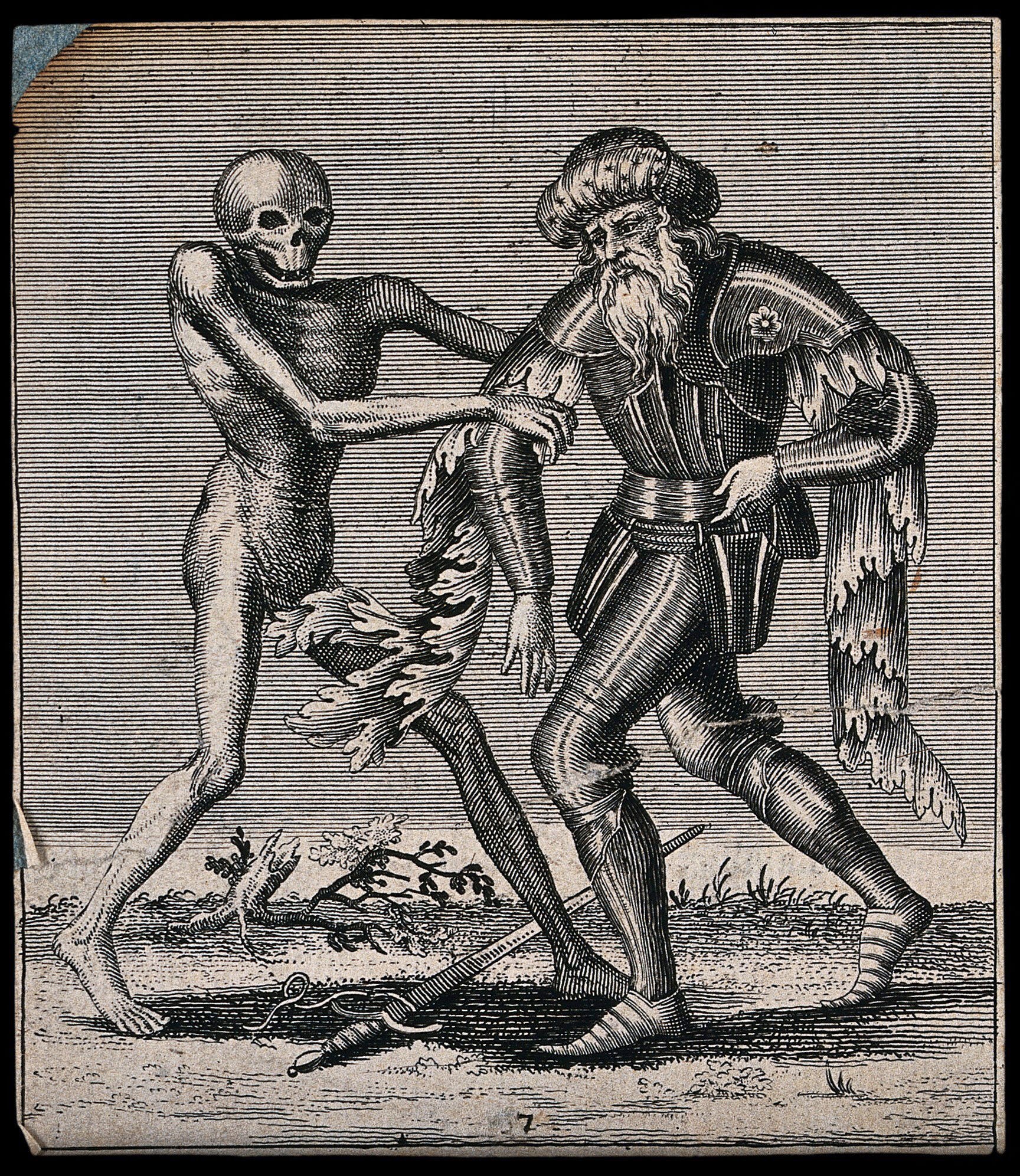
Dance of death: death and the gentleman. Etching attributed to J.-A. Chovin, 1720-1776, after the Basel dance of death.
Unknown artist
- Source:
- Wellcome Collection
- Rights:
- Public domain — free to use, share and adapt.
- Recorded as:
- Public Domain Mark
The danse macabre represents one of the few pre-modern European traditions in which dance is used not to celebrate beauty or social order but to express existential truth: that death is the only universal experience and that all rank and station dissolve before it. For dance historians, the skeleton's posture—the raised limbs, the bent knees, the turned torso—records how a sixteenth-century or early seventeenth-century artist understood the body in motion, and how dance gesture could carry moral and theological weight. The work shows that dance imagery in Western art has long carried meaning beyond entertainment or virtuosity.
What you are looking at
A skeletal figure of Death, rendered with anatomical precision and displayed in a posture of animated movement, dances opposite a richly dressed gentleman in heavy armor or formal court attire. The skeleton strikes an active pose—one leg extended, arms in motion—facing the living man, who stands in a composed stance despite the confrontation. The ground beneath them is bare and roughly textured, grounding the encounter in an undefined but intimate space. The etching's fine parallel hatching creates depth and shadow, emphasizing the contrast between Death's hollow frame and the gentleman's substantial, protected form. The composition captures the moment of encounter rather than flight or resolution: the two figures are locked in mutual attention.
The dancing
Death's skeleton is rendered in full anatomical detail—ribs, spine, pelvic bones all articulated—with the figure adopting an energetic, almost dancing posture: one leg appears to step or spring forward, both arms are raised and angled as if in gesture or embrace, the skull tilted toward the gentleman. The gentleman wears what appears to be 16th or early 17th-century armor, possibly with a feathered hat; his body is upright and composed, one arm extended in a gesture that could be resistance, negotiation, or acknowledgment. The relative scale and positioning suggest formal confrontation rather than struggle.
The dance depicted
This is a memento mori scene from the danse macabre tradition, in which Death dances or leads away figures from all social stations—a pictorial and performative tradition strong in Northern Europe from the 15th to 17th centuries. The skeleton's animated posture—the raised limbs, the forward weight, the turn of the skull toward its companion—indicates that Death is the active dancer, initiating movement or invitation. The gentleman's stillness and formal bearing suggest the living partner's hesitation or acceptance. This is not a depiction of an actual dance performed by humans, but an allegorical use of dance gesture to express the inevitability and universality of death. The danse macabre existed as both visual art and as actual ritual or dramatic performance; this etching documents the visual tradition.
How it was made
This is an etching, a process that allows fine linear detail and tonal gradation through parallel lines (hatching). The technique was ideal for the danse macabre tradition because it could render anatomical precision in the skeleton while simultaneously creating movement through deliberate line direction and intensity. Etchings circulated widely in multiple impressions, making them instruments of both artistic and moral education; this work's Wellcome source suggests it was valued for its visual clarity and allegorical content rather than as a technical display. The attribution to J.-A. Chovin (1720–1776) and the note that it is "after the Basel dance of death" indicate it is a later reproduction of an earlier, possibly 16th-century original, part of a long tradition of copying and adapting the most famous danse macabre compositions.
About this work
This etching depicts one moment from the danse macabre tradition: Death, rendered as an anatomically detailed skeleton in an animated, dancing posture, confronts a gentleman in formal armor. The work operates on two levels simultaneously: as a visual representation of allegorical dance and as a moral reminder of death's leveling reach across all social ranks. The skeleton's active gesture—raised arms, forward stance, animated tilt of the skull—marks Death as the agent of movement, while the gentleman's formal bearing records the living person's composed (or resigned) acknowledgment. The etching's fine linear technique allows both the grotesque clarity of skeletal anatomy and the fluidity of gestural motion, making Death's dance visible as both physical fact and spiritual truth.
How to look at it
Attend first to Death's posture: the skeleton is not passively standing but actively dancing—the raised arms, the forward-stepping leg, the angled torso all convey motion and agency. The artist has chosen to freeze the moment of encounter or invitation rather than flight or final embrace, creating a still image that nonetheless conveys dynamism. Notice how the etching line itself carries movement: the hatching that creates shadow also creates rhythm, and the direction of the lines often follows the direction of the bodies. The gentleman's formal bearing and composed posture—his armor, his stance—create a counterpoint to Death's animation: living and dead are differentiated not only by anatomy but by bodily energy.
The artist
J.-A. Chovin (1720–1776) was a printmaker active in the 18th century, working in a period when the danse macabre tradition, though centuries old, retained cultural resonance and continued to be reprinted and adapted. His role here is as a reproducer and interpreter rather than an inventor: the note that this work is "after the Basel dance of death" indicates he was copying or adapting a well-known earlier composition, likely from the 16th century. This practice of reproducing older danse macabre designs across multiple generations and media (woodcut, engraving, etching) itself demonstrates the tradition's enduring power and circulation.
The period
The danse macabre tradition emerged in Northern Europe in the late medieval period (c. 1350–1500), gaining particular force after the catastrophic mortality of the Black Death. By the 16th century, it had become established in both visual art (murals, prints, manuscript illumination) and as ritual or dramatic performance. The tradition reached its artistic peak in the 15th and 16th centuries but continued to be reproduced and adapted well into the 18th century, as Chovin's work demonstrates. In the 17th and 18th centuries, when Chovin was working, the danse macabre had become more of a learned or pious tradition than a lived social practice, but it retained theological and moral weight. The etching format allowed earlier designs—many originally in woodcut—to be circulated to new audiences in multiple copies.
Where it lives
The work is held in the Wellcome Collection, a medical and scientific archive that acquired this etching as part of its documentation of medical and anatomical knowledge, as well as cultural responses to mortality and disease. The danse macabre tradition sits at the intersection of art, theology, medicine, and public performance, making it appropriate to a collection concerned with the history of medicine and the body. The attribution to Chovin and the note of its basis in the Basel danse macabre are consistent with how these works were catalogued and circulated.
Questions about this work
Is this actually depicting a real dance that people performed?
Possibly both. The danse macabre existed first as a visual tradition (murals, manuscript illuminations, prints) and later as dramatic or ritual performances in churches and streets. This etching is part of the visual tradition, but the poses and gestures it records may have been inspired by or reflective of actual dramatic performances in which masked or costumed figures danced the roles of Death and the living. The skeletal anatomy, however, is the artist's interpretation rather than a record of costume.
What does the gentleman's armor tell us?
The armor and formal dress mark him as a person of high social status—a nobleman or knight. The danse macabre tradition's point was that Death comes for people of all ranks: it shows Death dancing with popes, kings, bishops, merchants, peasants, and children. By depicting Death with a gentleman in armor rather than, say, a beggar or child, the artist reinforces the tradition's central moral: rank and wealth offer no protection from mortality.
Why is the skeleton so animated?
In the danse macabre tradition, Death is not a passive or static force but an active agent—usually the one who invites, leads, or pulls the living into the dance. The skeleton's raised arms and forward motion express Death's agency and inevitability. The dance itself becomes a metaphor for the unstoppable progress toward death, and by making Death the dancer (not merely the destination), the artist emphasizes that death is a process, not an endpoint.
What's the relationship between the visual danse macabre and actual dance history?
The visual danse macabre documents how 15th- and 16th-century artists understood and depicted human movement and gesture. While the skeleton is allegorical, the living figure's posture, bearing, and implied movement record authentic movement vocabulary from that period. Additionally, the tradition influenced actual dramatic and ritual performances—mystery plays, processions, and church rituals—that used dance-like movement to communicate moral and theological ideas.
More dance artwork





