49 works in this view — arrow keys or swipe to move between them.
Dance in Art
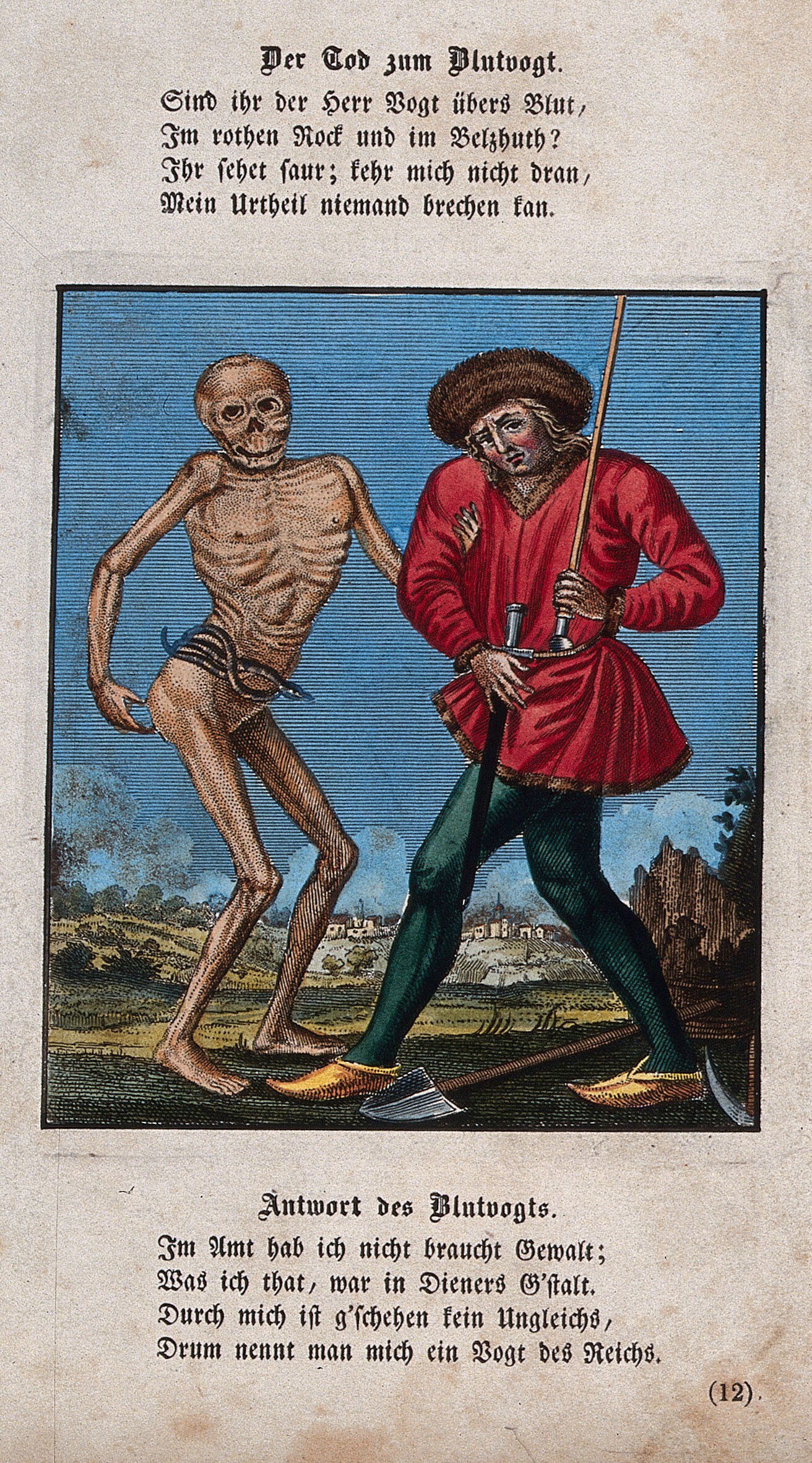
Dance of death: death and the executioner. Coloured etching and letterpress after J.-A. Chovin after the Basel dance of death.
Unknown artist
- Source:
- Wellcome Collection
- Rights:
- Public domain — free to use, share and adapt.
- Recorded as:
- Public Domain Mark
The Dance of Death was one of the most influential visual and performative traditions in late medieval and Renaissance Europe, a way of processing plague, war, and social upheaval through artistic encounter. This etching preserves that tradition in a German context and demonstrates how deeply the Dance of Death was integrated into print culture, verse, and visual art across linguistic and regional boundaries. For dancers and historians, it offers evidence of how bodily encounter, symmetry, and gestural dialogue were understood as a form of performance and communication before the codification of dance as a separate art form.
What you are looking at
A skeleton and a living man confront each other in a landscape rendered in blue and ochre. The skeleton stands to the left, anatomically precise and unclothed, its ribs and spine clearly articulated, one arm raised in a gesture that mirrors the man's own posture. The man, positioned to the right, wears a red tunic or doublet, a brown fur hat, and green hose; he grips a sword or halberd across his body, his weight shifted forward in an attitude of both threat and submission. Between them lies the ground, rendered with a few cursory lines suggesting earth and grass. In the far distance, a walled city or fortification rises on the horizon beneath a cloudless blue sky. The composition is frontal and symmetrical, presenting the two figures as equal protagonists in a confrontation.
The dancing
Both figures are depicted in nearly identical poses: legs planted wide, one arm raised or extended, bodies angled toward each other as if in dialogue or combat. The skeleton's raised arm and the man's grip on his weapon create a visual rhyme—the living and the dead mirror each other's stance. The man's weight appears forward, aggressive, yet his gaze and posture suggest recognition or resignation rather than triumph. There is no chase or flight; instead, they meet as equals in a moment of acknowledgment.
The dance depicted
This is a Dance of Death—a tradition of artistic and theatrical representation, not a depiction of an actual dance step or form. The confrontation between a skeleton and a living figure enacts a medieval and Renaissance memento mori: the inevitability of death and the levelling of all social rank. The verse above the image (Der Tod zum Plutoogt / The Death to the Executioner) frames this as a dialogue or performance—a theatrical encounter in which death claims even those who deal in death themselves. The pose and gesture suggest a formal engagement, almost a duel, that unfolds as much through visual parallelism as through movement.
How it was made
This is a coloured etching and letterpress (printed text above the image), executed after a design by J.-A. Chovin and based on the Basel Dance of Death cycle. The technique of hand-coloured etching allowed for fine linear detail in the skeleton's anatomy and the figures' costumes, while the limited colour palette—primarily blue for the sky, ochre and brown for the earth and clothing—emphasises the symbolic rather than naturalistic intent. The letterpress text above creates a complete artefact: image and verse together constitute the work. This combination of fine engraving and printed verse indicates a work of some sophistication, intended for educated viewers familiar with both visual allegory and German verse.
About this work
The Dance of Death was not a dance in the modern sense, but a powerful medieval and Renaissance art form that deployed visual and theatrical confrontation to meditate on human mortality. This etching stages that confrontation between Death (as a skeleton) and an Executioner (a man wielding a weapon and wearing the dress of a soldier or official). The composition is formal and symmetrical, presenting death not as a lurking threat but as an equal partner in a ritual encounter. The verse that accompanies the image transforms the visual into speech, suggesting that the Dance of Death was also performed—enacted as a dialogue, a procession, or a pageant in which the living came face to face with their own end. This work belongs in a dance gallery because it documents a significant and widespread performative tradition, even though the 'steps' of the Dance of Death lie as much in gesture, stance, and symbolic pose as in footwork.
How to look at it
Notice first the perfect symmetry of pose: the skeleton and the executioner are mirror images, their raised arms and splayed legs creating a visual echo. This symmetry is the key to understanding the Dance of Death—it is not about one figure pursuing another, but about recognition and equivalence. The skeleton does not loom or tower; it stands as an equal. Second, attend to the gesture and the weapon: the man grips his halberd as if to defend himself or strike, yet his posture does not suggest motion but rather a frozen moment of encounter. The verse above invites reading aloud, suggesting that this image was meant to be 'performed' or recited—the Dance of Death was as much oral and theatrical as it was visual.
The artist
The work is recorded as a coloured etching after J.-A. Chovin and based on the Basel Dance of Death, but the printmaker or colourist is not identified. The Basel Dance of Death (Totentanz) is a documented wall painting in the Basel Minster, created in the 15th century; this etching represents a much later print tradition that reproduced and circulated that image across Europe in hand-coloured and printed form. Chovin may have been the designer of this particular iteration, but the work is part of a long lineage of adaptations and reinterpretations.
The period
The Dance of Death flourished in the late 15th and 16th centuries, gaining urgency and prevalence in the wake of repeated plague outbreaks and the religious upheaval of the Reformation. In the German-speaking lands, the tradition was particularly strong; the Basel Totentanz became an iconic model, reproduced in painting, woodcut, and etching. By the time this etching was made, the Dance of Death had become a standard subject in print culture, allowing for wide circulation of the image and its moral message. The pairing of image and verse reflects the Renaissance integration of visual and literary culture, and the choice of an executioner as subject suggests engagement with anxieties about power, violence, and social order.
Where it lives
The work comes from the Wellcome Collection, a major holding of medical and cultural history materials. As a coloured etching with letterpress, it belongs to the tradition of early modern print culture and moral allegory, circulated to educated audiences across Europe. The Basel Dance of Death provided the original model, but this etching represents a later, independent iteration—evidence of how powerful and reproducible the image had become.
Questions about this work
Was the Dance of Death an actual dance that people performed?
Yes and no. In some contexts, the Dance of Death was enacted as a procession, pageant, or theatrical performance in which costumed figures (including a skeleton or death figure) moved through streets or public spaces. In other contexts, it was primarily a visual art form—a painting, relief, or print meant to be 'read' as a sequence of encounters between Death and figures of all social ranks. This etching preserves the visual and allegorical form, while the verse suggests a performative or recitative dimension—the text may have been spoken or sung aloud.
Why is an executioner depicted here?
The executioner is one of the traditional figures in the Dance of Death cycle. The conceit is that Death comes for everyone, regardless of their power or position—the executioner, who wields power over others, is not exempt. The parallel pose between skeleton and executioner suggests that death and killing are mirror images, two sides of a single power. This may also reflect anxieties about political violence and the fragility of authority in periods of war or upheaval.
What does the verse say?
The verse at the top, 'Der Tod zum Plutoogt' (Death to the Executioner), introduces the encounter. The man's response below states that he has not needed violence to gain his position—he was merely appointed to his office—and that through him no innocent has come to harm; therefore, he asks not to be called a 'servant of the Realm' or bound to Death's service. The dialogue is a negotiation between life and death, with the living figure attempting to claim exemption or mercy.
More dance artwork





