49 works in this view — arrow keys or swipe to move between them.
Dance in Art
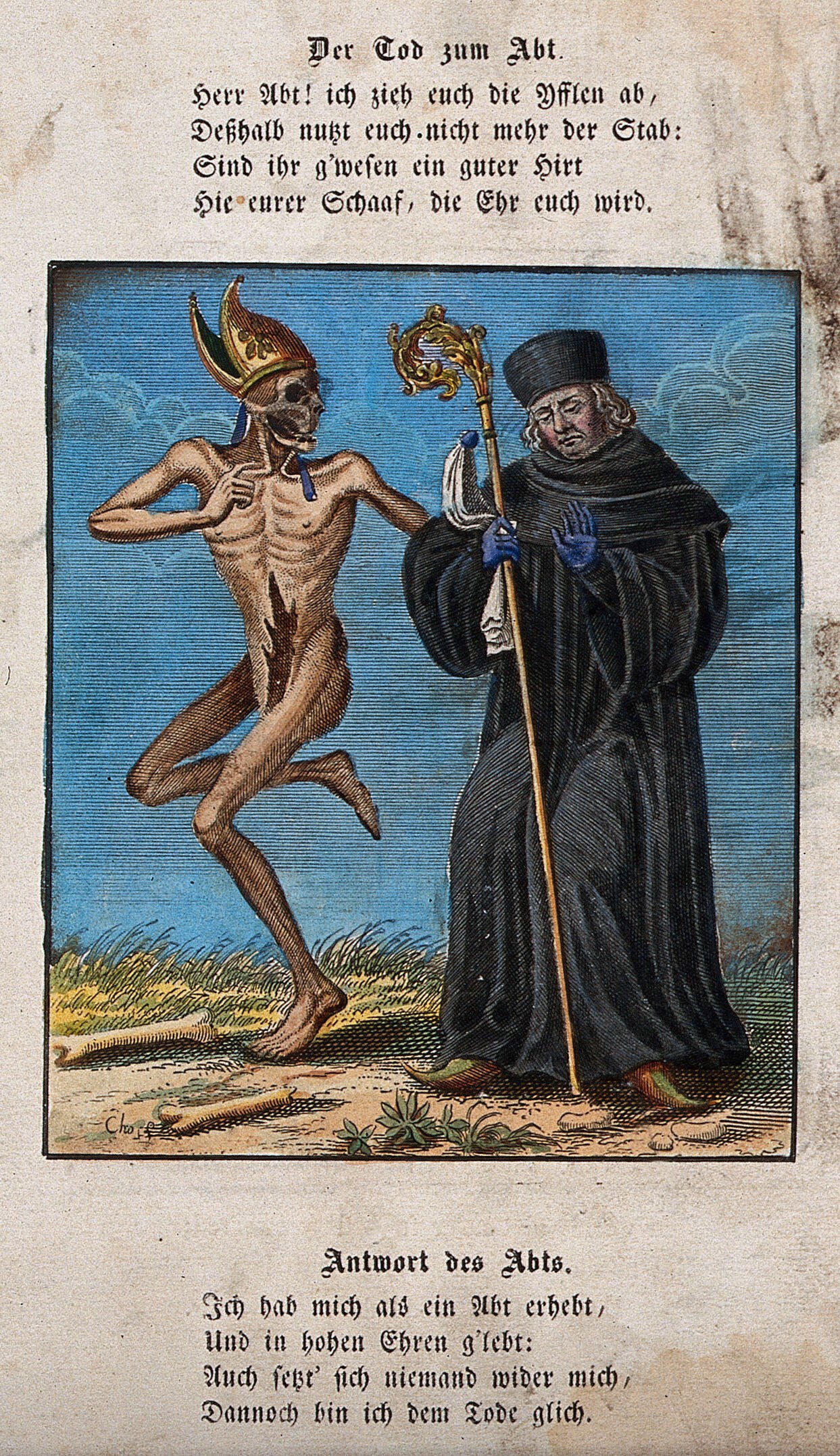
Dance of death: death and the abbot. Coloured etching and letterpress after J.-A. Chovin after the Basel dance of death.
Unknown artist
- Source:
- Wellcome Collection
- Rights:
- Public domain — free to use, share and adapt.
- Recorded as:
- Public Domain Mark
The *Danse Macabre* is a crucial precursor to all later European dance imagery and metaphor. For historians of dance representation, this print demonstrates how dance was weaponized as a moral and theological concept—not as a joyful or aesthetic practice, but as an involuntary surrender to a force beyond human control. The skeleton's grotesque animation influenced how death, fate, and the body in motion were visualized across centuries of European art.
What you are looking at
A skeletal figure wearing a tall pointed bishop's mitre and holding a staff confronts a Benedictine abbot in black robes and cowl. The skeleton dances with one leg raised and arms akimbo in a posture of grotesque animation, while the abbot stands facing him in formal stance, one hand raised in a gesture that may signal blessing, protest, or resignation. The setting is minimal—sparse grass and bare ground beneath a bright blue sky—which focuses all attention on the encounter between the living and the dead. This is a scene from the *Danse Macabre* (Dance of Death), the medieval moral tradition in which Death claims figures of all ranks regardless of station or piety.
The dancing
The skeleton is rendered in anatomical detail with visible ribs and limbs, posed in a lively, almost jaunty posture: weight on one leg, the other raised, torso twisted. The abbot is static and vertical, his broad shoulders and long dark robes creating a solid, earthbound mass. The contrast is stark—the skeleton moves, the abbot does not. There is no physical contact between them; Death approaches or has arrived, but the encounter is one of confrontation rather than dance partnership. The skeleton's posture suggests a kind of macabre invitation or mockery.
The dance depicted
This is not a dance in any conventional sense. The skeleton does not dance with the abbot; rather, Death *dances* and summons the living to join. The tradition of the *Danse Macabre* emerged in medieval and Renaissance Europe as a memento mori—a visual sermon on the inevitability and leveling power of death. The skeleton's energetic pose is deliberately grotesque, a parody of vitality, while the abbot's rigidity suggests the moment of summons: the living confronted by mortality. No footwork or partnering occurs; instead, the image captures the psychological moment when Death appears.
How it was made
This is a hand-colored etching and letterpress, identified as derived from J.-A. Chovin's work and based on the Basel *Dance of Death* tradition. The engraved lines are visible throughout, particularly in the cross-hatching of the abbot's robes and the anatomical precision of the skeleton. Hand coloring in watercolor or similar pigment fills the sky with bright blue and adds flesh tones to the skeleton and earth to the ground. The combination of etching (for fine detail and line) with letterpress (for the text above and below) meant this was a relatively accessible and reproducible image—designed for wide circulation among educated readers and clergy rather than a unique work. The technique allowed for detailed narrative imagery paired with moral commentary in verse.
About this work
This is a German-language *Danse Macabre* print from the early modern period, part of a long tradition of woodcuts and engravings that used the encounter between Death and the living as a vehicle for religious and moral instruction. The Basel *Dance of Death* cycle, painted on the walls of the Cemetery Church in Basel in 1440–1441, became one of the most influential sources for the genre, reproduced and adapted across Europe in various media. This version, based on Chovin's work, preserves that tradition while making it portable and reproducible. The print format allowed the image to reach beyond the church walls to domestic and scholarly settings, making the moral lesson available to anyone who could read German verse. It belongs in a dance history not because it depicts actual dance, but because the *Danse Macabre* is a foundational European image-type that shaped how dance was understood as a metaphor for social order, human vulnerability, and the inevitability of death.
How to look at it
The image freezes the moment of encounter—Death has arrived and moved, while the abbot has not yet responded. The skeleton's raised leg and twisted torso suggest motion arrested mid-step, a parody of living movement that makes the abbot's stillness more striking. Attend to the contrast in surface texture: the skeleton is linear and anatomical (the etched line makes every bone visible), while the abbot is massive and robed (dark shading, heavy folds). The composition places them at equal height despite their moral inequality—Death does not loom over the abbot; he appears as a peer, an equal claimant on the soul. The bright blue sky creates no narrative context; there is no landscape, no city, no church—only the two figures and the idea they embody.
The artist
The print is attributed to Chovin after the Basel *Dance of Death* tradition. J.-A. Chovin (dates unknown) was a 16th- or 17th-century engraver who worked in the *Danse Macabre* genre, adapting the medieval Basel cycle into etched and printed editions. This kind of reproductive printmaking was common in the early modern period—artists copied and re-engraved celebrated works to reach new markets and audiences. Chovin's versions were widely distributed and frequently re-issued, suggesting they were popular with both clergy and educated lay readers.
The period
The *Danse Macabre* emerged as a visual and literary form in 14th- and 15th-century Europe, driven by plague, warfare, and mortality anxiety. The Basel cycle (1440–1441) was one of the most influential and widely copied versions. By the 16th century, when this print was likely made, the tradition had become established across Europe—painted in churches, carved in stone, and reproduced in woodcuts and engravings. The Reformation and Counter-Reformation saw renewed interest in memento mori imagery as a tool for spiritual instruction. Printmaking technology made these images reproducible and therefore economically valuable, embedding the *Danse Macabre* in popular devotional culture. In dance history proper, this period saw the emergence of courtly renaissance dance forms (pavanes, galliards, etc.), but the *Danse Macabre* represents a parallel, darker thread: dance as death, compulsion, and the body's subjection to forces beyond will.
Where it lives
The work comes from the Wellcome Collection, a holding institution focused on medical history, science, and cultural artifacts. The *Danse Macabre* was often classed alongside medical and anatomical imagery in early modern collections, both because it emphasized the skeleton and anatomy and because it circulated in medical and scholarly contexts. As a colored etching with letterpress text, it is a hybrid object—part devotional print, part moral broadside, part anatomical diagram.
Questions about this work
Is this actually a dance?
Not in the practical sense. The *Danse Macabre* is a metaphorical and theatrical tradition in which Death 'dances' and summons the living to join, but no actual partnered dance occurs. The skeleton's animated posture is grotesque and parodic, meant to contrast with the abbot's rigidity and to suggest the violence of death's claim. The tradition uses dance as an image and metaphor for the involuntary surrender of the body to mortality.
Why are there German verses above and below the image?
The verses are the moral instruction of the piece. The title above reads 'Death at the Depart [Departure]'—addressing the abbot directly. The verses translate roughly: the skeleton says he has seized the abbot and taken his staff, and promises the abbot a good shepherd (Jesus), while the abbot responds that he lived well in high honors but now is equal to death like everyone else. The text makes explicit what the image shows: the leveling of all ranks before death.
Why an abbot? Why not a king or a peasant?
The Basel *Dance of Death* cycle was a comprehensive sermon on the universality of death, depicting figures of all social ranks—pope, emperor, knight, merchant, peasant, child—all equally claimed by Death regardless of status or virtue. The abbot represents the spiritual authority and high rank of the Church. The point is that even the most devout, the most protected, the most powerful are not exempt from death's call.
When and where was this made?
The catalogue record does not provide a date or place of publication. The work is based on the Basel *Dance of Death* (painted 1440–1441) and credited to Chovin, a 16th- or 17th-century printmaker. The technique, style, and German text suggest it was produced in a German-speaking region, likely in the 16th or 17th century, but the exact date and location are unknown.
More dance artwork





