49 works in this view — arrow keys or swipe to move between them.
Dance in Art
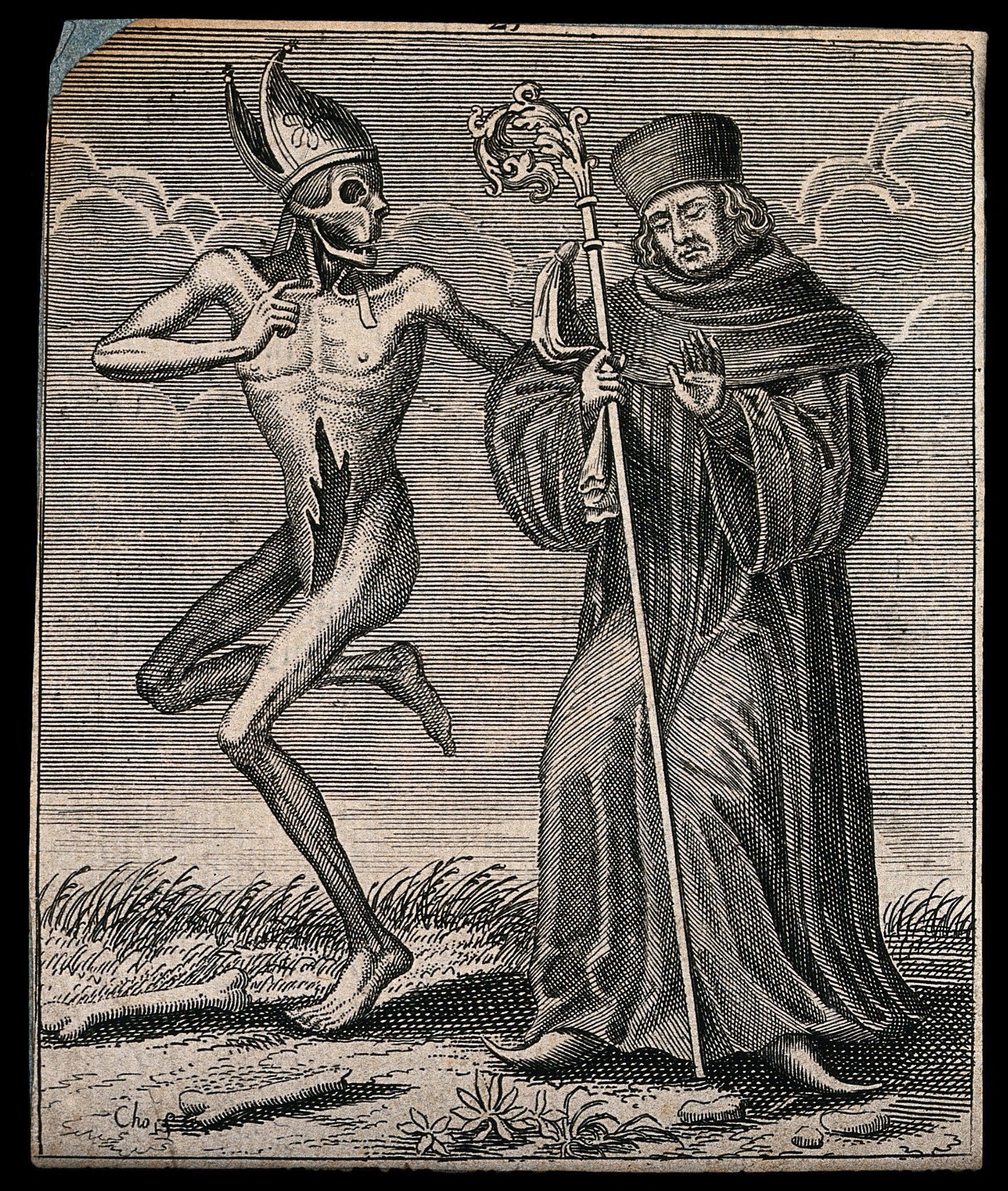
Dance of death: death and the abbot. Etching attributed to J.-A. Chovin, 1720-1776, after the Basel dance of death.
Unknown artist
- Source:
- Wellcome Collection
- Rights:
- Public domain — free to use, share and adapt.
- Recorded as:
- Public Domain Mark
This work documents the *danse macabre* as a visual convention that persisted and was continuously reinterpreted from the medieval into the modern period. It shows how the language of dance and music was deployed as a vehicle for theological instruction: movement itself becomes the medium of moral teaching. For historians of dance iconography, it illustrates how skeletal or supernatural figures could be depicted with anatomically coherent, dynamically convincing gesture—Death is not merely a symbol but a moving, musical, seductive presence.
What you are looking at
A skeletal figure personifying Death dances with an elderly abbot in robes and tall hat, set against a landscape of grass and distant hills. Death is rendered as a cadaverous skeleton with a pointed demon-like head crowned with a tall peaked cap; it has hollow eye sockets and displays its ribcage. The skeleton plays a stringed instrument (possibly a vielle or early fiddle) while dancing in a dynamic, acrobatic posture—one leg extended, torso twisted, body weight off-balance in active movement. The abbot stands to the right in full ecclesiastical dress: a long dark robe with draped sleeves, a tall cylindrical hat, and holds a crosier (bishop's staff) topped with an ornamental scroll. His posture is reserved and upright by comparison. The composition follows the convention of the *danse macabre*: a two-figure pairing in which Death, here as musician and dancer, leads or confronts a living figure of high social rank. The ground is scattered with small plants and flowers, marking a liminal space between life and death.
The dancing
Death's body is rendered with anatomical precision—visible spine, ribs, and skull—and adopts an exuberant, almost acrobatic pose: legs in a wide stride with one foot raised, spine arched, arms positioned to play the instrument. The abbot's frame is vertical, controlled, and hierarchical; his hands rest on or near the crosier. The two figures are locked in spatial relationship: Death faces toward the abbot and dominates the composition through dynamic gesture, while the abbot appears to be the object of Death's attention and musical invitation. The artist has understood the *danse macabre* as a confrontation between two contrasting states—motion and stillness, skeleton and flesh, musician and spectator.
The dance depicted
This is an image from the *danse macabre* (dance of death), a late medieval and early modern visual and literary trope that depicted Death as a figure who danced with or led members of all social ranks to their end. The abbot, a figure of ecclesiastical authority, is shown confronted by Death who takes the role of both musician and dancer. The dance itself is not a named courtly or folk form but rather a symbolic encounter rendered through the language of animated gesture and musical invitation. The skeleton's vigorous pose suggests that Death dances with mocking vitality while the living (here the abbot) are summoned or seduced into joining. This particular example derives from or references the Basel *Danse Macabre*, a famous 15th-century frescoed cycle that influenced printed versions throughout Northern Europe.
How it was made
This is an etching, a intaglio printmaking technique in which an image is incised into a metal plate with acid; the record attributes it to J.-A. Chovin (1720–1776). Etching allowed for fine linear detail and tonal variation through cross-hatching, visible here in the modelling of Death's skeleton, the texture of the abbot's robes, and the atmospheric background. The technique was well suited to rapid serial reproduction, making it an ideal vehicle for popular religious and moral imagery. The fine parallel lines that model form throughout the composition are characteristic of 18th-century etching practice. This work circulated as a print, making it accessible to a broad audience—clergy, educated laypeople, and those familiar with the *danse macabre* tradition.
About this work
This etching depicts a memento mori encounter between Death (as skeleton and musician) and an abbot, following the convention of the *danse macabre*—a didactic visual tradition that reminded viewers of mortality and the equality of all ranks before death. The work belongs to a long genealogy of *danse macabre* imagery stretching from 15th-century Basel frescoes through 16th- and 17th-century prints, concluding in 18th-century reworkings such as this one. It is both a dance image (the skeleton assumes a dynamic, acrobatic pose while playing an instrument) and a moral allegory in which the living are confronted with their inevitable end.
The abbot's formal ecclesiastical dress and staff identify his worldly authority; Death's vigorous physical animation and musical performance render the encounter as a supernatural seduction or summons. The etching format allowed this image to circulate widely, reinforcing religious and philosophical meditation on death across social classes.
How to look at it
Observe the contrast in posture and energy between the two figures: Death's body is twisted, elevated, and in motion; the abbot's is vertical and restrained. The skeleton's expression—if the skull can be said to have one—is rendered through the configuration of the ribs and spine: a kind of anatomical vivacity that makes Death appear more animate, more present, than the living man beside it. The instrument in Death's hands and the abbot's crosier are both implements of authority and summons (music and blessing), yet Death's music appears to be the more compelling force. The small flowers at the base of the composition mark the boundary between the living world (grass, earth) and the supernatural encounter occurring above it. The fine etched lines create an atmosphere of precision and inevitability.
The artist
J.-A. Chovin (1720–1776) was an 18th-century engraver and etcher known for reproductive works and copies after earlier designs. His practice was typical of the printmaking workshops of the period: taking compositions from well-known sources (in this case, the Basel *Danse Macabre*) and reissuing them in contemporary etching technique to meet demand for religious and moralistic imagery. Little is recorded about Chovin's biography; he is known primarily through surviving prints.
The period
The *danse macabre* was originally a late medieval phenomenon, flourishing in visual art (frescoes, panel paintings, manuscript illumination) from the 14th century onward. By the 18th century, when Chovin worked, the motif had entered the realm of printseller's stock imagery—recognizable, reproducible, and commercially viable. The Baroque and early Enlightenment periods saw continued fascination with mortality and the vanitas theme, reflected in literature, drama, and visual art. Etching and engraving had democratized access to such imagery; prints circulated to provincial clergy, educated households, and collectors interested in moral philosophy and the macabre. At the same time, the rigid social hierarchy implied by the *danse macabre*—where every rank from pope to peasant met Death—aligned with both religious teaching and emerging Enlightenment ideas about human equality.
Where it lives
The work is held in the Wellcome Collection, a London-based archive of medical, scientific, and cultural history materials. The Wellcome Collection acquired *danse macabre* imagery as part of its broader holdings on death, medicine, and the history of disease; such images were understood to document both artistic convention and popular attitudes toward mortality and the body.
Questions about this work
What is a danse macabre?
A *danse macabre* (dance of death) is a medieval and early modern artistic and literary motif in which Death, personified as a skeleton or corpse, dances with or leads figures of all social ranks. It served as a memento mori—a reminder that death is universal and inevitable, regardless of wealth, status, or office. The motif originated in 14th-century visual art and remained popular through the 18th century, appearing in frescoes, prints, and manuscripts.
Why is the skeleton dancing and playing music?
In *danse macabre* convention, Death is depicted as an active, seductive force—musician, dancer, summoner. The skeleton plays to invite or seduce the living into the dance; music becomes a metaphor for the irresistible pull of mortality. This active characterization made Death a more compelling subject than a passive symbol, and reflected medieval and early modern ideas about death as a supernatural presence that could charm or compel.
What does the abbot's costume tell us?
The tall hat (mitre), long dark robe, and crosier (bishop's staff) identify the figure as a high-ranking member of the clergy. By choosing an abbot rather than a peasant or merchant, the artist emphasizes the egalitarian message of the *danse macabre*: even ecclesiastical authority and spiritual rank offer no protection against death. The abbot's formal dress and dignified bearing contrast sharply with Death's acrobatic energy.
When and how was this made?
This is an 18th-century etching attributed to J.-A. Chovin, based on designs from the earlier Basel *Danse Macabre*. Etching is an intaglio printmaking technique that allowed fine detail and wide circulation. By the 18th century, *danse macabre* imagery had become reproducible popular print material, meeting demand from clergy, educated households, and those interested in moral and religious themes.
More dance artwork





