49 works in this view — arrow keys or swipe to move between them.
Dance in Art
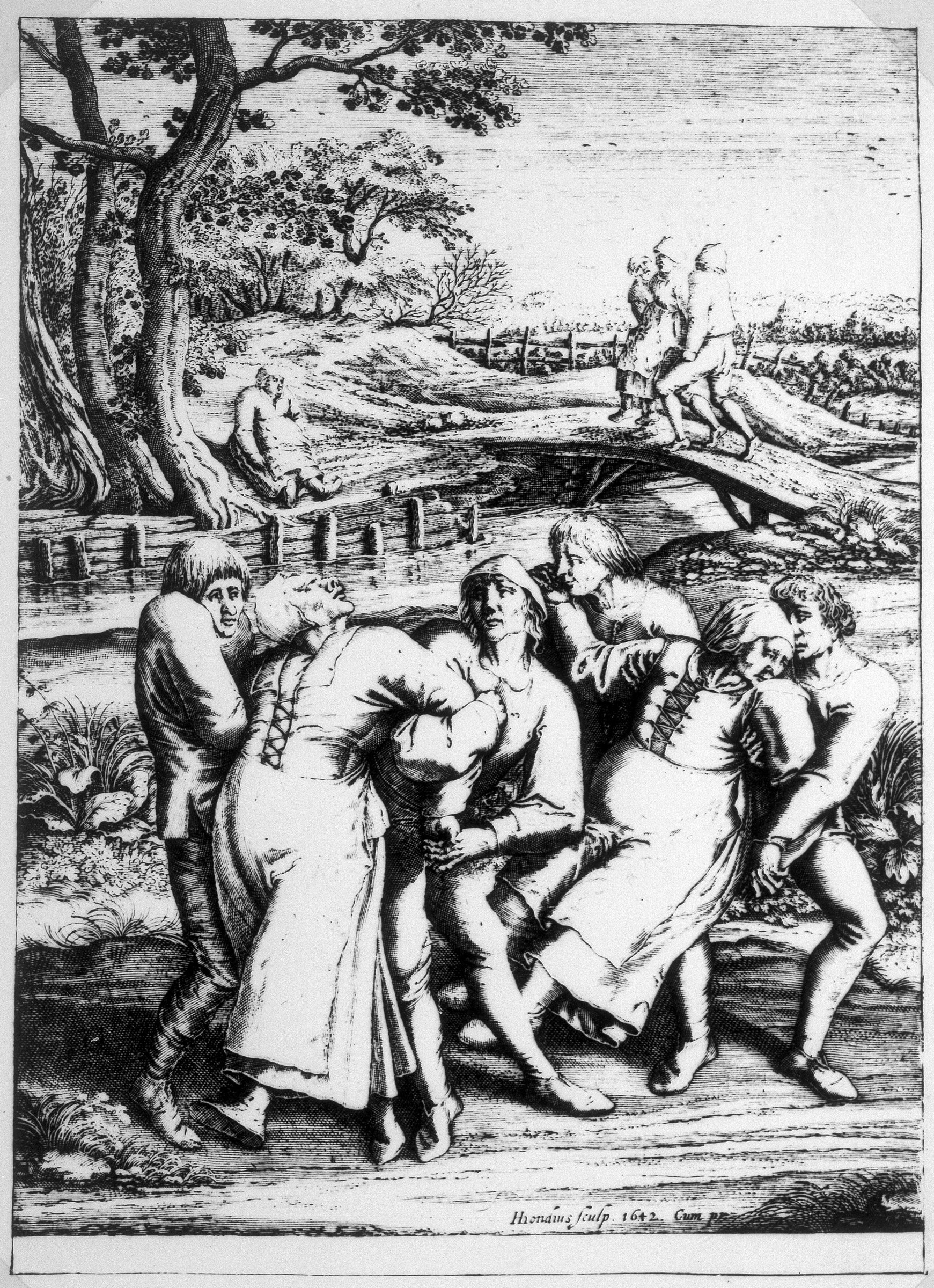
M0014846: Dancing mania, also known as St Vitus's Dance and dancing plague
Unknown artist
- Source:
- Wellcome Collection
- Rights:
- Reusable with conditions: credit the creator. Source record ↗
- Recorded as:
- Attribution 4.0 International (CC BY 4.0)
Dancing mania challenges us to ask what counts as dance. For historians of medicine and for dancers themselves, the work is crucial evidence that bodies can be made to move against will, and that communities have long witnessed and struggled to explain compulsive motion. The engraving also reveals how dance imagery was used not to celebrate movement but to communicate public catastrophe.
What you are looking at
An engraving depicting a chaotic scene of figures dancing uncontrollably near a stream in a rural landscape. In the foreground, a central group of emaciated or contorted dancers move with wild, jerking gestures—limbs splayed at odd angles, bodies twisted and bent as if against their will. A woman in a long dress dominates the center, her posture unstable and her companions supporting or grasping at her. To the left, massive gnarled trees frame the scene; to the right, the landscape opens to distant fields and a gathered crowd. The sky is rendered in fine horizontal lines suggesting distance. The entire composition conveys frenzy and compulsion rather than joy: the dancers appear afflicted, not performing.
The dancing
The bodies shown are contorted rather than graceful—spines curved, limbs flung outward, weight seemingly lost. Multiple figures press against or support one another without the coordination of partnered dance. The central woman's frame is collapsed; those around her gesture with what appears to be alarm or restraint rather than participation in formal steps. At least six figures are visible in the foreground group; others appear in the middle distance. The movement reads as involuntary spasm rather than learned choreography.
The dance depicted
This engraving illustrates dancing mania (also called St. Vitus's Dance or a dancing plague), a documented phenomenon in medieval and early modern Europe in which people danced compulsively, often to the point of physical collapse. The condition was attributed to divine punishment, demonic possession, or astrological influence. The image captures the medical and spiritual terror of the phenomenon: dancers did not choose their movements, could not stop, and often danced until exhaustion or death. The wild gestures and the presence of onlookers suggest the public spectacle these events became, with physicians and clergy often gathering to witness or attempt cure.
How it was made
This is an engraving, executed with fine parallel lines (hatching and cross-hatching) to build form and shadow. The technique is characteristic of 16th- or 17th-century Northern European print production, allowing for wide circulation of the image in affordable multiple copies. The precision of line work and the sophistication of the landscape background suggest a skilled professional engraver, probably working from a painted or drawn design. The medium's portability and reproducibility made it ideal for distributing medical and religious instruction to clergy, physicians, and educated households.
About this work
This engraving documents one of the most disturbing phenomena in European cultural memory: dancing mania, a compulsive, involuntary movement disorder that gripped entire communities. The image is not a representation of dance as an art or social practice, but as a symptom of illness, divine wrath, or demonic interference. It belongs in a gallery about dance precisely because it challenges the assumption that all documented dancing is chosen, skilled, or joyful—it shows dance as affliction, as loss of bodily autonomy, as spectacle of suffering. The work is a document of how early modern medicine and theology attempted to understand movement they could not explain or control.
How to look at it
Attend to the twisted postures of the bodies: they do not show skilled footwork or trained choreography, but rather a loss of control. Notice how the central woman is supported by those around her—this is not social dancing but a kind of medical emergency unfolding in public. The engraver has chosen a moment of maximum chaos, with figures at different stages of their affliction, and the distant crowd suggests the phenomenon as spectacle. The rural setting and the stream may reference the outdoor spaces where afflicted persons often gathered, or may signal this as a primal, uncontrolled force outside civilized boundaries.
The artist
The artist is not recorded. The style and technique suggest a Northern European print workshop of the 16th or 17th century, possibly German or Flemish. Dancing mania was a recurring subject in prints of this era, as the phenomenon recurred (notably in Strasbourg in 1518) and fascinated theological and medical authorities. Multiple engravers produced versions of these scenes, making them a standardized visual trope for communicating epidemic and divine judgment.
The period
Dancing mania episodes are documented from the 14th century onward, with major outbreaks in the 15th and 16th centuries. The most famous occurred in Strasbourg in 1518, when hundreds danced for days until many collapsed. Early modern medicine attributed the condition to natural causes—excess heat, corrupted humours, or astrological influence—while clergy saw divine punishment or demonic possession. Engravings of these scenes circulated widely among physicians and clergy, functioning as medical and theological documents. The phenomenon gradually disappeared by the 17th century, though its causes remain debated by modern historians (ergot poisoning, mass psychogenic illness, and stress-induced movement disorders have all been proposed).
Where it lives
The work is held in the Wellcome Collection, a major repository of medical and scientific imagery. It is catalogued as a print documenting dancing mania and related phenomena. The Wellcome Collection does not record the artist, date of creation, or specific medium details in the available record.
Questions about this work
Was dancing mania a real medical condition?
Yes, it was well documented in medieval and early modern Europe. Major outbreaks occurred in the 14th–17th centuries, with the most famous in Strasbourg (1518), where hundreds of people danced compulsively in public. The cause remains debated; historians have proposed ergot poisoning (a fungal infection of grain), mass psychogenic illness, stress-related movement disorders, or a combination of factors. Physicians and clergy of the time produced extensive written accounts and commissioned prints like this one to record and understand the phenomenon.
Is this dance?
Not in the artistic sense. Dancing mania was an involuntary affliction that people could not stop, not a learned or chosen practice. However, it is essential to the history of how bodies move and how communities interpret movement. It reminds us that dance can be pathological, compulsive, and terrifying, as well as joyful or skillful.
Why would early modern people commission prints of this?
Physicians and clergy used these images to document, understand, and teach about a phenomenon that terrified them. Prints circulated medical theory and theological interpretation among educated readers. They also served as a record for future physicians who might encounter similar cases. In an era before photography, engravings were the primary tool for visual documentation of medical and social phenomena.
More dance artwork





