49 works in this view — arrow keys or swipe to move between them.
Dance in Art
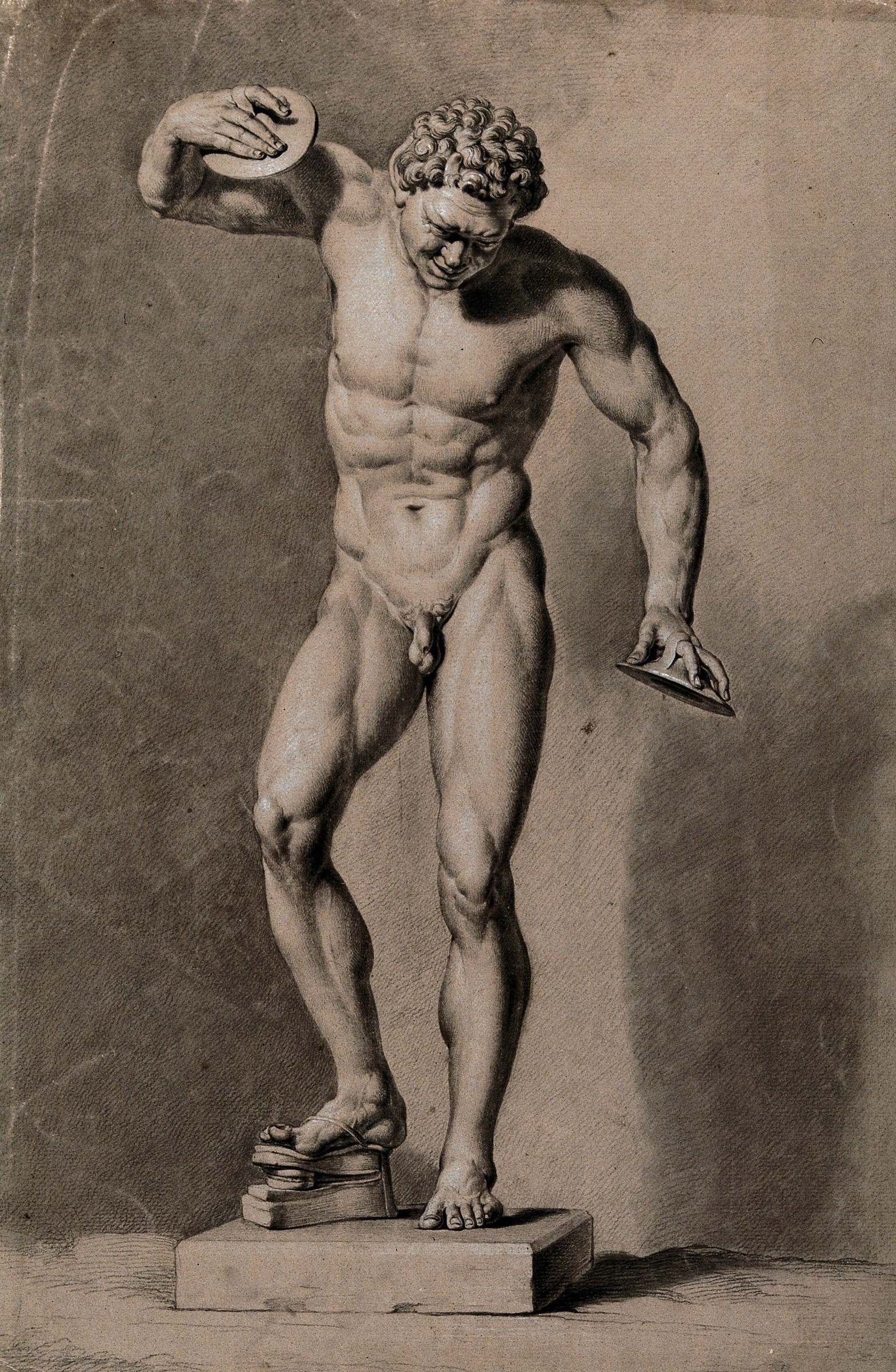
The dancing faun. Pencil drawing by R. Earlom.
Unknown artist
- Source:
- Wellcome Collection
- Rights:
- Public domain — free to use, share and adapt.
- Recorded as:
- Public Domain Mark
This work documents the neoclassical artistic obsession with classical body types and poses as models for ideal human movement and beauty. For dance historians, the 'dancing faun' type is significant as evidence of how European artists and dancers drew on classical mythology to imagine ancient and ideal movement vocabularies—a source that influenced ballet, masque, and academic choreography from the Renaissance through the 19th century.
What you are looking at
A monumental male nude figure stands in contrapposto against a neutral ground, his weight shifted onto his right leg. His left arm is raised and bent, the hand holding what appears to be a circular object—possibly a shield or tondo—at shoulder height. His right arm hangs at his side, the hand holding a small rectangular form that may be a tablet or blade. The figure's musculature is rendered with classical precision: pronounced abdominal definition, strongly modeled shoulders and chest, and carefully articulated limbs. His curly hair is arranged in the antique manner. The pose combines idealized anatomy with a suggestion of dynamic movement, though the figure is stationary. He stands on a simple rectangular base. The work is rendered as a pencil drawing with subtle tonal gradations that create volume and weight.
The dancing
The single figure demonstrates the classical contrapposto stance refined in Renaissance art: the free leg bends slightly while the supporting leg remains straight, creating a gentle S-curve through the torso. The raised left arm and lowered right arm establish a diagonal tension across the body. The pose is not one of active dance movement but rather of static display—the classical 'faun' attitude—though the lifted arm and forward weight suggest a moment of animation or about-to-move quality. The raised arm position and the objects held suggest mythological or allegorical content rather than social or theatrical dance.
The dance depicted
This is not a representation of dance as a performed activity, but rather a classical sculptural figure type—the faun or satyr from Greco-Roman mythology and Renaissance artistic tradition. The pose echoes the 'dancing satyr' or 'faun' sculptures that proliferated in European collections and served as models for artists. The figure may be based on or reference the celebrated marble Faun of the House of the Faun in Pompeii, or similar antique sources. The raised arm, often interpreted as part of a dancing or celebratory gesture in classical contexts, became a standard attribute of the faun type in Renaissance and later European art. While the pose suggests animation, this is academic life drawing from a sculptural model rather than documentation of actual dance practice.
How it was made
This is a pencil drawing, almost certainly a study or reproduction from a classical sculpture. The modeling of light and shadow across the musculature is accomplished through careful tonal gradation typical of neoclassical academic drawing. The signature or initials 'R. Earlom' visible in the catalogue record suggests this may be a reproductive print or drawing after a sculpture, rather than a direct observation drawing. Such works circulated widely in art academies and among collectors as teaching tools and as documents of important antique and Renaissance sculptures. The technique and finish suggest this is either an original academic study or a published engraved or lithographed reproduction.
About this work
This pencil drawing depicts a classical male nude in contrapposto stance, rendered with the anatomical precision of neoclassical academic study. Though titled 'The Dancing Faun,' the figure is not shown in active dance but in the static heroic pose derived from antique sculpture. The work belongs to a long tradition of European artists studying and reproducing the classical faun or satyr type—a figure associated with dance, revelry, and mythological abundance in classical imagery. The pose itself, with its raised arm and shifted weight, carries the suggestion of movement even in stillness, a quality central to how Renaissance and later artists reimagined classical dance and physical expression.
How to look at it
Observe the pose carefully: the figure is not mid-leap or mid-gesture, but captured in the classical contrapposto that Renaissance artists learned from antique sculpture. The raised arm is key—in classical iconography, this suggests animation, celebration, or the gesture of holding an attribute. The title 'Dancing Faun' asks us to read stillness as a moment before or after motion, or as the kind of idealized pose that suggests dance without depicting its actual movement.
The artist
R. Earlom (likely Raimondo Earlom, 1728–1822, an Italian-born printmaker working in England) was known for reproductive engravings and drawings after old masters and classical sculptures. Such drawings were part of the commercial art trade supplying academies, collectors, and the educated classes with models and documentation of important artworks.
The period
The neoclassical period (roughly 1750–1820) saw intense interest in Greek and Roman sources as models for all the arts. Sculptural types like the faun became canonical reference points. In dance, this same period saw the development of classical ballet vocabulary, which drew heavily on idealized classical body positions and mythological subject matter. The 'dancing faun' or satyr appeared frequently in ballet libretti and in artistic representations of dance as a classical and civilized art form.
Where it lives
The work is held in the Wellcome Collection, a medical and scientific archive, suggesting it may have been catalogued there as part of a broader collection of anatomical studies or classical reference materials rather than as a work primarily valued for its art-historical significance.
Questions about this work
Is this figure actually dancing?
No, the figure is in a static classical pose, not shown in motion. The title and the raised arm invite the viewer to associate the pose with dance, but this is a sculptural type rather than a representation of dancing. The pose derives from antique faun or satyr sculptures, which became emblematic of dance and revelry in later European art, even when rendered as still figures.
What is the figure holding?
The raised left hand appears to hold a circular object, possibly a shield, tondo, or thyrsus-related attribute. The right hand holds what may be a tablet or blade. These objects are typical attributes of mythological faun or satyr figures and would have been part of the original sculpture this drawing is based on.
Why is a faun associated with dance?
In classical mythology and art, fauns and satyrs are creatures of fertility, wine, music, and revelry. They were often depicted dancing, playing pipes, or in celebratory poses. Renaissance and later European artists inherited this association, making the faun a standard figure for representing dance, particularly in the context of pagan or classical subject matter.
Who was R. Earlom?
Raimondo Earlom was an 18th-century Italian-born reproductive printmaker and draughtsman working primarily in England. He was known for engravings and drawings after old master paintings and classical sculptures, works created for sale to academies, collectors, and the educated public as educational materials and reference sources.
More dance artwork





