49 works in this view — arrow keys or swipe to move between them.
Dance in Art
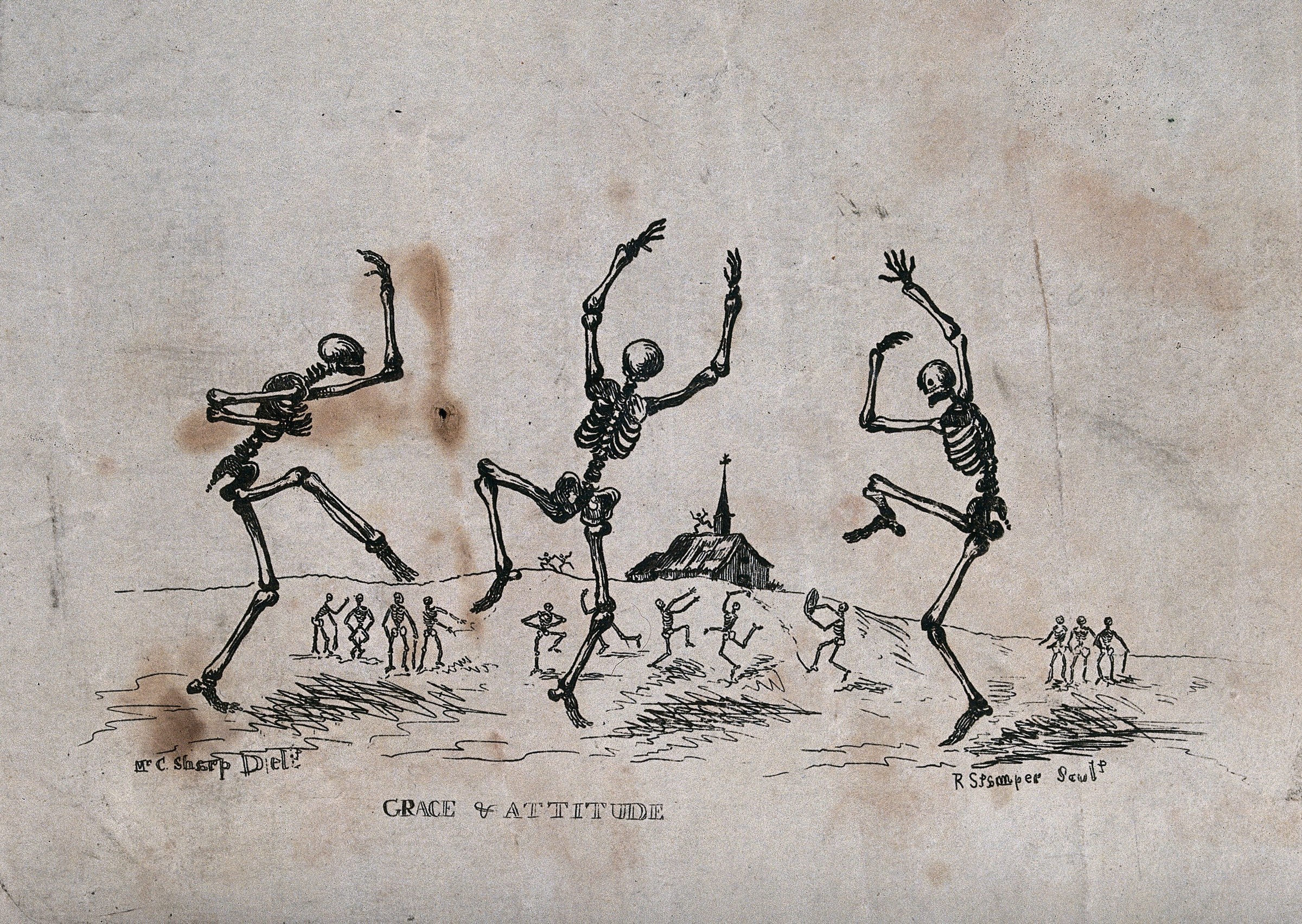
Skeletons dancing. Etching by R. Stamper after C. Sharp.
Unknown artist
- Source:
- Wellcome Collection
- Rights:
- Public domain — free to use, share and adapt.
- Recorded as:
- Public Domain Mark
The danse macabre is one of the oldest visual themes in European art, and the skeleton's athletic, contorted movement is essential to its meaning: death does not move like a living dancer. This etching preserves both an artistic tradition and a folk image that circulated widely as a moral teaching tool. For historians of dance representation, it shows how the human figure in motion was marshalled to convey abstract ideas—here, not beauty or courtship, but the levelling and liberation of death.
What you are looking at
Five skeletal figures dance in a landscape dotted with tiny human onlookers and a small church or chapel. The skeletons occupy the foreground in exaggerated, contorted postures—limbs akimbo, spines arched, bones outlined with precise anatomical detail. Three skeletons on the left and right raise their arms high with fingers splayed in wild gestures, while two central figures leap or stride with legs extended. The etching is executed in fine black lines on aged paper, the composition balanced around a central building in the middle distance. The tiny living figures scattered across the ground appear to witness this spectacle of death, their scale emphasizing the grotesque monumentality of the dancing skeletons. The mood is phantasmagoric—a danse macabre rendered with both anatomical precision and theatrical exaggeration.
The dancing
The five skeletons display exuberant, impossible postures: high arabesques and extensions, contorted spinal curves, and gestures more suited to acrobatic display than ballroom convention. Arms spread wide with fingers extended suggest wildness and abandon; one figure's raised leg achieves near-horizontal lift. There is no conventional partnering or hold visible—each skeleton moves in isolated, extreme attitudes. The artist has rendered each skeleton's articulation meticulously: ribs, vertebrae, and limb joints are clearly delineated, giving anatomical authority to these fantastic movements.
The dance depicted
This is a memento mori image—specifically, a danse macabre, a medieval and Renaissance tradition representing death as a universal dancer claiming all estates and ranks of the living. The skeletons perform impossible feats of contortion and athletic movement, suggesting both the triumph of death and a sardonic inversion of courtly grace. The tiny human figures witnessing suggest spectators to a grotesque show. The image offers no identification of a specific dance style; rather, the extreme, unnatural postures deliberately violate ballroom decorum and naturalistic movement to emphasize death's alien, anarchic power.
How it was made
This is an etching: fine lines bitten into a metal plate produce the precise, delicate linework visible throughout. The etching technique allowed dense detail and fine shading (visible in the skeletons' bone structure) and suited circulation as a reproducible print—likely a broadside or illustration in a book. The notation 'R Stamper Sculpt' indicates the artist who engraved or etched the plate; the attribution to 'C Sharp' (presumably Cecil Sharp, the English music and dance collector) as the original designer is marked 'W C Sharp Delt' (delineavit—drew it). The dated quality of the paper and the hand-tinted areas visible in some impressions suggest 19th-century or early 20th-century printing.
About this work
This etching presents five anatomically precise skeletons in acrobatic, contorted poses, dancing before a chapel witnessed by distant human figures. It is a memento mori image in the danse macabre tradition—a visual sermon on death's levelling power rendered through impossible, grotesque movement. The work belongs in a gallery about dance because it explores how the body in motion can be made to signify something beyond itself: here, the inversion of the living body's grace into the dead body's anarchic display. The image also documents a persistent trope in Western visual culture—the skeleton as dancer—that appears across centuries and genres, always carrying the weight of mortality and transgression.
How to look at it
Attend to the anatomical detail first: note how precisely each skeleton is articulated, with ribs, spine, and joint structure clearly rendered. Then observe the postures—these are not natural human attitudes but exaggerated, acrobatic, and sometimes physically impossible extensions and contortions. The composition places the five skeletons at varying scales and distances, creating a sense of frantic movement across the landscape. Finally, note the tiny human figures: their smallness and passivity contrast sharply with the skeletons' monumental, uninhibited movement, a visual argument about the reversal of hierarchy in death.
The artist
The record attributes the work to R. Stamper (sculptor/engraver) after a design by Cecil Sharp. Cecil Sharp (1859–1924) was an English music educator and dance collector, best known for his systematic collection of English folk songs and dances; he founded the English Folk Dance Society. Sharp's involvement in the design of a danse macabre image is unusual and may suggest this was a commissioned illustration or a personal artistic venture. Stamper was a practising engraver and etcher, likely working in the late 19th or early 20th century.
The period
The memento mori tradition flourished in European art from the 15th century onward, with danse macabre images appearing in wood engravings, prints, and illustrations throughout the 19th century as a didactic and moralizing form. By the time Sharp and Stamper created this work (date unknown but likely early 20th century, given Sharp's life span), the image was historically rooted yet still viable as folk art and moral instruction. The precision of Stamper's etching places it in a long tradition of reproductive print culture, where such images could be cheaply distributed and widely consumed.
Where it lives
The work is held in the Wellcome Collection (London), a research library and museum focused on medicine, science, and art. The Wellcome holds prints, engravings, and illustrated books related to medicine, anatomy, and popular belief; a danse macabre etching fits this collecting mandate as both a memento mori image and a document of anatomical interest.
Questions about this work
What is a danse macabre?
A danse macabre is a visual and literary motif that depicts death (usually as a skeleton or corpse) dancing with the living across all social ranks—pope, king, peasant, and child alike. It originated in medieval and Renaissance Europe as a memento mori, a reminder of mortality and the futility of earthly rank. Skeletons performing exuberant, transgressive movement was central to the image's power: death moves differently, outrageously, beyond the bounds of living decorum.
Who was Cecil Sharp?
Cecil Sharp (1859–1924) was an English music educator and folklorist, best known for collecting and publishing English folk songs and traditional dances. He founded the English Folk Dance Society in 1911 and worked to preserve and revive folk performance at a time when such traditions were disappearing. His role in designing this etching suggests a secondary artistic or editorial interest beyond his primary work as a dance and music archivist.
Why are the skeletons dancing with such wild gestures?
The exaggerated, acrobatic postures are intentional: they violate the rules of ballroom grace and decorum to signal that death moves according to different laws. The skeleton's impossible arabesques, contortions, and uncontrolled sprawls suggest anarchic, liberating, or threatening energy—the inversion of the living body's governed movement. In danse macabre imagery, the skeleton's freedom to move outrageously is part of the memento mori message: death is the great leveller, and it dances to its own rhythm.
What do the tiny human figures represent?
The small human figures scattered across the landscape are witnesses or victims of the skeletal dance. Their diminished scale emphasizes the monumentality and dominion of death. They may represent the living observing their own inevitable fate, or they may simply emphasize that death's dance encompasses all humanity regardless of station.
More dance artwork





