49 works in this view — arrow keys or swipe to move between them.
Dance in Art
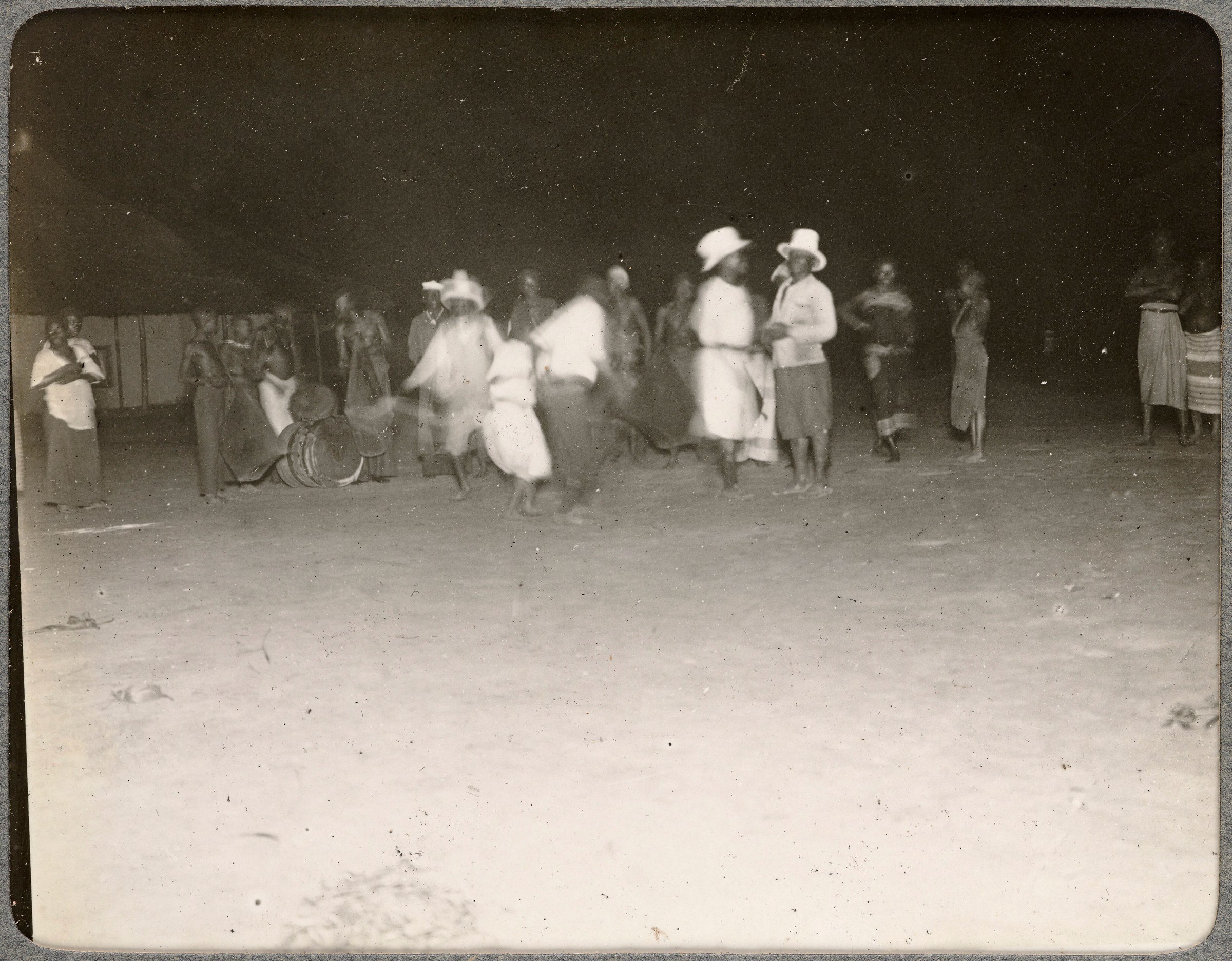
Our boys dancing at night to music of Maomedi's band
Unknown artist
- Source:
- Wellcome Collection
- Rights:
- Rights reserved by the holding institution — do not reuse without permission. Source record ↗
- Recorded as:
- In copyright
This photograph documents a form of dance knowledge that typically leaves no archive—the social dances of early-to-mid 20th-century East African communities, performed not for publication or posterity but for gathering and pleasure. It is rare visual evidence of how people actually danced together before colonial and commercial pressures reshaped local practice, and the presence of a named musician suggests that Maomedi's band was a known ensemble whose style influenced dance in that region.
What you are looking at
A nocturnal outdoor gathering captured in grainy monochrome photography. The scene shows a large group of people assembled on bare ground, with figures distributed across the frame in loose formation rather than orderly rows. In the middle distance, several figures in white clothing stand prominently—some appear to be in motion with arms raised or extended, while others stand at rest. The surrounding crowd, dressed in a mixture of light and darker garments, watches from various distances. On the left side of the frame, drums or large circular objects are visible on the ground. The photograph's exposure and depth of field suggest this was taken by available light, possibly moonlight or a flash, creating strong contrast between illuminated figures and dark background. The overall composition captures a moment of social gathering and movement rather than a staged or formal arrangement.
The dancing
The dancers in white stand out against the watching crowd. Several display raised or extended arms in loose, open gestures rather than the structured positions of ballroom or classical dance. The bodies appear relaxed and upright, with weight distributed over the feet rather than transferred through a partnered frame. Movement seems individual or loosely coordinated rather than coupled or in strict unison. The visible footwork is not sharply enough rendered to determine whether steps are grounded or elevated.
The dance depicted
The title "Our boys dancing at night to music of Maomedi's band" suggests a social dance event specific to a particular community, likely in East Africa based on contextual markers and the historical source. The open-armed gestures, outdoor setting, and informal gathering pattern are consistent with vernacular African social dances rather than imported ballroom forms. Without clearer detail of footwork, hand position, or regional dress markers, the specific dance tradition cannot be reliably identified from the image alone. The presence of Maomedi's band suggests a known ensemble whose repertoire might clarify the style, but that information is not visually accessible here.
How it was made
This is a black-and-white photograph, likely taken with early-to-mid 20th-century portable film stock. The grainy quality, soft focus on distant figures, and tonal compression are characteristic of flash photography or long exposure in low light. The full-frame composition and inclusion of crowd context suggest documentary rather than studio portraiture. The technical limitations of night photography at this period mean that fast-moving or subtle movement would not register sharply; the photographer has chosen to capture the gathering and general gesture rather than freeze a precise moment of technique.
About this work
This is a documentary photograph of a social dance event among a community in East Africa, identified by the title as performance to Maomedi's band. The image records not the refined detail of trained dancers or the formal arrangement of ballroom, but the lived reality of vernacular social dancing—the gathering, the musicians, the watching crowd, the informal movement of young dancers in white. It belongs in a dance archive because it is evidence of how people danced together outside formal institutions, and because the specificity of the title (naming the musician and the dancers as "our boys") positions it as a record of a particular community's practice at a particular time.
How to look at it
Pay attention to the white-clad figures in the center and their arm positions—raised, extended, and open rather than held close to the body or in formal frame. Notice the distribution of the watching crowd, which is informal and scattered rather than arranged in lines or circles, suggesting spontaneous gathering rather than ceremonial formation. The title identifies these dancers as "our boys," indicating they are known to the photographer or the community being documented, and the presence of named musician Maomedi suggests this is a specific, perhaps recurring, social event rather than a one-time occasion.
The period
The photograph dates to the early-to-mid 20th century based on photographic technique and the title's reference to "Maomedi's band," suggesting a documented musical ensemble. This period saw increasing documentation of African life by researchers and colonial photographers, though the domestic, community-focused nature of this image distinguishes it from most colonial archive photography. The social dances of East Africa during this era were in transition, as imported ballroom and popular forms competed with or blended into vernacular traditions. The photograph captures a moment before the homogenization of global popular dance had fully displaced local practice.
Where it lives
The photograph is held in the Wellcome Collection, a major archive of photographs documenting life, medicine, and social conditions across the world in the late 19th and 20th centuries. Works in this collection were often acquired as documentary evidence rather than as art, and frequently lack detailed provenance. The cataloguing information here is minimal, which is typical of many Wellcome Collection photographs where donor information or collection context was not systematically recorded.
Dance in this work
Questions about this work
Where and when was this photograph taken?
The catalogue record does not specify location or exact date. The title and photographic technique suggest East Africa in the early-to-mid 20th century. The reference to Maomedi's band as a known ensemble implies a specific community and time, but without further research those details cannot be established from the image alone.
What is Maomedi's band?
The title names Maomedi's band as the musicians for this dance event, indicating that this was a recognized ensemble, probably a local or regional group performing contemporary music for social dancing. The identity and repertoire of the band are not recorded in the photograph's documentation.
Is this a ritual dance or a social dance?
The informal gathering, outdoor setting, and the title's casual reference to "our boys dancing" suggest a social rather than ceremonial occasion. However, without knowing the specific cultural context or the identity of the dancers, it is not possible to rule out that this event had ritual or ceremonial dimensions.
Why is the photograph so grainy and unclear?
It was taken at night using the photographic technology available in the early-to-mid 20th century. Night photography of the period required either very long exposures (which would blur movement) or flash equipment, and the film stocks were slow by modern standards. The graininess reflects both the film and the scanning or reproduction of the original.
More dance artwork





