49 works in this view — arrow keys or swipe to move between them.
Dance in Art
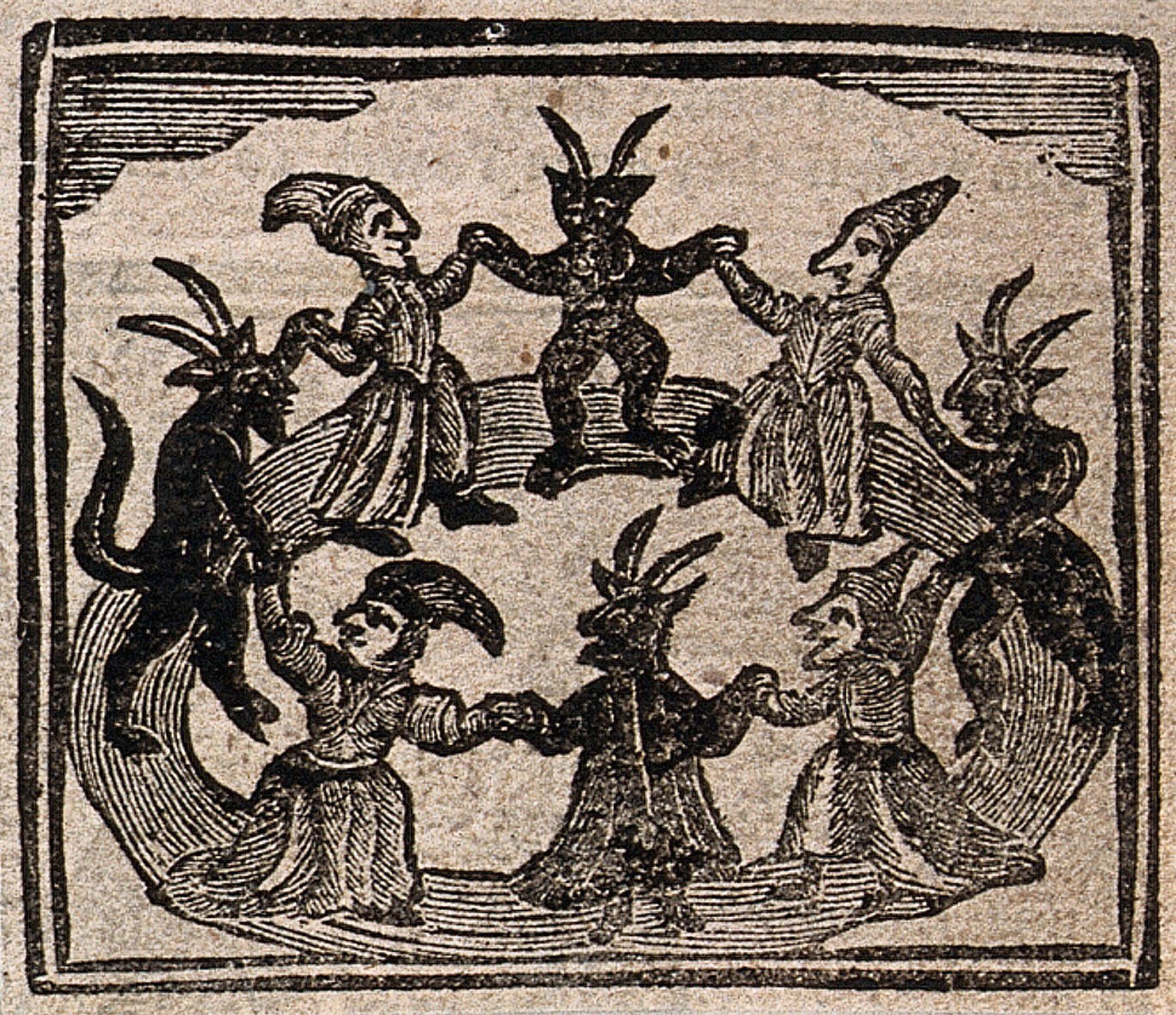
Witchcraft: witches and devils dancing in a circle. Woodcut, 1720.
Unknown artist
- Source:
- Wellcome Collection
- Rights:
- Public domain — free to use, share and adapt.
- Recorded as:
- Public Domain Mark
This print demonstrates how dance was deployed in early modern culture as a visual language of transgression and moral disorder. The circle dance, a form found across European folk and courtly contexts, is recontextualized as a sign of demonic inversion, revealing how the same bodily practices could signify opposite meanings depending on their framing. For historians of witchcraft and persecution, the image is evidence of how visual media constructed and circulated the fantasy of the sabbath, which was rarely or never observed in fact but became a tool of prosecution and public terror.
What you are looking at
A woodcut depicting a supernatural gathering arranged in a circle around a central demonic figure. Eight human-shaped dancers or witches occupy the perimeter, most wearing tall pointed hats and flowing robes with horizontal hatching indicating fabric texture. They are interspersed with four goat-headed demons or devils, also robed, creating an alternating human-demon pattern. The central figure is a prominent devil with horns, wings, and a distinctly bestial head, seemingly the focus or leader of the assembly. The figures appear to be in motion, leaning or gesturing toward the center, their arms raised or extended. The entire scene is framed by a bold border typical of early modern woodcuts, and the composition uses strong black lines and cross-hatching throughout to create depth and texture against a lighter ground.
The dancing
The dancers and demons form a closed circle with bodies angled inward toward the central horned figure. Arms are raised, extended, or gesturing in engaged postures rather than formal ballroom positions. The figures alternate between human and goat-headed creatures, suggesting a ritualistic or supernatural inversion of social order. Weight appears distributed for circular movement; the postures suggest swaying, turning, or processing around the center rather than fixed positions. The tall pointed hats on some figures are consistent with early modern depictions of witches and may also indicate tall headdresses worn in courtly settings, though here rendered demonic.
The dance depicted
This woodcut illustrates the witches' sabbath or 'witchcraft gathering' as a dance, a motif that appears throughout early modern European prints and texts as a representation of heretical gatherings and demonic inversion of Christian ritual and courtly order. The circular formation—a fundamental structure in folk and ceremonial dance—is repurposed here as a symbol of forbidden communion. The alternation of human and demon figures suggests a perversion of social hierarchy. The dance itself is not identifiable as any specific European dance form, but rather serves as a visual metaphor for the transgressive nature of witchcraft: the circle is a known structure of folk and sacred dance, here rendered uncanny by the presence of demons and by the implicit claim that witches danced with devils. The composition draws on visual conventions established by earlier German and Dutch prints on the same subject.
How it was made
This is a woodcut, a relief printing technique in which an image is carved into the surface of a wooden block, with ink applied to the raised portions. The technique is evident in the bold, high-contrast lines, the use of parallel hatching to indicate shadow and fabric, and the crisp black silhouettes against white ground. Woodcuts were the most common and economical method of mass-producing images in early modern Europe, allowing for rapid circulation among a broad, often semi-literate audience. The medium's reliance on strong linear definition made it ideal for narrative and moral instruction, which explains its use in disseminating images of witchcraft—a subject of intense public fear and legal persecution during the 16th–18th centuries. The date of 1720 places this in the later phase of witchcraft persecution in Europe, when such imagery had become semi-standardized and circulated in printed collections.
About this work
This is a woodcut from approximately 1720 depicting a witches' sabbath as a demonic circle dance—a visual trope that merged genuine folk and courtly dance structures with theological anxieties about heresy, gender, and social inversion. The image belongs to a large genre of early modern prints on witchcraft that combined documentary pretension with moral and sensational interest. The circular formation and the alternation of human and supernatural figures transform the dance from a social gesture into a sign of transgression and danger. The work is representative of how dance imagery was weaponized in early modern culture: the same circular forms used in processional, folk, and sacred contexts became markers of the demonic when transposed into a witchcraft narrative. For dance historians, it is evidence of how dance—particularly the circle—functioned in the early modern imaginary as a boundary marker between the sacred and the transgressive, the natural and the supernatural.
How to look at it
Attend to the circular composition and the alternation of human and demonic figures: this pattern is not accidental but the core of the image's argument about witchcraft as an inversion of natural and social order. Notice the raised and extended arms and the inward-angled bodies, which suggest motion and engagement toward the central demonic figure—this is the visual language of ritual or transgressive communion, distinguished from the formal, outward-facing postures of courtly dance. The woodcut's bold linear technique and high contrast make each figure distinct and legible despite the crowded composition; this clarity was essential for an image meant for rapid comprehension and moral instruction. The tall pointed hats and flowing robes reference both courtly dress and folkloric or transgressive clothing, a visual pun that collapses social categories.
The period
This woodcut dates to 1720, more than a century after the peak of large-scale witchcraft prosecutions in northern Europe (roughly 1580–1630) and during a period when witchcraft belief and legal persecution were declining in much of western Europe, though they persisted in some regions. By 1720, witchcraft imagery had become conventionalized and was circulated as sensational or morally instructive material for popular consumption rather than as direct support for active prosecution. The image reflects a long visual tradition of representing witchcraft gatherings that drew on earlier German and Dutch prints, particularly those by Lucas Cranach and Albrecht Dürer, which had established many of the standard motifs: the circle, the demons, the inverted social order, the emphasis on female bodies and sexuality. The woodcut medium itself, while still in use, was beginning to be supplanted by newer techniques such as etching and engraving, which offered finer detail; the persistence of woodcut for this subject suggests its continuing appeal to a mass or semi-popular audience.
Where it lives
The work is held in the Wellcome Collection, London, an institution that holds extensive materials on the history of witchcraft, medicine, and the supernatural in early modern Europe. Wellcome collection records often include multiple impressions and variant states of woodcuts and engravings on witchcraft and related topics, making it a primary resource for understanding the circulation and evolution of these images.
Dance in this work
Questions about this work
Did witches actually dance together?
There is no reliable historical evidence that organized witches' sabbaths occurred as described in early modern accounts and images. The 'sabbath' was largely a theological and legal construction, shaped by learned demonology, torture-extracted confessions, and folk tradition, then visualized and circulated through prints like this one. These images were tools of prosecution and moral instruction rather than documentary records.
Why is the dance shown as a circle?
The circle is a foundational structure in both folk and ceremonial dance across European cultures, and it carried associations with magic, ritual, and communitas. By depicting witchcraft gatherings as circle dances, artists and authorities transformed a form of social bonding into a sign of transgression and demonic inversion. The circle also visually emphasizes the insularity and secrecy of the supposed gathering.
What is the significance of the tall hats?
Tall pointed hats appear in witchcraft imagery to mark gender, transgression, and otherness. Some may reference the hennins and tall headdresses worn in courtly fashion; others draw on folkloric or transgressive headgear. In the context of witchcraft, they distinguish these figures from ordinary people and suggest both supernatural status and social deviance.
Why were witchcraft prints so popular?
Witchcraft prints circulated in a market that combined sensationalism, moral instruction, and religious anxiety. They were inexpensive, produced in large quantities, and addressed contemporary fears about disorder, female agency, and supernatural danger. They also served as tools of prosecution and public pedagogy, making visible a threat that authorities claimed was hidden and widespread.
More dance artwork





