49 works in this view — arrow keys or swipe to move between them.
Dance in Art
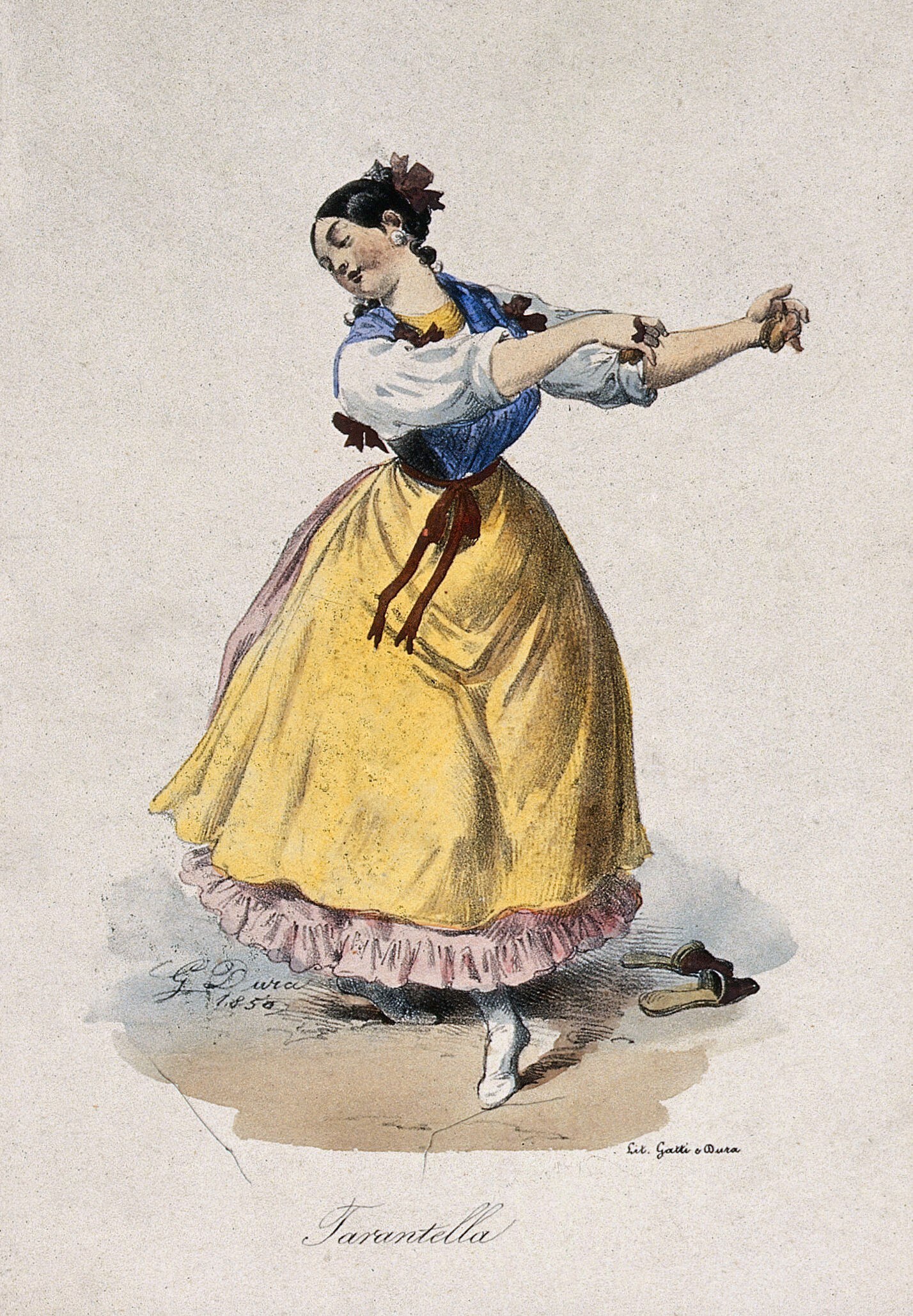
A young woman dancing the tarantella. Coloured lithograph by G. Dura.
Unknown artist
- Source:
- Wellcome Collection
- Rights:
- Public domain — free to use, share and adapt.
- Recorded as:
- Public Domain Mark
The tarantella was one of the most frequently depicted European folk dances in 19th-century visual culture, yet detailed contemporary images of how it was actually performed are less common than the dance's literary and musical representations. This print provides direct visual evidence of the costume, posture, and energetic character attributed to the dance by a contemporary artist, and the inscription confirms that audiences of the period recognized and could identify the specific dance from its visual presentation. For historians of dance, costume, and the circulation of folk culture through European imagery, this work documents both the dance itself and the aesthetic conventions through which it was understood.
What you are looking at
A single female dancer occupies the center of the composition, depicted mid-performance against a plain background. She wears a yellow full skirt with a deep pink or mauve ruffle at the hem, a blue bodice or corset, and a white chemise with puffed sleeves. Her dark hair is gathered up with a decorative bow. Her right arm extends outward at shoulder height with fingers splayed in a characteristic gesture; her left arm is raised and bent. Her weight appears to be on her left leg while her right leg is extended or lifted. A dark shoe lies on the ground to the lower right, as if kicked off in the energetic motion of the dance. The figure is rendered in colored lithograph with delicate watercolor tinting, creating a soft, three-dimensional effect against the cream paper. The inscription "Tarantella" appears below the figure.
The dancing
The dancer's posture shows asymmetrical arm carriage typical of folk dance: one arm extended horizontally with an open hand gesture, the other raised and bent at the elbow. Her torso twists slightly, engaging her core. The extended leg suggests either a lift or a pointed extension. The overall frame is open and expansive rather than formally contained, with the body in a moment of dynamic motion rather than a held position. The removal of one shoe and its placement on the ground suggests the vigorous, uninhibited nature of the movement.
The dance depicted
The inscription identifies this as the tarantella, the rapid, energetic southern Italian folk dance that was widely known across Europe in the 19th century and frequently depicted in romantic and genre imagery. The tarantella typically involved solo or paired dancers moving in quick, rhythmic patterns, often performed at celebrations and social gatherings. The open arm gesture and the lifted leg visible here align with documented descriptions of the dance's characteristic style—joyful, physical, and less formally constrained than ballet or court dances. The removal of the shoe suggests the passionate, uninhibited quality attributed to the dance in contemporary accounts and imagery.
How it was made
This is a hand-colored lithograph, as indicated by the signature "G. Dura" and the technique visible in the image. Lithography allowed for relatively rapid production and distribution of images with color; hand-coloring added individual character to each print. The soft pastel palette and delicate tinting suggest this was aimed at a middle-class audience interested in ethnographic or picturesque imagery of European folk culture. The technique's accessibility meant such prints circulated widely in periodicals, albums, and collections devoted to dance, costume, and cultural representation—reaching dancers, theater professionals, and educated households across Europe.
About this work
This colored lithograph documents the tarantella as it was understood and visually represented in 19th-century Europe. The work captures a moment of folk dance performance through a Romantic-era lens: the dancer is individualized as a character type rather than an anonymous performer, her costume is picturesque and legible, and her gesture conveys energy and cultural particularity. The tarantella held considerable appeal for European artists and audiences interested in folk culture, regional costume, and the spectacle of uninhibited bodily movement—a fascination that drove both theatrical performances of such dances and the production of imagery like this one. This print exemplifies how folk dances circulated through visual culture and helped shape European audiences' understanding of dance forms beyond their own regions.
How to look at it
Attend to the moment the artist has chosen: not a static pose but a snapshot of vigorous movement, with the dancer's weight in transition and her limbs arranged asymmetrically. The extended arm with splayed fingers and the raised, bent other arm show a gestural vocabulary quite different from ballet's closed positions and verticality. The kicked-off shoe is a narrative detail that conveys the physical freedom and energy of the performance—a common motif in Romantic imagery of folk and ethnic dance. The bright yellow skirt and the contrast between the formal blue bodice and the loose white sleeves convey both the specificity of regional costume and a Romantic aesthetic that valued the picturesque and the colorful.
The artist
The signature reads "G. Dura," but the artist is not further identified in the record. The hand-coloring and skilled draftsmanship suggest a professional lithographic workshop, possibly Italian or centered in a major European publishing hub such as Paris or London. Colored lithographs of regional dance and costume were produced by numerous such workshops throughout the 19th century, often published in periodicals, collected albums, or as individual prints for framing.
The period
The tarantella experienced a significant rise in European artistic and theatrical attention during the Romantic period of the early 19th century, when folk dances and regional cultures were subjects of fascination for educated audiences. The dance appeared in ballets, in musical compositions (Rossini, Liszt, and others wrote tarantellas for concert performance), and in numerous prints and illustrations. By the mid-19th century, when this lithograph was likely produced, the tarantella had become a staple of picturesque ethnographic imagery—a visual shorthand for southern Italian vitality and sensuality. At the same time, ballet was moving toward pointe work, formalized vocabulary, and European (especially Russian) aesthetic standards, making folk dances like the tarantella visually and culturally distinct from theatrical dance.
Where it lives
The work is held in the Wellcome Collection, which preserves images related to medicine, science, and social history including dance and human movement. As a lithographic print, this is a relatively common object type—reproducible, collectible, and affordable—that would have circulated in 19th-century Europe as part of albums of regional dances and costumes.
Dance in this work
Questions about this work
What is the tarantella and why was it so frequently depicted?
The tarantella is a rapid, energetic folk dance from southern Italy, typically performed at celebrations and social gatherings. It became one of the most popular European folk dances in 19th-century artistic representation because it embodied Romantic ideals: passionate, uninhibited, regionally specific, and visually striking. European artists, composers, and audiences were fascinated by folk cultures and regional variation, and the tarantella offered both musical and visual interest. It appeared in ballets, concert music, literature, and prints aimed at educated middle-class audiences.
How do we know this depicts the tarantella and not another dance?
The inscription at the base of the print reads 'Tarantella,' which is an explicit identification by the artist or publisher. Additionally, the costume (southern Italian folk dress), the posture (open, asymmetrical arm carriage), and the energetic movement all align with how the tarantella was visually and textually described in 19th-century sources. The removed shoe is a particular detail found in other contemporary images of the dance, suggesting it was a recognized aspect of how the dance was understood and performed in this period.
Who was this print made for and how was it circulated?
Hand-colored lithographs like this were produced for middle-class audiences interested in costume, regional culture, and dance. They circulated as individual prints for framing, in bound albums of regional dances, and sometimes in illustrated periodicals. They were affordable compared to paintings or original drawings, and lithography allowed for relatively rapid production and distribution. Such prints reached dancers, theater professionals, educated households, and anyone with interest in European folkways and the picturesque.
What does the removed shoe tell us?
The discarded shoe is a detail that conveys the energetic, uninhibited, and physical nature of the tarantella as understood by Romantic-era audiences. It suggests a moment of such vigorous movement that a shoe has been kicked off—a narrative touch that emphasizes freedom of movement and emotional expressiveness. This detail appears in other contemporary representations of the tarantella and may reflect actual performance practice, or it may be a Romantic convention used to convey the dance's passionate character.
More dance artwork





