49 works in this view — arrow keys or swipe to move between them.
Dance in Art
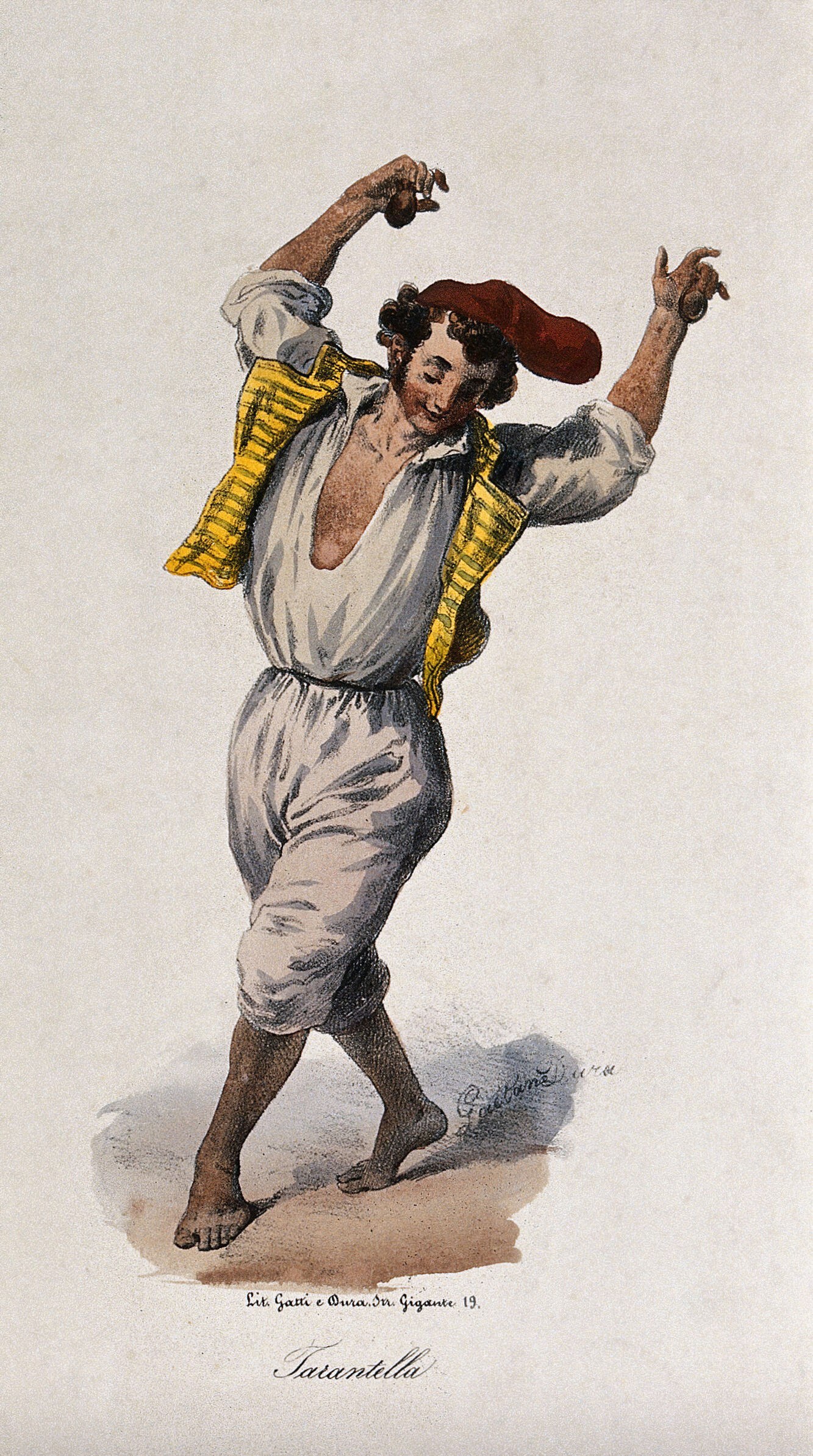
A young man dancing the tarantella. Coloured lithograph by G. Dura.
Unknown artist
- Source:
- Wellcome Collection
- Rights:
- Public domain — free to use, share and adapt.
- Recorded as:
- Public Domain Mark
The tarantella was one of the most widely disseminated European folk dances in the 19th-century visual imagination, and this image shows how such dances were mediated to audiences outside southern Italy through commercial prints. For dance historians, it documents the physical style, costume, and expressive character of the tarantella as understood by contemporary European artists and audiences, offering a window into how regional dance was viewed, stereotyped, and celebrated in the period.
What you are looking at
A single male dancer is captured mid-movement against a plain cream background, barefoot and dynamically posed. He wears loose white knee-length breeches gathered at the waist and a light blue-grey shirt or tunic that falls open to mid-chest, revealing his torso. Over this he has tied a bright yellow-and-black striped scarf or sash diagonally across his body. A red cap sits on his dark curled hair. His body is arched backward in an energetic pose, with his left leg extended and his right leg bent, suggesting rapid weight transfer. Both arms are raised in curved, expressive gestures—the left arm pulled high and back, the right extended upward with the hand flexed. His face shows a broad smile, animated and engaged. A shadow cast to the lower right suggests a light source from the upper left. The entire figure conveys vigorous, joyful movement.
The dancing
A single male dancer in a dynamic, arched backward position with asymmetrical weight distribution and lifted, curved arm positions. The raised arms and flexed hands suggest emphatic, celebratory gestures rather than the closed frame or structured hold of ballroom dance. The extended leg and backward arch indicate a snapshot of rapid, spiraling movement through space. His posture shows the elasticity and abandon associated with folk and social dance rather than formal technique.
The dance depicted
This is a tarantella, a southern Italian folk dance known for its rapid, spinning movements and celebratory character. The inscription at the bottom confirms this identification. The tarantella was traditionally danced individually or in couples, often at festivals and social gatherings, and was known for its energetic, almost frenzied quality. The dancer's open, joyful expression, the dynamic backward arch, the raised and curved arms, and the colorful but simple dress all align with the tarantella's reputation as an uninhibited, exuberant social dance. The barefoot stance was common for folk dancers of the period.
How it was made
This is a colored lithograph, a print technique that allowed for relatively economical mass production while preserving hand-colored detail. Lithography's capacity to capture loose, gestural linework and its suitability for commercial circulation suggest this was made for a broad audience—likely a popular print, travel souvenir, or ethnographic publication. The hand-coloring is applied in flat, bright areas (the yellow-striped sash, the red cap, the blue tunic) with fine linear detail preserved in the line work for facial features and musculature. The technique's accessibility and the lively subject matter indicate a work aimed at the general public rather than a fine-art audience.
About this work
This colored lithograph documents a tarantella dancer at the height of his movement, capturing one of the most recognizable folk dances of southern Italy. Created in an era of growing ethnographic and costume documentation, the print preserves both the visual spectacle of the dance and the cultural identity of its performer. The tarantella—known across Europe as a symbol of Italian exuberance and passion—was a favorite subject for popular prints, and this image exemplifies how 19th-century audiences consumed images of 'foreign' or regional dance through the commercial print trade. The work sits at the intersection of documentary, artistic representation, and popular entertainment.
How to look at it
Notice the moment the artist has chosen: not a stable, posed moment but a split-second of rapid movement captured mid-arch, with the dancer's body twisted and limbs extended in opposed directions. This is the tarantella's signature quality—the sense of uncontrolled, spiraling energy. Observe how the asymmetrical pose, the bright costume colors, and the broad smile work together to convey joy and abandon rather than technical precision or restraint. The barefoot stance and open tunic emphasize the dancer's bodily freedom and physicality, a striking contrast to the corseted, controlled movement of contemporary European ballroom dance.
The artist
The lithograph is attributed to G. Dura, about whom little appears to be recorded in standard art historical sources. The hand-signature visible on the stone suggests this was an independent artist or commercial illustrator working in the lithographic trade, likely in the 19th century. The work's style—energetic line, colorful costume detail, and emphasis on picturesque regional types—is consistent with the output of popular European print makers of the period who specialized in ethnographic and costume subjects.
The period
The 19th century saw an intense European fascination with regional and 'exotic' folk culture, driven by Romanticism's valorization of authentic, uncorrupted cultural expression. Dance was a key site of this interest, and the tarantella—with its reputation for wild, uninhibited movement—epitomized the 'passionate' Southern European character in the northern European imagination. Lithography, invented in 1796, had become the dominant medium for illustrated popular culture by the 1830s-1860s, making images of distant places and unfamiliar customs accessible to a literate middle-class audience. Travel literature, ethnographic collections, and costume books all relied on colored lithographs to present regional dances to readers who would likely never witness them in person.
Where it lives
The work is held in the Wellcome Collection, a holding focused on the history of medicine, science, and human experience. Its presence there reflects how ethnographic dance images were often collected alongside medical and anthropological materials as documents of human culture and physical variation.
Dance in this work
Questions about this work
What is a tarantella?
The tarantella is a rapid, spinning folk dance of southern Italy and Sicily, traditionally danced at festivals, celebrations, and social gatherings. It is known for its energetic, exuberant character and was often danced individually or in couples. According to folklore, the dance originated as a cure for tarantism, a condition supposedly caused by the bite of a tarantula spider, though this etymological connection is likely legendary. By the 19th century, the tarantella had become famous across Europe as a symbol of Italian passion and vitality.
Why were folk dances like this documented in prints?
The 19th century saw growing interest in regional and 'exotic' cultures, fueled by Romanticism and the expansion of travel literature. Colored lithographs were an affordable way to circulate images of distant places and unfamiliar customs to a broad European audience. Such prints served educational, entertainment, and collectible purposes, allowing people to experience other cultures visually without traveling.
What does the costume tell us?
The simple, bright costume—loose breeches, open tunic, striped sash, and red cap—represents a stylized version of rural southern Italian dress as understood by 19th-century European audiences. The barefoot stance emphasizes physical freedom and earthiness, contrasting sharply with the controlled, corseted bodies of contemporary European ballroom dancers. The bright colors and loose fit convey accessibility and spontaneity.
How was this image made?
This is a colored lithograph, a print technique in which an image is drawn on a smooth limestone surface with a grease-based medium, then printed with oil-based ink. Hand-coloring was then applied to each print, making it both a mechanical and artisanal process. This technique was ideal for producing popular prints in quantity while preserving vivid color and fine detail.
More dance artwork





