49 works in this view — arrow keys or swipe to move between them.
Dance in Art
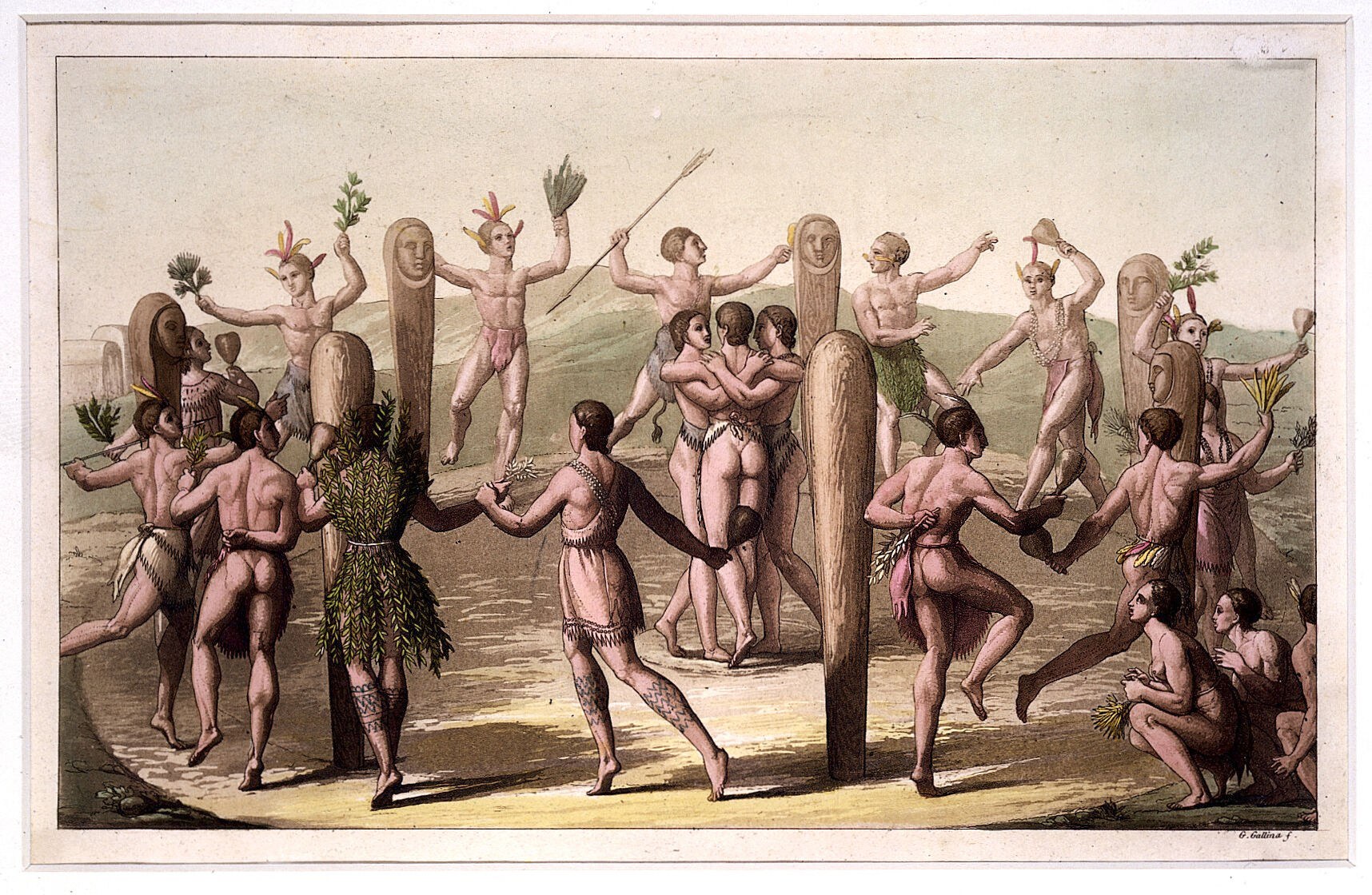
Indians of Virginia dancing. Coloured aquatint by G. Gallina, ca. 1820.
Unknown artist
- Source:
- Wellcome Collection
- Rights:
- Public domain — free to use, share and adapt.
- Recorded as:
- Public Domain Mark
This image is a key example of how European artists misrepresented and aestheticised Indigenous movement and ceremonial life to suit metropolitan tastes. For dance historians, it demonstrates the dangers of visual sources in ethnographic contexts: what appears to document ritual practice is actually a European invention. For scholars of colonialism and representation, the work shows how print media disseminated stereotypes and shaped European understandings of Indigenous peoples.
What you are looking at
A hand-coloured aquatint presents a gathering of Indigenous peoples in a landscape setting, arranged in a semicircle around two tall wooden posts or totems. The composition is dense and theatrical, crowded with figures in various states of undress and movement. The figures wear minimal clothing—some with grass or plant-fibre skirts, some bare-chested—and several sport feathered headdresses or elaborate head ornaments. In the background, rolling hills suggest an open landscape; the foreground is a sandy or earthen ground. The scene is animated: some figures dance or gesture with raised arms, others embrace or interact in pairs, and children appear throughout. A few figures on the left hold bundles of plants or palm fronds. The whole composition reads as a scene of ritual gathering or celebration, with the wooden posts as the spatial anchor.
The dancing
Bodies are loosely grouped rather than formally positioned. Dancers use open, expansive arm gestures—arms raised or extended outward—rather than any closed partnering hold. Several figures stand upright with arms aloft in celebratory poses; others bend, crouch, or move in less structured ways. The composition suggests uninhibited, individualistic movement rather than synchronised steps or coordinated formations. Children and adults mingle without clear hierarchies of position. No evidence of turnout, pointed feet, or the codified body positions of European dance traditions.
The dance depicted
This is a European artist's imaginative depiction of Indigenous Virginian ceremonial or celebratory gathering, not a documented record of actual dance practice. The title claims to show "Indians of Virginia dancing," and the wooden posts suggest a sacred or ceremonial context—possibly referencing indigenous ritual structures. However, the image is a European invention filtered through early-19th-century colonial aesthetics and fantasies of the "natural" or "primitive." The composition draws on picturesque and ethnographic conventions of the period rather than authentic observation. Any specific dance identification is impossible and inappropriate; this is an imagined scene constructed to entertain a European audience.
How it was made
A coloured aquatint, a printmaking process that combines etching and aquatint techniques to allow delicate gradations of tone and selective hand-colouring. Aquatint was a popular commercial medium in the early 19th century, particularly for travel narratives, natural history, and ethnographic subjects aimed at educated middle-class audiences. The technique allowed for relatively economical production of illustrated books and print series. The hand-colouring indicates this was a higher-end publication, suggesting the work was circulated among readers with disposable income and interest in colonial and ethnographic imagery.
About this work
This is a coloured aquatint from around 1820 purporting to depict a dance or ceremonial gathering of Indigenous Virginians. It is a European artist's imaginative reconstruction rather than an ethnographic document—the scene is theatrically composed, densely populated, and organised around picturesque conventions of the period. The work belongs in a gallery about dance primarily as a historical record of European fantasies about Indigenous peoples and movement, and as an example of how dance imagery was enlisted in the service of colonial representation. It reveals more about early-19th-century European aesthetics and anxieties than about actual Indigenous Virginian practice.
How to look at it
Attend to the composition's symmetry and theatricality: the way the figures are arranged around the central posts like a staged scene, rather than scattered naturally across a landscape. Notice the artist's choices about bodies: the emphasis on nakedness or minimal dress, the exaggerated gestures, the crowding and energy. Compare this to how European dancers were depicted in the same period—in ballet images, for example, or in regency dance scenes—to see how the same medium, technique, and artistic hand produced very different representations of movement depending on the racial and cultural identity of the figures. The vivid colouring and aquatint technique create an illusion of documentary authority that the composition itself undermines.
The artist
Attributed to G. Gallina in the record, but the artist remains uncertain. The style and subject matter are consistent with early-19th-century commercial aquatint practice in Britain and Europe, when illustrated travel narratives and ethnographic prints were a growing market. Such works were often produced by teams of engravers and colourists rather than single authors; attribution to a single name may reflect only one stage of production.
The period
The early 19th century saw explosive growth in ethnographic and travel imagery, fed by colonial expansion, scientific curiosity, and commercial appetite for exotic subjects. Prints of Indigenous peoples were widely circulated and consumed; they shaped metropolitan fantasies about colonised lands even as they were presented as factual documentation. In the same period, European dance was undergoing codification—ballet was developing its vocabulary and professionalism—which made the contrast between "civilised" European movement and the imagined "natural" or "wild" movement of colonial subjects a recurring theme in visual culture. The wooden posts in this image may reference Powhatan-era Virginia (early 17th century), but the entire aesthetic is a 19th-century invention.
Where it lives
Held by the Wellcome Collection, which specializes in art and artefacts related to the history of medicine, science, and human experience. This work likely entered the collection as an example of ethnographic imagery or colonial visual culture rather than as a dance document.
Dance in this work
Questions about this work
Is this a reliable picture of how Virginia Indigenous peoples actually danced?
No. This is a European artist's imaginative creation, filtered through early-19th-century colonial aesthetics and fantasy. It was made to entertain European viewers, not to document Indigenous practice. Real ethnographic knowledge of Virginia Indigenous peoples' ceremonial life comes from archaeological evidence, oral history, and written accounts by Indigenous peoples themselves—not from picturesque prints made for the London market.
Why are the figures so scarcely clothed?
This reflects European conventions for depicting colonised peoples, not historical fact. Early-19th-century prints routinely stripped Indigenous figures of clothing to emphasise their imagined "naturalness" or "primitiveness" and to appeal to viewers' prurient interest. These conventions served colonial ideology by suggesting that Indigenous peoples were less civilised, less clothed, less regulated in their bodies and behaviour.
What do the wooden posts represent?
Possibly a reference to indigenous sacred structures or ritual space, but the artist's understanding is speculative and mediated through European artistic convention. The posts serve a compositional function in the image: they anchor the scene and provide a focal point around which the figures arrange themselves theatrically.
Who was G. Gallina?
The record credits the work to G. Gallina, but little is known about this artist. The name may refer to an engraver, colourist, or printmaker active in early-19th-century commercial publishing. Aquatint production often involved multiple hands; attribution may reflect only one stage of the work's creation.
More dance artwork





