49 works in this view — arrow keys or swipe to move between them.
Dance in Art
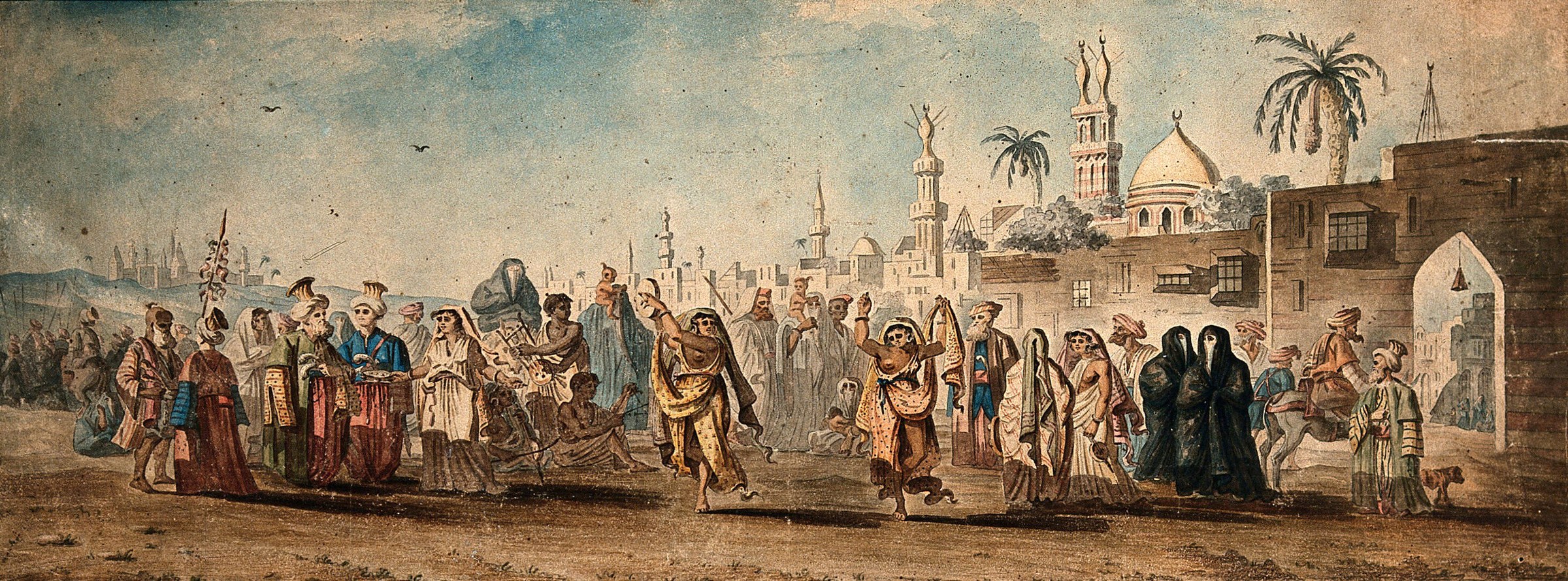
People standing or dancing outside a city gate in Turkey (?). Watercolour.
Unknown artist
- Source:
- Wellcome Collection
- Rights:
- Public domain — free to use, share and adapt.
- Recorded as:
- Public Domain Mark
The work illuminates the gap between what a European artist saw in an Ottoman ceremony and what they chose to record: costume and gathering rather than the rhythm and flow of any movement that may have taken place. It is also a rare visual document of Ottoman public ritual from an outsider's perspective, valuable to historians of both dance and cross-cultural representation.
What you are looking at
A large gathering in an open plaza before a walled city with minarets and domes, likely Ottoman or Eastern Mediterranean in setting. The composition is a processional or ceremonial scene: figures in richly colored robes—deep reds, golds, blues, and earth tones—are arranged across the foreground in loose groups, some standing, some in motion. The architecture behind them includes a prominent mosque or shrine with a golden dome and tall minarets with crescents. Palm trees frame the right side. The sky is pale and atmospheric, rendered in soft washes. The watercolor technique creates a sketchy, documentary quality: the figures are somewhat flattened and outlined, with costume and gesture taking precedence over anatomical precision. This appears to be a record of a specific observance—possibly a religious or state procession, military gathering, or public celebration—rendered with ethnographic attention to dress and spatial arrangement rather than narrative drama.
The dancing
The figures are depicted in costume with minimal modeling of the body beneath. Most stand upright in small clusters, dressed in layered, voluminous garments characteristic of Ottoman or Turkish dress: long robes, cloaks, turbans, and head coverings. Several figures in the center and right have raised arms or gesturing hands, suggesting speech, blessing, or ritual greeting rather than dance movement. The postures are formal and processional rather than rhythmic; weight appears grounded and frontal. A few figures in the left middle distance appear to be in motion, but without the articulated lines or clear weight-shift that would indicate organized dance steps. The overall impression is of stationary ceremony punctuated by ritual gesture.
The dance depicted
The scene does not clearly depict dance. The figures may be engaged in a ceremonial procession, military review, or public gathering, and some hand gestures could be ritual or celebratory, but there is no evidence of coordinated movement, characteristic steps, or the kind of body organization that would indicate a specific dance form. The title suggests uncertainty—'People standing or dancing'—and the image supports 'standing' more strongly. If there is dance present, it would be ceremonial or devotional in character, possibly connected to Ottoman court ritual or religious observance, but the artist has chosen to document the scene as formal assembly rather than movement.
How it was made
This is a watercolor on paper, executed in a sketch-like documentary style with outlined figures and flat color washes. The technique is consistent with 19th-century travel art and ethnographic illustration—the kind of work produced by European artists recording non-Western dress and custom for a viewing public unfamiliar with Ottoman or Turkish life. The loose handling and flat figures suggest the work was made quickly or from notes rather than direct observation of movement, which would account for the difficulty in reading any dance content. Watercolor's portability and relative speed made it ideal for field recording.
About this work
This watercolor documents a formal gathering in an Ottoman or Eastern Mediterranean city, rendered in the style of 19th-century European travel illustration. The scene shows elaborately dressed figures assembled before a mosque or shrine, with architecture and costume recorded in careful ethnographic detail. While the title leaves open the possibility of dance, the image presents the event as primarily ceremonial and processional—a record of public ritual rather than choreographed movement. The work belongs in a gallery of dance in art both as a document of cultural ceremony (which may include dance elements not clearly legible here) and as an example of how Western artists chose to represent non-Western public gatherings, often emphasizing static spectacle and exotic dress over dynamic movement.
How to look at it
Attend first to the architectural setting and the careful rendering of the mosque or shrine: this tells you what kind of ceremony is taking place and its religious or state significance. Then read the dress: the variety of robes, turbans, and head coverings records a specific cultural moment and possibly a specific social hierarchy within the gathering. The few raised arms and gestures in the center should be examined closely—they may indicate blessing, address, or ritual greeting. Finally, look at the absence of what you would expect to see in a dance scene: no clear rhythmic grouping, no coordinated stepping, no dynamic line through the composition. The flatness and frontality of the figures, while partly a result of the artist's style, also reflects the stillness of formal ceremony.
The period
The watercolor style and ethnographic subject matter suggest a date in the 19th century, during the height of European interest in Oriental travel and visual documentation. This was the era of the Grand Tour expanded eastward, and watercolor albums recording Turkish, Egyptian, and Persian dress and custom were a popular genre among both professional artists and wealthy amateur travelers. The Ottoman Empire was in its late period, and European fascination with its ceremonies, dress, and urban life was documented extensively through prints, watercolors, and later photography. Dance in Ottoman contexts—whether court ritual, Sufi devotion, or popular celebration—was rarely the primary subject of Western European art, though it may appear incidentally in scenes of daily life or ceremony.
Where it lives
The work is held by the Wellcome Collection, a repository of art and objects related to medicine, science, and social history, as well as travel documentation and ethnographic material. Its presence there suggests it may have been valued as a record of non-Western public practice or custom rather than as a fine art object.
Questions about this work
Is this actually depicting dance?
The image does not clearly show organized dance steps or coordinated movement. The figures are arranged in a formal ceremonial gathering with some gesture and ritual posture, but nothing that unmistakably identifies a specific dance form. The title's uncertainty—'standing or dancing'—reflects this ambiguity. The work may be a record of a ceremony that included dance, but the artist's focus on dress and gathering rather than movement makes that impossible to confirm.
What culture or region is this documenting?
The architecture, dress, and setting are consistent with the Ottoman Empire, likely a major city in Turkey or the Eastern Mediterranean. The mosque or shrine with golden dome and minarets, the style of robes and turbans, and the overall urban arrangement all point to Turkish or Ottoman cultural context. The work was likely created by a European artist traveling in or documenting the Ottoman region.
Why is this in a dance gallery if it may not show dance?
The image sits at the boundary between ethnographic documentation and dance representation. It records a public ceremony in a non-Western culture that may have included dance or ritual movement, and it shows how European artists chose to represent such gatherings. The work is valuable for understanding both what dance looked like in Ottoman contexts and how Western observers recorded—or failed to record—movement in unfamiliar cultures.
More dance artwork





