49 works in this view — arrow keys or swipe to move between them.
Dance in Art
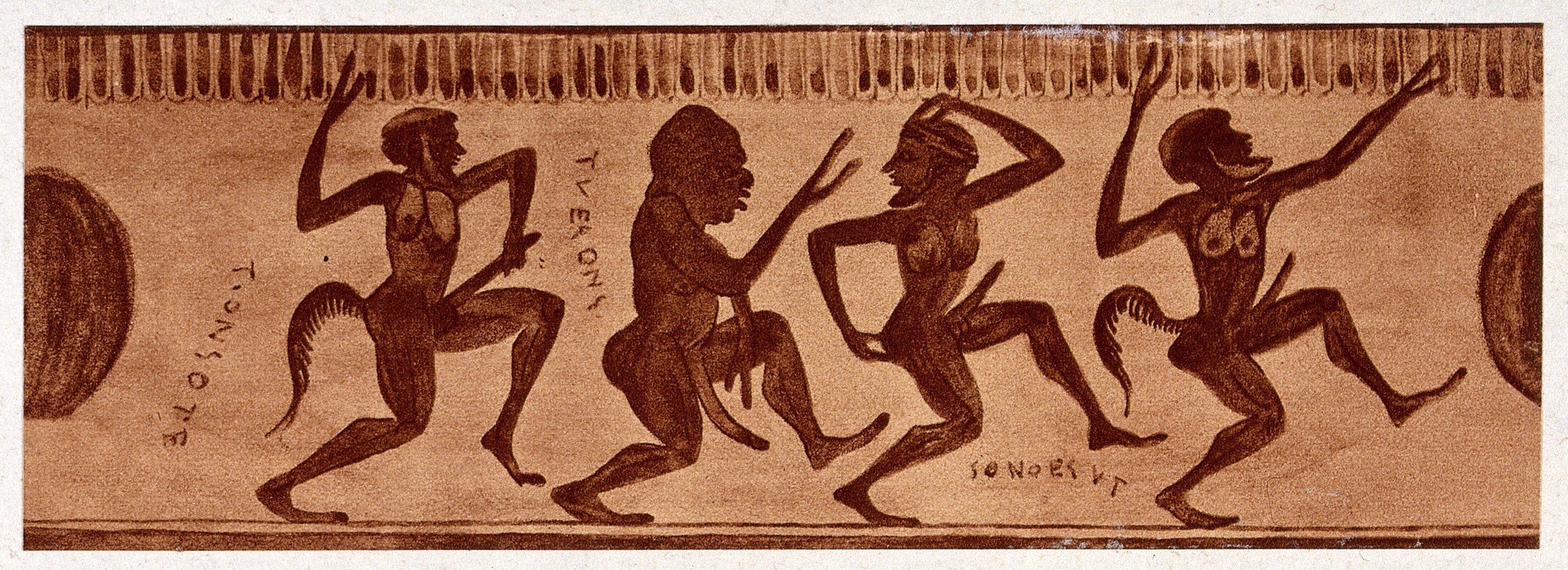
A frieze depicting dancing half-human, half-animal figures. Process print, 1921.
Unknown artist
- Source:
- Wellcome Collection
- Rights:
- Public domain — free to use, share and adapt.
- Recorded as:
- Public Domain Mark
This work documents how early-twentieth-century artists and printers visualized ecstatic or ritual movement through the bodies of fantastic creatures. The frieze arrangement—a sequential unfolding of distinct poses—anticipates twentieth-century notational practices in dance and reveals how non-naturalistic bodies were used to express movement beyond the constraints of human anatomy.
What you are looking at
A frieze of five dancing figures rendered in sepia or brown ink against a pale ground. The figures are anthropomorphic hybrids: each has a human torso and head but animal hindquarters—the rear half of a quadruped, visible in profile. They are arranged in a processional sequence moving left to right across the composition. Each figure is caught mid-movement in a distinct pose: the first with arms raised and body twisted; the second stepping forward with one arm extended; the third leaning back with head tilted; the fourth in a lunging stride with arms spread; the fifth echoing a similar dynamic stance. A decorative frieze border runs along the top and bottom edges. The monochromatic print technique and linear arrangement suggest an archaeological document or scientific illustration of mythological or ancient imagery rather than a contemporary naturalistic scene.
The dancing
Each figure is rendered in silhouette with careful attention to the contrapposto of the human spine against the animal gait. The arms articulate through space with fluid extension—reaching, pressing, gesturing—while the hind legs remain planted or stride forward in sequence. The proportions are consistent: small heads, elongated torsos, powerful animal quarters. The poses suggest a rhythmic procession rather than a chaotic melee; each figure occupies its own moment within a larger choreographic pattern. No closed holds or partner contact is evident; this is a solo progression of individual bodies moving through space.
The dance depicted
The identity of this dance cannot be established with certainty from the image alone. The half-human, half-animal morphology suggests these are not representations of actual human dancers but of mythological or allegorical figures—satyrs, fauns, or similar creatures from Greco-Roman antiquity or Renaissance imagination. The frieze format and the sequential arrangement of distinct poses suggest either a processional ritual, a theatrical pageantry, or an illustrated record of classical sculpture. The gestural vocabulary—raised arms, extended limbs, weight shifts—is generic enough to belong to many traditions: it could evoke ecstatic movement, ritualistic ceremony, or merely the vocabulary of European art-school figure drawing applied to fantastic bodies.
How it was made
The work is identified in the catalogue as a process print from 1921. From the image, the technique appears to be either a photomechanical reproduction or a high-quality line block reproduction—the consistent tone, the crisp edges, and the uniform sepia suggest printing from a prepared block rather than direct drawing. The frieze format and the even distribution of brown pigment indicate a well-made reproductive print, likely used for publication or exhibition. This technique allows wide circulation and suggests an audience beyond a single patron—scholars, students, or the general public interested in classical imagery or ethnographic documentation.
About this work
This is a decorative frieze of five dancing hybrid figures—human torsos with animal hindquarters—arranged in a processional sequence. The print records a composition that may derive from classical art, Renaissance emblem books, or early-twentieth-century artistic archaeology. The figures move through space in a rhythm of individual gestures, each pose distinct yet harmonious with the whole. The sepia process print from 1921 suggests this was a published or widely distributed artwork, intended for an audience interested in classical imagery, mythological iconography, or the choreography of ancient ritual.
How to look at it
Trace the procession from left to right and note how each figure's pose echoes and varies the last—a visual stanza of movement. The animal hindquarters are the key formal device: they permit the artist to show weight and thrust in the rear while the human torso remains free to gesture and arch. Look at the arms: they are rarely at rest, and their direction and height shift the balance and emotional tone of each figure. The frieze border frames the action as both timeless (like classical art) and staged (like a performance or pageant).
The period
The 1921 date places this work in the early modernist period, when European artists were actively mining classical and non-Western sources. The frieze format echoes both ancient Roman decorative schemes and contemporary interest in primitive and archaeological art. Early-twentieth-century dance was itself exploring fantasy and non-naturalistic bodies—the Ballets Russes had already staged works featuring stylized and grotesque movement. The Wellcome Collection provenance suggests this may have been preserved as an ethnographic or scientific artifact rather than as fine art, reflecting the period's blurred boundaries between art, documentation, and classical study.
Where it lives
The work is held in the Wellcome Collection, a repository of medical history, natural philosophy, and art. Its classification there as a process print from 1921 suggests it was acquired as a document of visual or scientific interest rather than as fine art, and may originally have been published in a journal, book, or exhibition catalog.
Questions about this work
Are these real creatures or mythological?
Almost certainly mythological or allegorical—satyrs, fauns, or similar classical hybrids. The frieze format and the stylized drawing technique suggest the artist was illustrating classical iconography or an invented variant, not documenting observed beings.
Is this a dance at all, or just a procession?
The distinction is subtle here. The poses—arms raised, bodies twisted, weight shifted—suggest choreographed movement rather than simple walking. Whether this represents a real dance tradition or a fantasy of ecstatic movement is unclear, but the variation and intentionality in the poses mark it as more than mere procession.
Who made this and why?
The artist is not recorded in the catalogue. The Wellcome Collection's acquisition suggests it was preserved as an ethnographic or scientific artifact, possibly a published illustration. The 1921 date and process print technique indicate professional reproduction, likely for circulation in print media or educational contexts.
More dance artwork





