49 works in this view — arrow keys or swipe to move between them.
Dance in Art
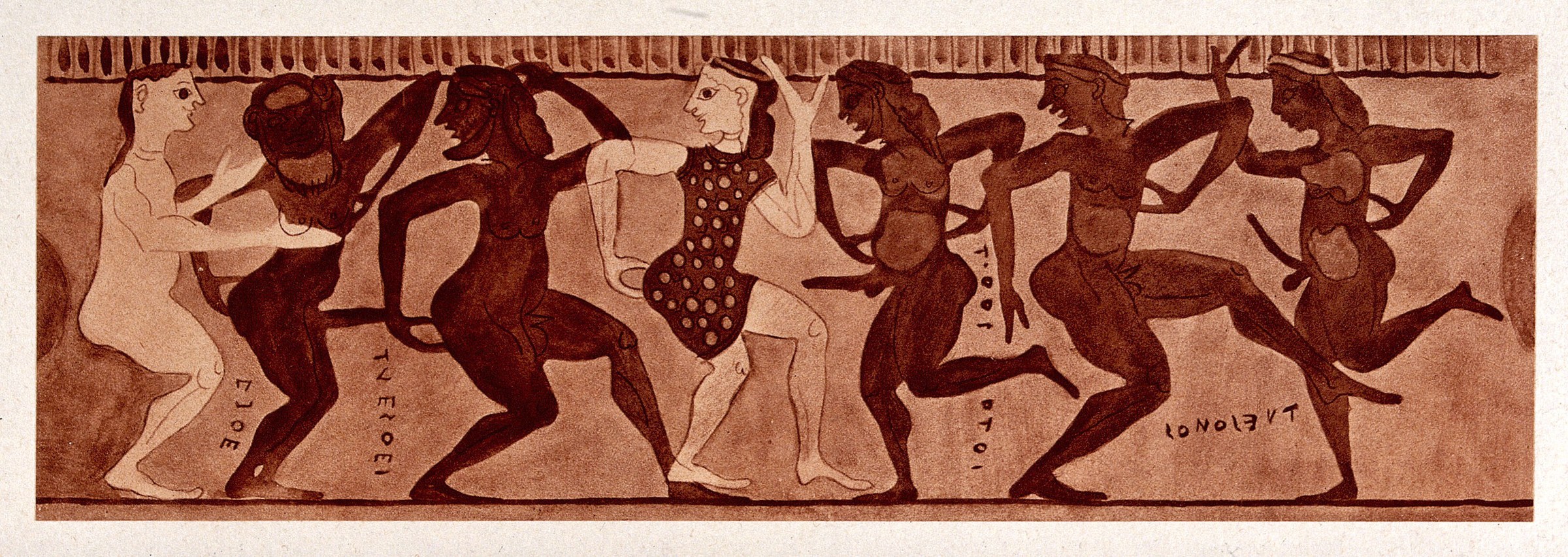
A frieze depicting dancing figures of men and women. Process print, 1921.
Unknown artist
- Source:
- Wellcome Collection
- Rights:
- Public domain — free to use, share and adapt.
- Recorded as:
- Public Domain Mark
For dancers and historians, this print is primary evidence of how ethnographic authority represented non-European dance in the early twentieth century, and of the visual conventions — flattened forms, anthropological framing, the observing figure — used to distance and objectify it. The gestural vocabulary visible in the dancers' bodies also documents continuities in African diaspora social dance that persist across centuries.
What you are looking at
A frieze shows a processional scene of dancing figures arranged in a continuous horizontal band. At the left, a pale-skinned figure in profile faces right; to their right dance seven darker-skinned figures in varied poses of motion. One figure wears a white garment with a bold polka-dot or patterned overlay, standing out as a focal point; the others are rendered in tones of reddish-brown to dark brown. The dancers move in a swaying, rhythmic arrangement across the composition, their bodies in profile or three-quarter view, arms raised and bent, legs in varied positions suggesting step and sway. The background is a uniform tan, with a decorative architectural frieze of vertical lines suggesting a classical or institutional setting at the top. The style suggests early-twentieth-century ethnographic or anthropological documentation rendered through printmaking.
The dancing
The seven darker-skinned dancers display a vocabulary of raised arms, bent knees, and swaying torsos consistent with social or celebratory dance. Several have one arm raised to the level of the head or higher; others hold arms at waist or hip level. The weight appears to shift from leg to leg in a rhythmic pattern. The figure in the patterned garment stands more upright than the others, creating a compositional break. The pale-skinned figure at left appears to observe or lead rather than fully participate, a compositional choice that reflects early-twentieth-century ethnographic representation.
The dance depicted
The image appears to document African or African diaspora social dance, most likely from a late-nineteenth or early-twentieth-century ethnographic or colonial source. The continuous frieze format, the rhythmic repetition of body positions, and the gestural vocabulary—raised arms, hip and torso movement, weight shifts in the legs—are consistent with circle or processional dances of West African, Caribbean, or diaspora tradition. The presence of the pale observer figure and the anthropological framing suggests this was drawn or printed as ethnographic documentation, a genre that frequently flattened and essentialized the dances it depicted. Without inscription or text, the specific dance form cannot be securely identified.
How it was made
The record identifies this as a process print from 1921. The image bears the characteristics of early photomechanical reproduction: flat colour separations in reddish-brown and tan, simplified forms without tonal modulation, and a print quality consistent with rotogravure, photolithography, or similar mass-reproduction techniques of the period. The visual language—the frieze format, the simplified figuration, the decorative border—suggests this was part of an illustrated publication, ethnographic study, or museum catalogue rather than an autonomous fine art print. Such reproduction techniques made ethnographic imagery widely available and helped circulate — and standardize — visual representations of non-European dance.
About this work
This frieze documents a moment in early-twentieth-century ethnographic representation of dance. The 1921 process print shows seven figures dancing in a loose processional or circle, rendered in the simplified, flattened style typical of ethnographic illustration of the period. The inclusion of a pale-skinned observer and the anthropological framing locate this within a tradition of colonial-era documentation that treated non-European dance as a subject for scientific observation and classification.
The print is significant as a historical artefact of how European and American institutions visualized African and diaspora dance in the early twentieth century. It documents both the dances themselves — the raised arms, weight shifts, and bodily vocabulary — and the structure of the gaze that framed them. The frieze format echoes classical antiquity, a choice that situates these dancers within an archaeological or museum register rather than as contemporary practitioners.
How to look at it
Attend first to the variety of arm and torso positions: several dancers raise arms high, others keep them lower, and the rhythmic alternation of these positions suggests the step-pattern and weight-shift of the dance. The figure in the patterned garment breaks the visual rhythm, functioning as a focal point or leader. Notice also what is absent: faces are blank profiles, and individual expression is suppressed in favour of a generalized, repeating gestural vocabulary. This erasure is itself historically significant — it reflects the ethnographic desire to document 'the dance' as a type rather than as performed by particular people in particular moments.
The period
This print dates to 1921, during the height of European and American ethnographic collecting and museum-building. The post-war period saw intensified anthropological fieldwork and publication, and parallel commercial distribution of ethnographic imagery through process printing. The visual style reflects the influence of modernist primitivism — the flattening and formal simplification visible here was also employed by avant-garde artists — but in this context it serves the apparatus of ethnographic authority rather than aesthetic rebellion. The frieze format echoes both classical sources and the exhibition conventions of ethnographic museums, where such images appeared in monographs, wall labels, and gallery installations.
Where it lives
The work is held in the Wellcome Collection, which documents the history of medicine, science, and human experience. This print was likely part of an ethnographic publication or museum acquisition related to medical anthropology, colonial documentation, or the history of race science in the early twentieth century. The Wellcome holds such material as evidence of the institutions and visual practices through which colonialism and anthropology intersected.
Dance in this work
Questions about this work
What dance is this?
The specific dance cannot be identified from the image alone. The gestural vocabulary—raised arms, weight shifts, rhythmic sway—is consistent with West African, Caribbean, or African diaspora social dances, but the ethnographic framing and the absence of contextual information prevent certainty. The print likely documented a specific tradition, but that information is not preserved in this catalogue record.
Why is there a pale figure watching?
This reflects the ethnographic conventions of early-twentieth-century visual documentation. The observing figure (often representing the anthropologist, curator, or educated viewer) was positioned outside and above the 'subject' of study. This compositional choice reinforced a hierarchy of knowledge and authority, making the pale figure the implicit viewer and validator of what is represented.
What does 'process print' mean?
A process print uses photomechanical reproduction — typically photolithography or rotogravure — to translate an artwork into multiple colour separations for mass printing. This technique was faster and cheaper than hand-drawn illustration, and made ethnographic imagery widely available through publications and museums. It also standardized the visual representation of the dances it depicted.
Is this documenting real dance or an artist's imagination?
Both. The gestural vocabulary is consistent with documented African diaspora dance traditions, suggesting the artist drew from observation or reference materials. However, the flattening, simplification, and the framing device (the observing figure) are choices made by the artist or publication that shape how the dance is presented. This is documentation, but documentation always involves interpretation.
More dance artwork





