49 works in this view — arrow keys or swipe to move between them.
Dance in Art
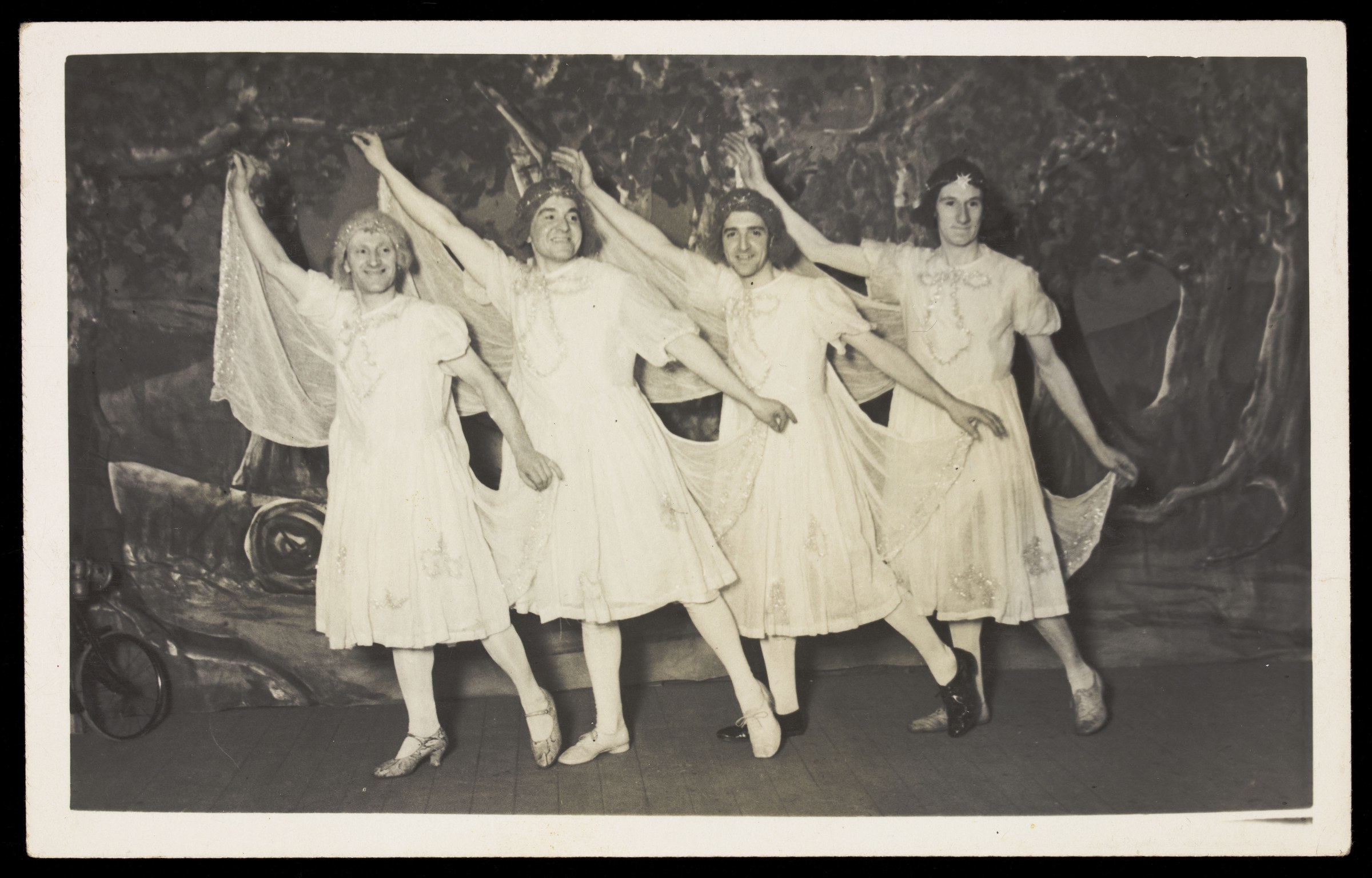
Amateur actors in drag, wearing white dresses and dancing on stage. Photographic postcard, 191-.
Unknown artist
- Source:
- Wellcome Collection
- Rights:
- Public domain — free to use, share and adapt.
- Recorded as:
- Public Domain Mark
This image documents the visual vocabulary and costume practice of amateur theatre and drag comedy in the early 1900s, showing how theatrical cross-dressing worked and how it was marketed through photographic postcards. For theatre and performance historians, it provides concrete evidence of how non-professional performers presented themselves and how theatrical companies used photography to create and circulate promotional materials.
What you are looking at
Four young men stand in a line across a stage, all dressed in identical white knee-length dresses with short sleeves, worn over dark stockings and dark shoes. Their poses are theatrical and exaggerated: all four have one or both arms raised high, and their bodies are angled with visible energy and playfulness. The figure second from left holds what appears to be a draped white fabric or shawl that extends from his raised arm. The setting is a stage with painted theatrical scenery visible behind them—dark, ornate backdrop suggesting an interior or garden scene. The photograph is a black-and-white postcard; the lighting is theatrical, with the figures brightly lit against the darker background. The composition suggests a moment of coordinated group movement, possibly a finale or curtain call, though the bodies are held in a frozen, posed attitude rather than mid-motion.
The dancing
All four dancers face toward the viewer in a loose line formation. Their weight appears evenly distributed and grounded; they are not executing jumps or traveling steps. The raised arms and angled postures suggest theatrical expression and humor rather than technical ballet vocabulary. The men's bodies are relatively upright, with arms extended at various heights—some reaching overhead, creating a sense of unison or near-unison in the group gesture. No balletic turnout or pointed feet are evident. The dresses, while period-appropriate for costume, sit naturally on their bodies without the fitted, elongated silhouette of a trained dancer.
The dance depicted
This is almost certainly a moment from amateur theatrical drag performance—a comic or entertainment sketch rather than professional dance. The white dresses, staged setting, and exaggerated poses suggest music hall, variety theatre, or amateur theatrical company work of the early 1900s. Cross-dressing comedy was a common element of such entertainment. The formal line formation and synchronized arm gestures suggest a group number, possibly a finale, but the movement vocabulary does not correspond to any codified dance style. The archival label "Amateur actors in drag" supports this reading. Without musical accompaniment or fuller context, we cannot identify a specific dance form, but the visual language is that of early 20th-century theatrical comedy rather than dance proper.
How it was made
This is a black-and-white photographic postcard, a popular format for theatrical documentation and promotion in the early 1900s. Postcards allowed theatrical companies to circulate images to fans and to preserve records of performances. The image quality and format suggest professional theatre photography, likely taken in a studio or on stage under theatrical lighting. The postcard format indicates this work had wide circulation beyond the immediate theatrical company—postcards were collected, mailed, and displayed. Photography's capacity to capture movement in a frozen moment made it ideal for preserving ephemeral theatrical performance, even though the moment here is clearly posed rather than captured in action.
About this work
This is a theatrical photograph documenting an amateur theatrical drag performance, likely from a music hall, variety show, or amateur dramatics company in the early 1900s. Four young men in white dresses execute a synchronized group pose on stage, their raised arms and exaggerated attitudes conveying theatrical energy and comedy. The work survives as a photographic postcard, a format that allowed theatrical companies to document and distribute images of their performances to wider audiences. While drag performance and cross-dressing comedy were staples of early 20th-century theatre, this is not a dance in the technical sense; rather, it documents a moment of theatrical spectacle and humor within the variety entertainment tradition.
How to look at it
Look at the coordination and uniformity of the poses: all four men are dressed identically and hold their bodies in a deliberately exaggerated, synchronized manner. The raised arms and angled bodies convey theatrical expression and comedy rather than trained movement. Notice the theatrical backdrop and stage lighting, which frame this as a posed moment rather than a natural gesture. The postcard format and professional photographic quality indicate this is an official record of a public performance, preserved for distribution and collection.
The period
Theatrical drag and cross-dressing comedy were widespread in early 20th-century variety entertainment, music hall, and amateur theatrical societies. The postcard boom of the 1890s-1920s coincided with the height of music hall and variety theatre popularity, making photographic postcards a primary means of theatrical publicity and fan engagement. Amateur theatrical societies were a major social and cultural activity in Britain and Europe during this period, staging comedies, farces, and satirical sketches. The white dress costume and theatrical styling visible here reflect Edwardian-era fashion and theatrical aesthetics.
Where it lives
The image comes from the Wellcome Collection, which holds this as a photographic postcard dated to approximately 1910s. The label on the record identifies it as depicting amateur actors in drag, suggesting it was catalogued based on its subject matter and theatrical context rather than artist attribution or performance details.
Questions about this work
Were these performers professional dancers?
No. The label and visual evidence both indicate these were amateur actors performing in a theatrical sketch or variety show, not professional dancers. The movement vocabulary, costume fit, and staged pose do not reflect trained dance technique. This is theatre rather than dance proper.
What was the purpose of this photograph?
This is a theatrical postcard, a promotional and documentary tool used to publicize performances and allow fans to collect images of actors and scenes. Theatrical companies distributed these postcards to build audiences and create a record of their work.
Why were men performing in women's clothes?
Cross-dressing comedy and drag performance were standard elements of music hall, variety theatre, and amateur dramatics in the early 1900s. Male performers in women's dress were common comic figures, and this entertainment was socially acceptable within the theatrical context.
More dance artwork





