49 works in this view — arrow keys or swipe to move between them.
Dance in Art
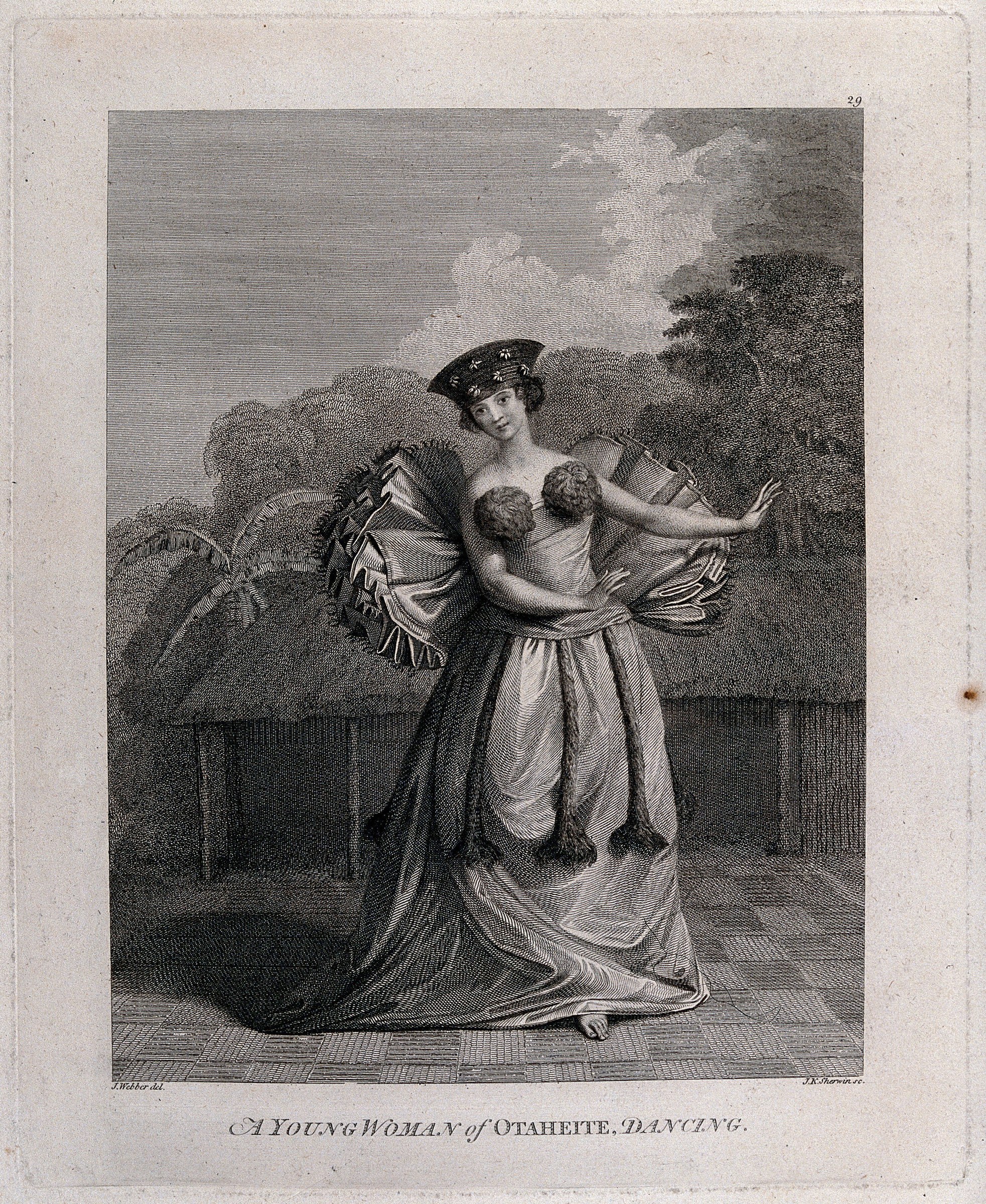
A young woman from Tahiti, dancing. Engraving by J.K. Sherwin, 1784, after J. Webber.
Unknown artist
- Source:
- Wellcome Collection
- Rights:
- Public domain — free to use, share and adapt.
- Recorded as:
- Public Domain Mark
This print is vital evidence of how European artists and audiences imagined non-European dance in the late eighteenth century—not as something to be documented in motion, but as a pose to be aestheticized and domesticated. It reveals the distance between actual Polynesian practice and what European prints claimed to show, and the work engraving did in circulating these fantasies as fact.
What you are looking at
A woman stands alone in a garden or park setting, wearing the high-waisted neoclassical dress fashionable in the 1780s, with her long skirt falling in elegant folds to the ground. She wears a small feathered headdress and holds a large fan in one hand while her other arm is raised in a graceful gesture. A cherub or putto is depicted in her arms or at her side, adding an allegorical dimension to the scene. The background shows dense foliage and clouded sky rendered in the soft tonal gradations typical of engraving. The composition is frontal and posed rather than narrative—this is a portrait-style presentation of a figure in motion or gesture rather than a captured moment of activity.
The dancing
A single female figure dominates the composition, her body angled slightly in contrapposto, one arm lifted in an open, welcoming gesture. Her carriage is upright and refined, the posture of an educated, genteel woman. The presence of the cherub—either held or positioned beside her—suggests an allegorical reading: she is not simply dancing, but embodying an idea. Her weight appears centered, her frame open, her bearing confident. There is no sense of vigorous or athletic movement; instead, the pose conveys grace and poise.
The dance depicted
The title identifies this as a young Tahitian woman dancing, but the image presents an eighteenth-century European interpretation of an exoticized female figure rather than an ethnographic record. The dress is entirely European neoclassical, not Polynesian; the fan and headdress are fashionable London accessories. The pose and gesture belong to the genteel accomplishments taught to European women of the period—a refined, stationary stance with the arm raised in the manner of academic drawing manuals. Any actual Tahitian dance is invisible here; what the engraver has depicted is a European woman costumed as an exotic 'Tahitian' for polite society's entertainment.
How it was made
This is a line engraving, executed by J.K. Sherwin after a drawing by James Webber (as noted in the inscription). Engraving was the primary medium for reproductive prints in this period, allowing wide circulation among educated audiences in print collections, bound volumes, and periodicals. The fine parallel lines and careful tonal modeling are characteristic of the technique. The inscription and credit to both artist and engraver indicate this was a commercial reproductive print, likely part of a larger series documenting exotic lands or fashionable subjects.
About this work
This is an eighteenth-century engraving presenting European fantasy rather than documentation. It exemplifies the period's fascination with the exotic Pacific, filtered entirely through the lens of London fashion and neoclassical aesthetics. The figure wears the dress and accessories of 1780s England, strikes the pose of a neoclassical sculpture, and performs for an audience that understood 'Tahitian' as a category of fashionable spectacle. The cherub adds a classical allusion, linking the 'savage' Pacific to European mythology and 'civilization.' The work is less a dance image than a curiosity—a document of what Europeans wanted to see when they imagined the South Pacific, and what they were willing to call dance when the figure was sufficiently removed from their own world.
How to look at it
Look at the dress first: it is not Polynesian, but London 1780s. Note the stillness of the pose—there is no sense of motion, only of a figure arranged for display. Observe how the cherub transforms the image from documentary to allegory: this is not a record of dance, but an aesthetic invention. The open arm gesture and the upright carriage follow European conventions of feminine grace taught in drawing academies. The engraving's fine lines and tonal subtlety mark this as a luxury print for educated collectors, not a popular broadside. The image is asking you to enjoy the idea of a beautiful foreign woman in fashionable dress, not to understand how Pacific peoples actually danced.
The artist
James Webber (1751–1793) was a landscape and figure artist who served as draughtsman on Captain Cook's third Pacific voyage (1776–1780). On his return he became fashionable in London society, exhibiting at the Royal Academy and producing works on exotic subjects. However, Webber's training was in European academic drawing, and his sketches from the Pacific were filtered through that convention. J.K. Sherwin (1751–1790) was a leading engraver of the period, known for reproductive prints after contemporary artists and for work in the elegant neoclassical style.
The period
The 1780s saw an explosion of European interest in the Pacific following Cook's voyages. Publishers capitalized on this by commissioning prints, books, and illustrated accounts that fed metropolitan curiosity about distant lands. At the same time, neoclassicism dominated taste in art and design—straight lines, classical poses, and allegorical reference were the markers of refinement. The figure of the exotic woman, rendered in neoclassical dress and pose, was a fashionable subject in its own right, appearing in prints, fashion plates, and as a theme in erotica. Dance from the Pacific was entirely unknown to European audiences except through prints like this, which typically showed not movement but a statuesque pose.
Where it lives
The print comes from the Wellcome Collection, a history-of-medicine and related-sciences archive. Its presence there may reflect the period's conflation of exploration, natural history, and curiosity—the Pacific and its peoples as subjects of learned interest rather than practical medical knowledge.
Dance in this work
Questions about this work
Is this based on something Webber actually saw in Tahiti?
Probably not in this form. Webber was aboard Cook's ships and did sketch from observation, but this engraved print is a composite creation: Webber's drawing, Sherwin's interpretation in engraving, and the publisher's commercial choices about what would sell in London. By the time the print was finished, it had been refined and aestheticized far beyond field documentation.
Why does she look European?
Because she is dressed in European clothes by European artists for a European audience. The 'Tahitian' identity is in the title, not the image. This was a common practice: the exotic appeal lay partly in the idea of distance, but the actual execution had to conform to European standards of beauty and refinement to be marketable.
Is this engraving a primary source for Tahitian dance?
No. It is a primary source for what London in 1784 wanted to believe about Tahitian dance, and about what counted as artistic refinement in depicting it. For actual knowledge of Pacific dance, other sources—oral histories, later ethnographic work, and twentieth-century documentation—are far more reliable.
More dance artwork





