49 works in this view — arrow keys or swipe to move between them.
Dance in Art
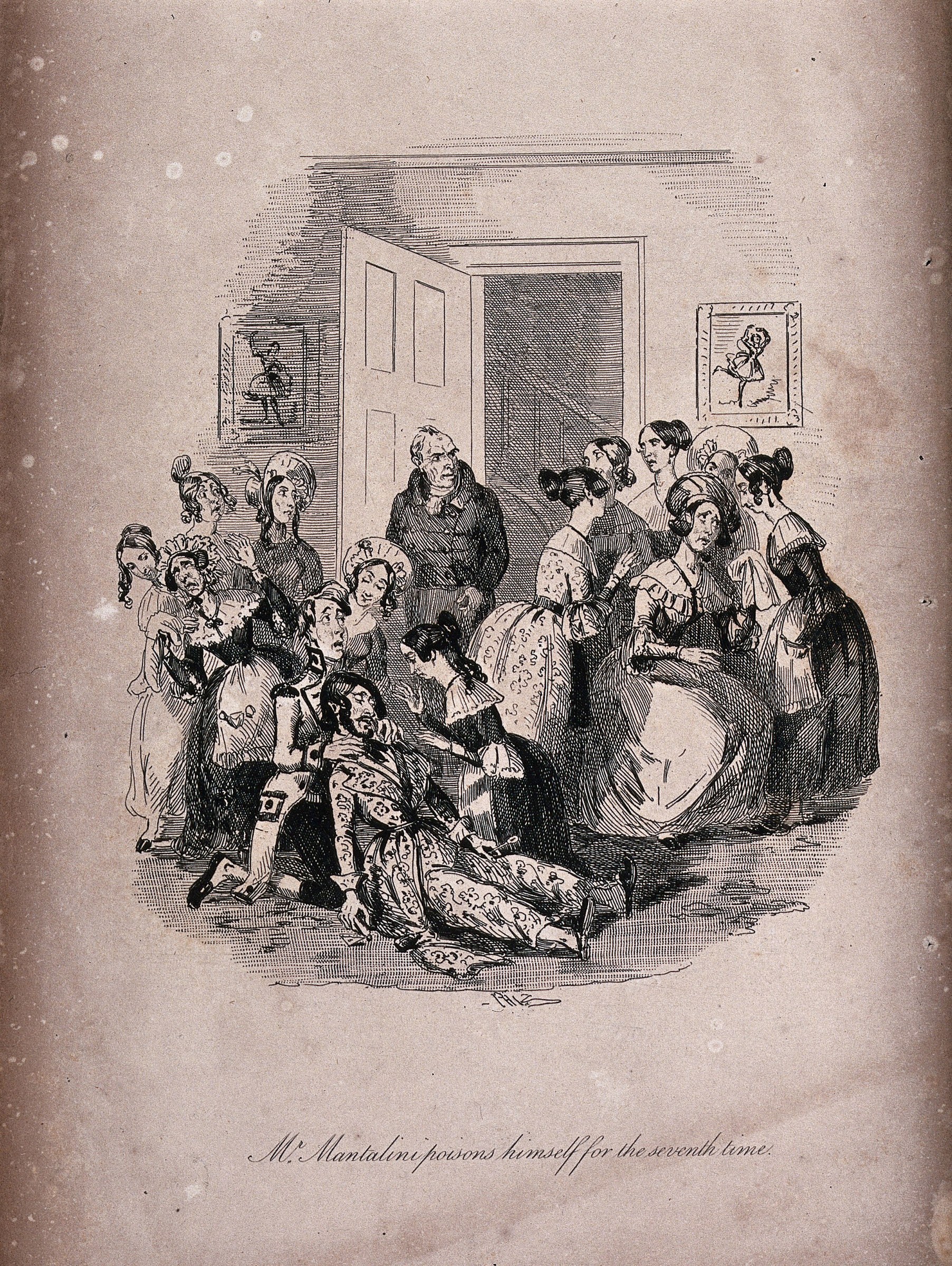
An episode in Nicholas Nickleby by Charles Dickens: a crowd gathers around Mr Mantalini who has attempted to poison himself. Etching after Phiz (Hablot K. Browne).
Unknown artist
- Source:
- Wellcome Collection
- Rights:
- Public domain — free to use, share and adapt.
- Recorded as:
- Public Domain Mark
This etching is a window into the embodied social world of early Victorian England—how people dressed, moved, and expressed emotion in domestic crisis. For historians of movement culture and everyday embodiment, it records physical convention and spatial relationships among different social actors in a specific historical moment, complementing but complicating the formalized dance records of the same era.
What you are looking at
A crowded interior scene depicting the moment of crisis described in Dickens's Nicholas Nickleby. Mr. Mantalini, a portly man in dark coat, lies sprawled on the floor in the foreground, having apparently attempted to poison himself. His body is limp and dramatically positioned, with ornate patterned clothing visible. Around him stands a densely packed group of women and at least one child, their faces expressing alarm, concern, and curiosity. They wear the fashionable dress of the 1830s-1840s: bonnets with decorative trim, high-waisted dresses, shawls, and elaborate upholstered sleeves. The setting is a domestic interior with a door and window visible in the background; a small framed picture hangs on the wall. The composition is tightly constructed, with figures overlapping and compressing the space to intensify the emotional pressure of the moment. Light and shadow are rendered through cross-hatching, creating a theatrical chiaroscuro that emphasizes Mantalini's prone form at the center.
The dancing
No dancers are present in this image. The figures are arranged in a tableau of emotional response rather than choreographed movement: women lean toward the central prone figure with gestures of shock and solicitude, their bodies inclined forward in concern. Some clasp their hands; others reach toward Mantalini. Their postures are naturalistic and varied—standing, bending, turning—rather than held in any formal frame or relationship. A child stands among the adults. The overall impression is of spontaneous crowd reaction rather than any organized or practiced bodily arrangement.
The dance depicted
This image does not depict dance. It is a narrative illustration of a dramatic crisis in a Victorian novel, chosen for its emotional and social content rather than for choreographic interest. The figures are responding to an emergency within a domestic setting, not engaging in any form of dance practice, performance, or movement convention.
How it was made
This is an etching rendered in fine cross-hatching and parallel lines, characteristic of reproductive engraving practice in the 19th century. The technique allows for subtle gradations of tone and precise rendering of texture, fabric, and facial expression—essential for narrative illustration. Etchings could be mass-produced and widely distributed, making them the dominant medium for book and periodical illustration during this period. The artist (identified in the catalogue record as working after Phiz, the pseudonym of Hablot K. Browne, Dickens's principal illustrator) would have worked from Browne's original design, translating it into print.
About this work
This is a narrative illustration from Charles Dickens's serial novel Nicholas Nickleby, likely published in the 1830s-1840s. It depicts a moment of domestic crisis—the attempted suicide of a comic villain—as rendered by one of the era's most prolific illustrators. The work belongs in a dance collection not because it depicts dance, but because it documents the lived environment and bodily culture of the period: the dress, the domestic interior, the modes of physical expression available to people of different classes and genders in early Victorian England. It records how bodies were clothed, arranged, and moved in non-ceremonial moments of stress and surprise.
The work exemplifies the genre of serialized narrative illustration that shaped visual culture for millions of readers. It is a primary document of 19th-century social life and emotional expression, rendered in a medium designed for rapid circulation and democratic access.
How to look at it
The viewer should attend to the precise moment chosen: not the act of poisoning but its aftermath, the collective witnessing and response. Notice how the artist stages the crowd response through overlapping bodies and repeated gestures of concern—a formal grammar of social emotion. The compression of figures creates claustrophobia and intensity. Look at the dress: bonnets, sleeves, shawls are rendered with specificity that allows dating and social placement. Finally, observe how Mantalini's prone body is the visual center despite being the smallest figure—the artist's emphasis is on the social meaning of the gesture (self-destruction, failed masculinity) rather than on anatomical realism.
The artist
The catalogue identifies this as an etching after Phiz (Hablot Knight Browne, 1815–1882), the most celebrated illustrator of Charles Dickens's novels. Browne worked directly with Dickens on serialized novels beginning with The Pickwick Papers (1836) and continued with Nicholas Nickleby, establishing a collaborative practice that made him the visual voice of Dickens's fiction for contemporary readers. His style combined precise social observation with expressive exaggeration suited to Dickens's own narrative mode. The original etching artist is not recorded in the catalogue but would have been a reproductive engraver working from Browne's design.
The period
This etching dates to the era of the penny dreadful and serialized illustrated fiction (1830s–1850s), when reproductive engraving technology made visual narrative accessible to a mass reading public. Dickens's novels appeared first as serialized installments in periodicals, each accompanied by two or more illustrations; readers anticipated the visual commentary as much as the text itself. Simultaneously, this period saw the establishment of Romantic ballet as a theatrical form (La Sylphide premiered in 1832, La Giselle in 1841), creating a sharp division between formalized staged dance and the undisciplined, emotionally expressive movement of everyday life captured in illustrations like this one. The image thus sits at the intersection of two competing 19th-century movement cultures: the ethereal, controlled grace of concert dance, and the unruly, socially-coded physicality of ordinary people in crisis.
Where it lives
This etching is held in the Wellcome Collection, London, which houses the world's largest private collection of medical and social history imagery. The Wellcome Collection's mandate includes visual culture and social documents; this work entered the collection as part of the broader Dickens illustrated archive, valued for its historical and social record rather than for medical content.
Questions about this work
Is this a dance illustration?
No. While it documents 19th-century dress and bodily culture, it depicts a crisis scene in a novel, not any form of choreographed or practiced movement. It is included in the Gallery as a historical document of how bodies were clothed, arranged, and moved in non-performance contexts.
Who was Phiz and why was he important?
Phiz (Hablot Knight Browne) was the principal illustrator of Charles Dickens's major novels. Working directly with Dickens, he created the visual language through which millions of Victorian readers first encountered Dickens's characters and narratives. His expressive style combined social realism with grotesque exaggeration suited to Dickens's own mode.
Who is Mr. Mantalini and why would he poison himself?
Mantalini is a vain, parasitic character in Nicholas Nickleby—a failed rake and fortune-hunter dependent on his wife's money. His attempted suicide is treated comically by Dickens as the melodramatic despair of a man whose masculinity and social position have collapsed. The illustration captures the moment when his suicide attempt is discovered by his wife and her companions.
How was this etching made and distributed?
Phiz produced the original design in pencil or wash; a reproductive engraver then transferred it to an etched copper plate, working in fine parallel lines to create tone and texture. The plate could be printed thousands of times, making this a mass-market image. It appeared as one of two or more illustrations accompanying each installment of the novel as it was serialized in a periodical.
More dance artwork





