49 works in this view — arrow keys or swipe to move between them.
Dance in Art
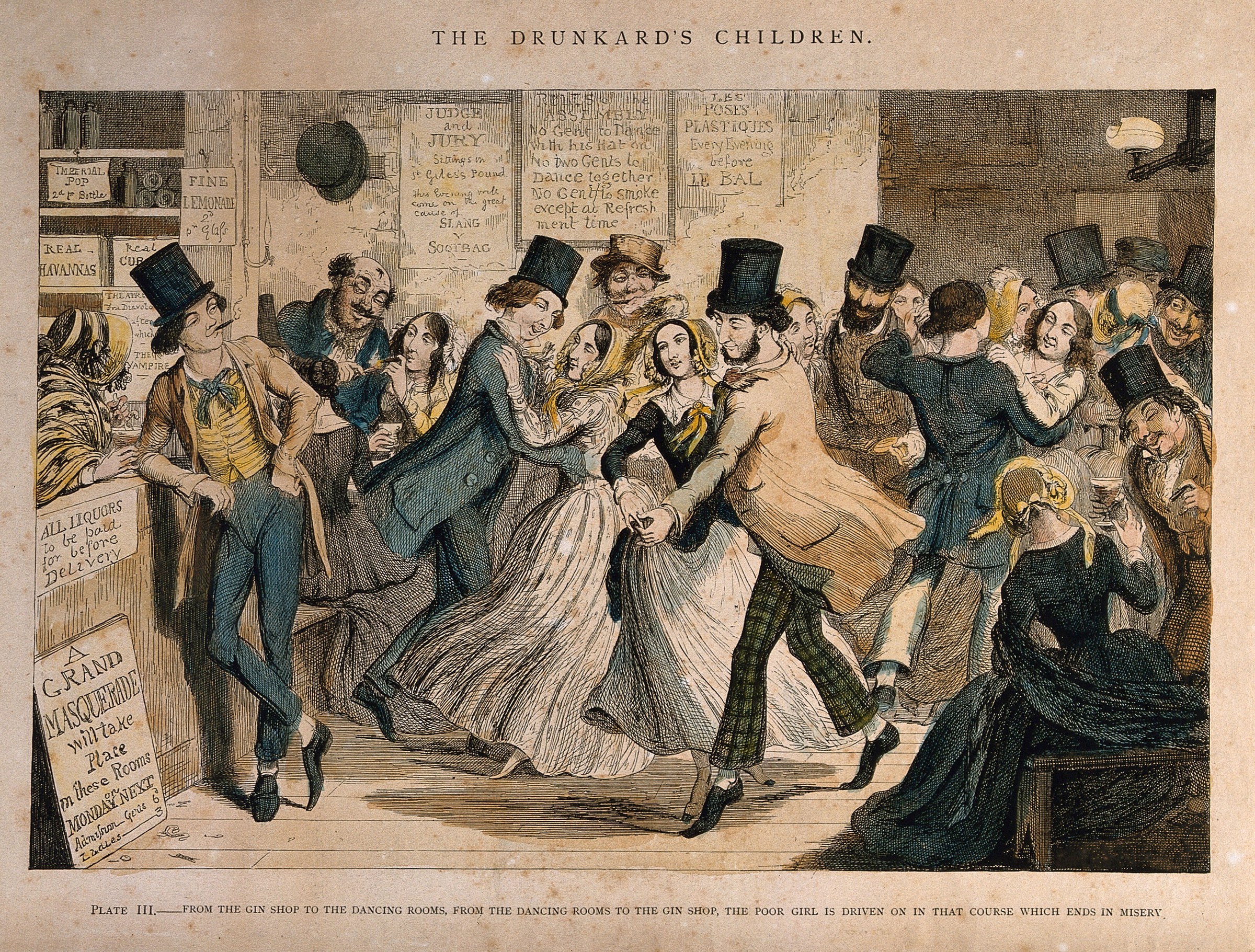
A drunken scene in a dancing hall with a sly customer eyeing a girl. Coloured etching by G. Cruikshank, 1848, after himself.
Unknown artist
- Source:
- Wellcome Collection
- Rights:
- Public domain — free to use, share and adapt.
- Recorded as:
- Public Domain Mark
For dance historians, this print is crucial evidence of how ordinary people—the poor, women, the working classes—actually danced in public in the 1820s–1840s, outside the ballroom and the page of instruction manuals. For art historians and social historians, it exemplifies how dance was conscripted into moral and political argument in the age of industrial capitalism: the image shows that Cruikshank understood dance as legible, powerful, and dangerous enough to use as a vehicle for social critique. The print circulated widely in Britain and abroad, shaping middle-class attitudes toward working-class leisure for decades.
What you are looking at
A crowded gin shop or public house has transformed into an impromptu dance floor. A young woman in a white muslin dress dances in the center, her skirt caught mid-swirl, while two men in top hats and tailcoats guide or support her movement. Around them, a dense crowd of onlookers—men in tall hats, women in bonnets and shawls—press inward, some drinking, some watching intently, others turning away. The walls are papered with handwritten notices advertising spirits and dancing rooms; bottles and glasses sit on shelves behind. The composition is tightly packed, with figures overlapping and crowded into every corner, creating an atmosphere of moral chaos. The etching's title, 'The Drunkard's Children,' and the caption below—'From the gin shop to the dancing rooms, from the dancing rooms to the gin shop; the poor girl is driven on in that course which ends in misery'—frame this as a cautionary scene of social degradation.
The dancing
The central dancer's body is in motion with her skirt billowing outward, suggesting a rotational step or twirl; her arms are raised or extended outward in an unselfconscious, uninhibited manner. The two men flanking her appear to propel her rather than partner her in the formal sense—their hands guide or grasp her, and they lean into the movement with their bodies. The surrounding figures show no unified dance formation; instead, they are scattered spectators in various attitudes of intoxication, attention, and indifference. No closed holds, no structured frame, no ballroom decorum—the movement is hasty, chaotic, and driven by alcohol rather than technique.
The dance depicted
This is not a named or codified dance but a improvised reel or jig typical of early 19th-century working-class public houses. The style is vernacular social dancing—casual, energetic, and uncontrolled—as opposed to the polite ballroom dances of the respectable classes. The setting and the crude energy of the movement suggest a breakdown, jig, or country reel performed in a gin shop by and for the poor and drunk. The artist has captured the moment at the threshold between pleasure and moral ruin: the dance is real, but it is being weaponized by the narrative as evidence of the drunkard's household sliding toward destruction.
How it was made
This is a hand-colored etching in the manner of James Gillray and Thomas Rowlandson—Cruikshank's immediate predecessors in satirical social commentary. The technique allows for dense, fine linework that can render both the delicate folds of the woman's dress and the savage caricature of the surrounding faces. Etching was the dominant medium for mass-produced satirical prints in early 19th-century Britain, allowing multiple impressions to be made and hand-colored individually, and could be circulated cheaply in print shops and periodicals. The color—muted ochres, blacks, and flesh tones—was likely applied after printing. The technique's precision and portability made it ideal for moral propaganda aimed at a literate, urban middle-class audience.
About this work
This is a scene from George Cruikshank's satirical series 'The Drunkard's Children' (the title appears at the top; the artist is identified on the left margin and in the caption). It depicts an improvised dance in a gin shop as a moment of moral crisis—the poor girl at the center dances with apparent pleasure while surrounded by the visual markers of degeneracy (drunkenness, overcrowding, vice). The work is both a documentary image of how the poor actually danced in public houses and a morality tale constructed by the artist to persuade middle-class viewers that gin-drinking and working-class leisure were pathways to ruin. The dance itself is real—a reel or jig of the kind that would have been performed in such venues—but Cruikshank has weaponized it, using the visibility and energy of the dance to illustrate a social argument about poverty, alcohol, and female vulnerability.
How to look at it
Attend first to the central dancer's body: note the swirl of the skirt, the raised arms, the forward lean of her torso. This is not a taught, corseted posture but an abandoned one. Now look at the faces around her—some leering, some concerned, some indifferent—and notice how the artist uses the crowd to frame her as both the subject of pleasure and the object of danger. The etching technique allows Cruikshank to render her dress in fine white lines against the darkness of the surrounding figures, making her visually dominant but morally isolated. The notices on the walls ('JUDGE AND JUICY / SLANG,' 'PLASTIGUES,' 'LE BAL') are genuine period advertisements, embedded in the scene to anchor it in a specific time and place. Finally, read the caption: it transforms the dance from a moment of joy into a moment of tragedy, using the image to make an argument about the trajectory of the poor girl's life.
The artist
George Cruikshank (1792–1878) was the leading satirical engraver and printmaker of early 19th-century Britain, inheriting the mantle of Rowlandson and Gillray but bringing greater technical refinement and moral urgency to his work. He was prolific across multiple genres—political satire, literary illustration, moral tracts—and pioneered the serial narrative in prints, most famously in 'The Drunkard's Children' (1848) and 'The Bottle' (1847). By mid-career, he had become an ardent temperance advocate, and many of his later works, including this series, were tools of social reform. He was also an acute observer of contemporary manners and an anatomist of the human form, capable of rendering both the grotesque and the pathetic with equal conviction.
The period
In the 1840s, when this print was made, gin-drinking was a major public health and moral panic in Britain. The rise of industrial towns, the cheapness of gin relative to beer or ale, and the visibility of female drunkenness in public spaces provoked intense social anxiety among the respectable classes. At the same time, working-class leisure—including dancing—was increasingly subject to surveillance and moral judgment. The ballroom and dancing master had become symbols of respectability for the middle classes; working-class dance in public houses was coded as unregulated, sexual, and dangerous. In art, this period saw the emergence of social-problem paintings and prints as a distinct genre, with artists using the human body—especially the female body—to tell stories about moral decline. Cruikshank's work exemplifies this movement: dance becomes a visual language for narrating class, gender, and moral catastrophe.
Where it lives
The work is held by the Wellcome Collection, a London-based institution that collects art, artefacts, and documents related to medicine, science, and human experience. It acquired this print as part of its documentation of social history and public health—the work functions as both a historical document (evidence of 19th-century leisure and vice) and a piece of moral propaganda (evidence of how the middle classes understood and sought to regulate working-class behavior).
Dance in this work
Questions about this work
Is this a real dance or something the artist invented?
The dance is real—a reel or jig of the kind danced in working-class public houses in early 19th-century Britain. These were improvised, energetic country dances performed to the fiddle or pipes. Cruikshank was a keen observer of contemporary life and based his prints on actual scenes he witnessed or heard about. However, the moral framing—the suggestion that this particular dance is a marker of degeneracy—is the artist's invention, part of a broader temperance narrative.
Why is the dancing girl the focus if the scene is about drunkenness?
The girl is the moral center of the narrative. The print is part of a series called 'The Drunkard's Children,' and this image illustrates the moment at which the child of a drunkard is herself being drawn into the same cycle of gin and vice. Her visibility, her motion, her youth, and her apparent pleasure make her both a sympathetic figure and a cautionary one—the viewer is invited to see her as a victim of circumstance, but also as someone complicit in her own ruin. The dancing body makes the abstract concept of moral decline concrete and visual.
What was the audience for this print?
The primary audience was the middle and respectable working classes—people who could afford to buy or view satirical prints, who read newspapers and moral tracts, and who supported temperance reform. Prints like this circulated in print shops, were reproduced in periodicals, and were sometimes pasted on walls as public education. They were tools of moral persuasion, designed to generate disgust at gin-drinking and sympathy for its victims, particularly women and children.
Why did Cruikshank choose dance as the vehicle for this moral argument?
Dance was visually compelling, immediately readable, and already coded in the public mind as either respectable (ballroom dancing by the middle classes) or disreputable (working-class dancing in public houses). By showing a girl dancing in a gin shop surrounded by drunkenness and vice, Cruikshank could communicate her moral danger without stating it explicitly. The dance itself is innocent, but the context—the crowds, the bottles, the din—corrupts it and corrupts her.
More dance artwork





