49 works in this view — arrow keys or swipe to move between them.
Dance in Art
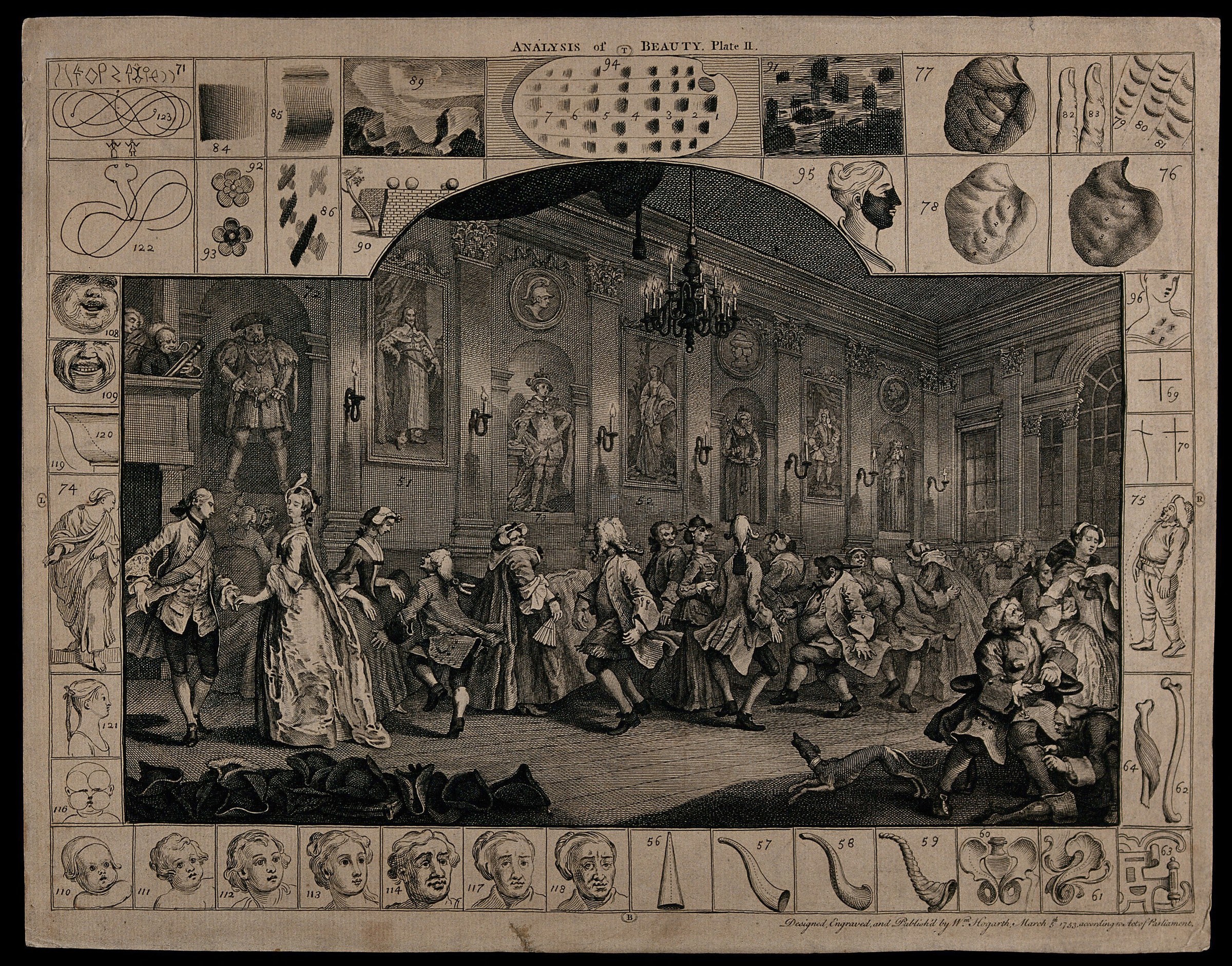
Analysis of beauty. Plate II.
Unknown artist
- Source:
- Wellcome Collection
- Rights:
- Public domain — free to use, share and adapt.
- Recorded as:
- Public Domain Mark
For dance historians, this engraving is invaluable as a record of how bodies moved and presented themselves in polite society at mid-century, and how contemporary theory linked aesthetic beauty to bodily form. The surrounding diagrams—particularly the emphasis on curved, serpentine lines—show what educated audiences of the 1750s understood to be graceful, and this directly informed the aesthetics of dance training and performance. Hogarth's work was widely known and influential; his theory of the line of beauty shaped how dancers and choreographers thought about movement.
What you are looking at
This is Plate II from William Hogarth's *Analysis of Beauty*, a didactic engraving that frames a theatrical interior scene with a grid of analytical diagrams. The central image depicts an elegant indoor reception or assembly in what appears to be an 18th-century drawing room, with a coffered ceiling, wall sconces, and framed portraits. Two dozen figures in fashionable dress are distributed across the floor in a loose social formation. The women wear full skirts and decorative gowns; the men are in coats and breeches. A woman in the left-center ground wears a notably full white or pale dress and appears to be the focal figure. The composition is not a frozen moment of organized dance but rather a crowded social gathering with multiple overlapping conversations and gestures. Surrounding this central scene is an extensive border of numbered reference diagrams—serpentine curves, facial proportions, drapery studies, architectural moldings, profiles of heads, body contours, and decorative flourishes—all keyed to Hogarth's theory of aesthetic beauty and proportion. The whole functions as both a scene of contemporary life and a visual treatise on form.
The dancing
The figures are not engaged in partnered or formal dance. They stand in loose, conversational clusters with varied postures—some facing outward, some turned inward toward companions. Arm positions are relaxed and gestural rather than structural; hands gesture in conversation, rest at sides, or reach toward companions. The gathering shows the informal social mobility of an assembly or reception: figures overlap, turn away, lean toward neighbors. No figures are in a recognized dance hold or frame. The crowded composition and varied body angles suggest social interaction rather than the synchronized movement or visible footwork that would characterize an actual dance performance.
The dance depicted
This is not a depiction of dance itself but a crowded social assembly, the kind of gathering in which dance might occur. Hogarth's purpose is didactic rather than documentary: he is using the scene as one example among many of how beauty arises from the interplay of proportion, curve, and line. The border diagrams—with their emphasis on the serpentine or 'line of beauty' that Hogarth championed—are the true subject. The central interior is a stage of fashionable social life where elegance of form and grace of bearing are on display. The image belongs to the history of 18th-century social and aesthetic theory rather than to the documentation of a particular dance form.
How it was made
This is a copper-plate engraving, executed with fine line work characteristic of mid-18th-century printmaking. The technique allowed Hogarth to combine dense, readable detail—the architectural setting, the costumes, the analytical diagrams—on a single plate legible to contemporary viewers. Engraving's precision and capacity for fine tonal gradation through parallel lines (visible in the shading of the interior walls and fabrics) made it ideal for a work that is as much diagram as scene. The print was designed for wide circulation among educated audiences and would have been studied as both an aesthetic treatise and a record of contemporary manners.
About this work
This is Plate II of William Hogarth's *Analysis of Beauty* (1753), a seminal work in 18th-century aesthetic theory that combines social observation with geometric analysis. The central scene shows a fashionable interior gathering of men and women in Georgian dress, surrounded by a comprehensive border of analytical diagrams keyed to Hogarth's theory that beauty emerges from specific proportions and the serpentine 'line of beauty.' While the scene is not a dance scene per se, it depicts the kind of social assembly—the assembly room or drawing room—in which dances took place, and it records the ideals of grace, proportion, and elegant bearing that governed both social deportment and dance movement of the period. The work is both a mirror of contemporary social life and a visual argument about aesthetics, making it a document of how 18th-century society understood elegance and form.
How to look at it
Approach this as two works at once: first, read the central scene as a record of how fashionable people stood, gestured, and carried themselves in a social assembly. Note the varied postures, the angles of the bodies, the gestural language of the hands—this is what Hogarth saw as the living embodiment of his aesthetic principles. Then attend to the border diagrams: these are not mere ornament but the theoretical apparatus. The serpentine curves, the facial proportions, the drapery studies—each is numbered and intended to guide the eye back to corresponding elements in the central scene. The engraving asks you to see beauty as the product of proportion, curve, and the harmonious relationship of parts. For a dance viewer, the lesson is that the grace Hogarth prized in social movement—the curve of an arm, the turn of the head, the fall of a skirt—was understood as an expression of geometric and mathematical order.
The artist
William Hogarth (1697–1764) was an English painter and printmaker whose satirical and morally didactic works became defining images of 18th-century social life. He pioneered the 'modern moral subject'—narrative scenes of contemporary manners that combined acute social observation with critical commentary. *The Analysis of Beauty* (1753) was his attempt to codify the principles of aesthetic judgment, arguing against arbitrary rules and in favor of precise geometric and proportional analysis. The work combined Hogarth's skill as a draftsman with his ambition as a theorist, and it became one of the most influential aesthetic treatises of the century, translated widely and studied by artists, architects, and designers.
The period
This engraving belongs to the mid-Georgian period, an era of refined social manners and the expansion of public assembly rooms and subscription balls. The 1750s saw the rise of dance as a mark of gentility; dancing masters were fashionable, and mastery of a repertoire of dances—minuets, cotillions, country dances—was essential to participation in polite society. Aesthetically, the period was marked by a move away from the ornate Baroque toward more restrained elegance and rational proportion. Hogarth's *Analysis of Beauty* was one of the most important statements of this shift: it offered a theory of beauty rooted in geometry and natural observation rather than inherited rules, and it situated beauty as a property of movement and line, not static form. For dance, this meant validation of grace and fluidity over rigidity, and emphasis on how the body moves through space.
Where it lives
The image comes from the Wellcome Collection, a holdings of historical medical, scientific, and cultural artifacts. *Analysis of Beauty* was a popular and widely distributed engraving; multiple impressions survive in public collections. This particular impression and its acquisition history are not detailed in the available record.
Questions about this work
Is this a dance scene?
Not directly. It shows a fashionable indoor assembly—the kind of social gathering in which dances took place—but the figures are conversing and standing informally rather than dancing. Hogarth's intent was to illustrate his theory of beauty through the forms and proportions of the human body in a setting of contemporary refinement. The scene is evidence of how people moved and held themselves in polite society.
What do the diagrams around the edge mean?
They are the heart of Hogarth's aesthetic theory. The serpentine curves, facial proportions, drapery studies, and architectural details are all keyed to his argument that beauty arises from specific geometric relationships and the interplay of curved lines. Hogarth is teaching the viewer to see beauty as a function of proportion, not taste or whim.
When was this made and why?
The *Analysis of Beauty* was published in 1753. Hogarth created it to defend his own approach to art and design against rigid neoclassical rules, and to offer a new theory of beauty based on mathematics and nature. It became one of the most influential aesthetic treatises of the 18th century and was widely translated.
How does this relate to dance?
Hogarth's theory of beauty—his emphasis on curved lines, graceful proportion, and the harmony of moving form—directly influenced how dance was conceived and taught in the 18th century. The elegant, flowing carriage shown in the central scene was the ideal toward which dancers and dancing masters aimed. The engraving is thus a record of the aesthetic principles that governed refinement in both social movement and formal dance.
More dance artwork





