49 works in this view — arrow keys or swipe to move between them.
Dance in Art
Ballets Russes de Serge Diaghilev
Unknown artist
- Collection:
- Prints & Photographs
- Source:
- Library of Congress
- Rights:
- Rights vary by item — check the source record before reusing this image. Source record ↗
- Recorded as:
- Library of Congress — no known restrictions (verify per item)
The Ballets Russes under Diaghilev fundamentally transformed modern dance and theatre in the early 20th century, and studio photographs like this one were central to the company's strategy of visual publicity and aesthetic innovation. This image is a primary document of how orientalist themes and exotic costume vocabularies were central to modernist dance, and how photography was deployed to circulate and legitimize those aesthetic choices.
What you are looking at
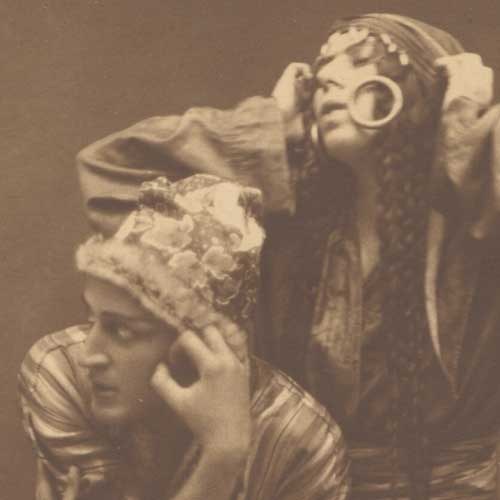
A sepia-toned photograph captures two figures in elaborately decorated costume, positioned in an intimate, staged arrangement. The figure in the foreground sits or reclines, wearing a draped garment and an ornate turban or headdress, gazing downward in a contemplative pose. Behind and above, a second figure leans in from the upper right, wearing similar rich drapery and a large circular earring, with an arm extended in a gesture of attention or affection. Both wear costume jewelry and textiles suggesting orientalist or exotic theatrical dress. The composition is tightly framed against a neutral studio background, emphasizing the figures' bodies and the careful arrangement of fabric. The lighting is soft and directional, typical of early 20th-century studio photography, with attention paid to the play of light across the draped materials and the sculptural quality of the posed bodies.
The dancing
Both figures are in sustained, statuary-like poses rather than caught mid-movement. The lower figure's body is reclined or collapsed, with limbs arranged expressively; the upper figure bends at the torso with arm extended in a gesture of solicitation or consolation. Neither figure appears weightless or in flight; the emphasis is on the emotional tableau and the arrangement of the costumed body in space. The relationship between the two is asymmetrical and hierarchical—one attending, one attended to—suggesting a dramatic or narrative moment rather than a social dance interaction.
The dance depicted
This appears to be a costume study or promotional photograph for an orientalist-themed theatrical production, most likely from a Ballets Russes work of the 1909-1920 period. The catalogue attributes it to 'Ballets Russes de Serge Diaghilev,' though the photograph itself is undated and uncredited. The pose, costume vocabulary, and photographic technique are consistent with rehearsal or costume documentation for early Diaghilev productions, which frequently drew on non-European aesthetic vocabularies and employed studio photography as part of their publicity apparatus. However, the image does not depict active dancing; it is a posed character study, likely representing a scene or moment from a narrative ballet rather than a technique or movement vocabulary that can be identified from the visible body mechanics.
How it was made
This is a photograph, most likely a gelatin silver print or platinum print, produced in a commercial studio with artificial lighting. The photograph exhibits the soft focus and tonal subtlety characteristic of early 20th-century theatrical and portrait photography, where diffused lighting and careful toning were used to achieve dramatic effect and to complement the costume and subject matter. Such photographs served dual purposes: as documentation of costume and staging for archival and production purposes, and as promotional images for distribution to press and patrons. The sepia or warm toning visible here was often applied in printing or tinting to enhance the 'exotic' or 'historical' character of orientalist subjects.
About this work
This is a studio photograph of two costumed performers in an elaborately staged pose, attributed to the Ballets Russes of Serge Diaghilev and dated to 1909. The photograph documents a moment of dramatic interaction between two figures dressed in orientalist theatrical costume, arranged in a tightly composed studio composition that emphasizes sculptural form and emotional relationship over the depiction of movement. The image is evidence of how early 20th-century dance companies, particularly Diaghilev's ensemble, used studio photography to create a visual record of costume, character, and dramatic staging, and to circulate images of their productions through print media and promotional channels.
The work belongs in a gallery of dance in art because it shows how dance and theatre were documented, promoted, and imagined in the early modernist period. Though the figures are not actively dancing, the photograph is an artifact of dance production—a by-product of the process of creating and publicizing a theatrical work. It reveals the orientalist aesthetics, the emphasis on costume and design, and the use of photography as a tool of avant-garde theatre that characterized the Diaghilev company's innovative approach to dance and spectacle.
How to look at it
This photograph is not a candid capture of dancing; it is a carefully composed tableau vivant that asks the viewer to imagine the character, emotion, and narrative context of the two figures. Attend to the asymmetry of the pose—the way one figure is elevated and bending inward, the other reclined and receptive—and how the fabric of their costumes creates flowing, voluptuous forms that suggest both weightlessness and sensual presence. Note the jewelry and details of dress: the headdresses, earrings, and draped textiles are arranged to create a layered, exotic visual effect. The photograph is an exercise in creating 'the look' of the oriental character through costume, pose, and toning; the dance historian should ask what movement vocabulary, if any, this costume and pose were designed to support.
The period
In 1909, when this photograph is dated, Diaghilev's Ballets Russes had just premiered its first season in Paris (May 1909) to extraordinary acclaim. The company's aesthetic was built on a fusion of Russian imperial ballet technique with avant-garde visual design, and a deliberate embrace of non-European themes and aesthetics. Works such as Cléopâtre, Schéhérazade, and Le Spectre de la rose established the company's signature blend of orientalism, modernist design, and narrative spectacle. Orientalist costume and subject matter were not incidental to these productions; they were central to their appeal and their artistic vision. Studio photography was a key medium for documenting and promoting this work, reaching audiences in Europe and beyond who would never see the live performances. The soft focus and theatrical lighting of such photographs complemented the dreamlike, exotic quality of the productions themselves.
Where it lives
This photograph is held in the Library of Congress Prints & Photographs collection, catalogued as a work associated with the Ballets Russes de Serge Diaghilev, 1909. The catalogue record is minimal, providing only title, date, and collection information; the artist/photographer is not recorded, and no accession number or publication history is provided in the record consulted.
Questions about this work
Is this a photograph of an actual performance, or a studio study?
This is a studio photograph, composed in a commercial theatre or portrait photography studio with artificial lighting and a neutral background. It is a costume study or character documentation rather than a performance photograph. Such photographs were created to document design, costume, and character for archival purposes and to serve as promotional images for the company.
How do I know this is a Ballets Russes production?
The catalogue record attributes it to 'Ballets Russes de Serge Diaghilev' and dates it to 1909, the year of the company's Paris debut. The costume vocabulary, orientalist theme, and photographic style are all consistent with the company's known aesthetic and promotional practices. However, the specific production, choreography, and performers are not identified in the available record.
What does orientalism have to do with Diaghilev's dance?
Orientalism—the European aesthetic and imaginative engagement with non-European, particularly Islamic and Middle Eastern and Asian, cultures—was central to the Ballets Russes' artistic vision and commercial appeal. Diaghilev and his collaborators deliberately embraced exotic and non-Western subject matter, costume, and visual design as part of a modernist strategy to challenge the conventions of academic ballet and to create spectacular, visually rich theatrical experiences.
More dance artwork





