49 works in this view — arrow keys or swipe to move between them.
Dance in Art
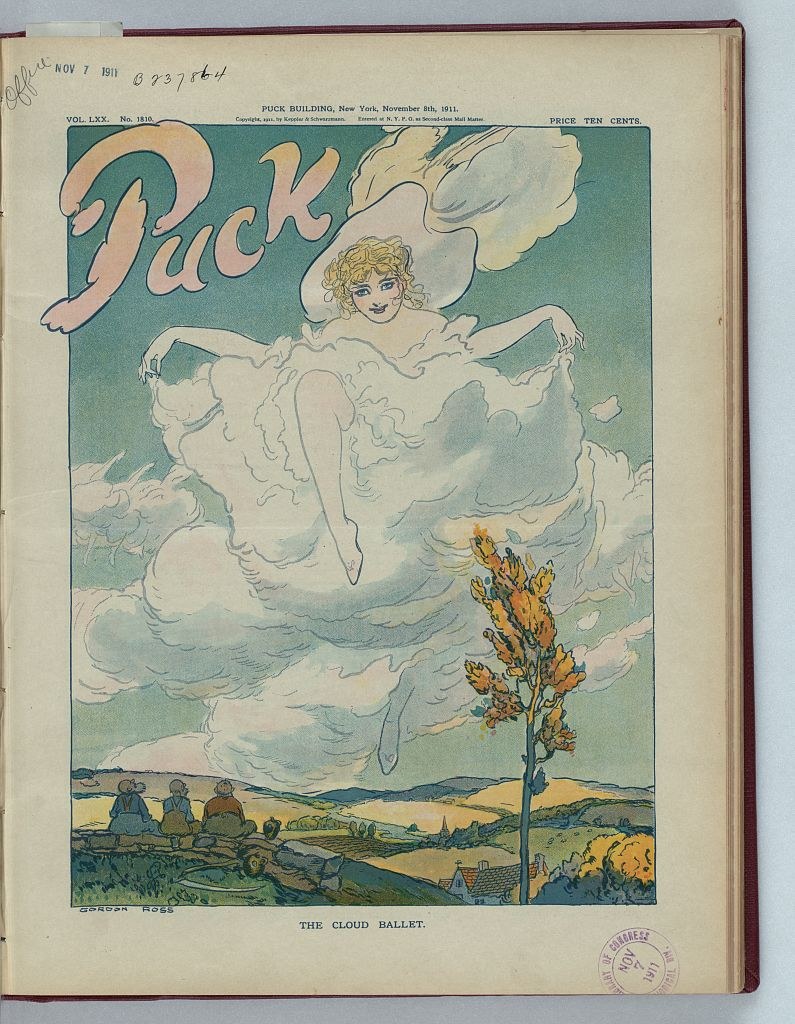
The cloud ballet
Unknown artist
- Collection:
- Prints & Photographs
- Source:
- Library of Congress
- Rights:
- Rights vary by item — check the source record before reusing this image. Source record ↗
- Recorded as:
- Library of Congress — no known restrictions (verify per item)
This work documents how dance was imagined and sold to the American public in the early 20th century—not as technique or entertainment, but as an ideal, a metaphor for natural grace and feminine liberation. It shows the degree to which Romantic and Symbolist ideas about dance had penetrated mass-market visual culture by 1911. For historians of dance imagery, it is evidence of dance's central role in the visual vocabulary of modernity.
What you are looking at
A woman's figure materializes from billowing clouds in a stylized landscape, her body emerging from and dissolving into vaporous forms. She is positioned in the upper half of the composition, her blonde curled hair and pale limbs contrasting sharply against the soft greens and grays of the clouds that swirl around her torso and legs. Below, a rural landscape unfolds in autumn tones: a lone tree with golden foliage stands in the middle distance, small figures sit in the foreground on the left, and a patchwork of fields and distant hills stretch across the horizon. The overall effect is dreamlike and allegorical—the woman is less a solid figure than a manifestation of the weather itself, her dance inseparable from the natural world.
The dancing
The woman's body is arched and graceful, with one leg extended and arms spread wide in a gesture of joy or abandon. Her posture suggests weightlessness and freedom, as if she floats rather than stands. The proportions are elongated and stylized rather than anatomically precise, which emphasizes the ethereal quality. There is only one figure—the cloud-woman—though the composition includes spectators or pastoral figures in the distant landscape.
The dance depicted
This is not a depiction of literal choreography but rather an allegorical representation of dance as a natural and atmospheric phenomenon. The title, *The Cloud Ballet*, invites us to read the swirling clouds themselves as the dancers, with the woman's body as their momentary crystallization or symbol. This reflects early 20th-century Romantic and Symbolist attitudes toward dance as transcendent, non-narrative, and connected to nature and music rather than to social or technical convention. No specific dance style is performed; instead, the image embodies the idea of dance as a manifestation of natural forces.
How it was made
This is a color lithograph, a process that allowed for the soft gradations of tone, the fluid blending of colors, and the delicate line work visible here. The artist has used the inherent qualities of lithography—its capacity for both bold linear design and subtle tonal transitions—to create the atmospheric effect of clouds. The technique was particularly suited to decorative and illustrative work, which this clearly is, as a magazine cover for *Puck*, a major American humor and satire publication. Lithography's reproducibility meant this image circulated widely among readers of popular publications.
About this work
This is a *Puck* magazine cover from November 1911, rendered as a color lithograph. It is a work of commercial illustration and graphic design rather than fine art, yet it is sophisticated in its composition and conceptual approach. The image presents dance not as a social or technical practice but as an ethereal, Romantic ideal—dance as the visible expression of natural forces. The work sits at the intersection of popular culture, advertising, and Symbolist aesthetics, reflecting the early 20th-century fascination with dance as a subject that could convey ideas about freedom, nature, femininity, and transcendence. It is a product of the Jazz Age's visual culture and the era's investment in dance as a modern symbol.
How to look at it
Attend to the way the artist has dissolved the boundary between the dancer's body and the clouds: the woman is not *in* the clouds but *of* them, her flesh and the vapor nearly continuous. The composition pulls the eye from the ethereal upper register down to the grounded rural landscape, creating a sense of descent from dream to reality. Notice the artist's choice to make the woman's face serene and eyes closed, emphasizing internal experience rather than external performance. The color palette—soft greens, grays, creams, and the warm gold of the autumn tree—creates a mood rather than depicting a specific moment or place.
The artist
The artist is not identified in the catalogue record. The style suggests a trained illustrator working in the Art Nouveau or transitional Art Deco tradition, fluent in lithographic technique and in the decorative conventions of American magazine design in the early 20th century. The signature on the work is not clearly legible in the image.
The period
In 1911, dance was undergoing a radical transformation in both Europe and America. Isadora Duncan had spent the previous two decades reimagining ballet as an expressive, naturalistic form rooted in classical antiquity. In Russia, Sergei Diaghilev's Ballets Russes, founded in 1909, was introducing avant-garde choreography and design to European audiences. The modern dance movement was emerging. At the same time, in popular and commercial culture—in magazines, theater posters, and decorative arts—dance was being represented as a symbol of modernity, nature, youth, and female freedom. This cover reflects that popular cultural moment: dance as an idea rather than a technique, aligned with nature and emotion rather than with the strictures of classical ballet. The work also reflects the established tradition of dance as a subject for allegorical and poetic representation in visual art.
Where it lives
This is a reproduction from *Puck*, a weekly publication of humor, satire, and commentary issued from New York. The issue is dated November 8, 1911. The holding is Library of Congress, Prints & Photographs Online Catalog. As a magazine cover, it was produced for mass circulation and visual consumption by the general American public.
Questions about this work
Is this a real dance or a made-up one?
Neither, exactly. *The Cloud Ballet* is a poetic conceit—the artist is visualizing an imaginary dance of clouds and nature rather than depicting an actual choreographed work. It reflects the early 20th-century Romantic idea of dance as something transcendent and close to nature, rather than a specific technique. The image invites us to see natural phenomena (weather, atmosphere, landscape) as themselves a kind of dance.
Why is she emerging from clouds?
The clouds are the subject matter, not just the background. By merging the woman's body with cloud forms, the artist makes her a personification or embodiment of the atmosphere itself. This is a visual convention of Symbolist and Art Nouveau design, where human figures were often used to represent abstract ideas like air, water, fate, or in this case, the aesthetic ideal of dance as a natural force.
What was *Puck* magazine?
*Puck* was a major American weekly magazine founded in 1876, known for humor, satire, and commentary. It featured color lithograph covers and illustrations and was widely read by educated middle-class audiences. Publishing a dance-themed cover in *Puck* suggests that the subject had cultural currency and broad appeal among readers of popular magazines.
More dance artwork





