49 works in this view — arrow keys or swipe to move between them.
Dance in Art
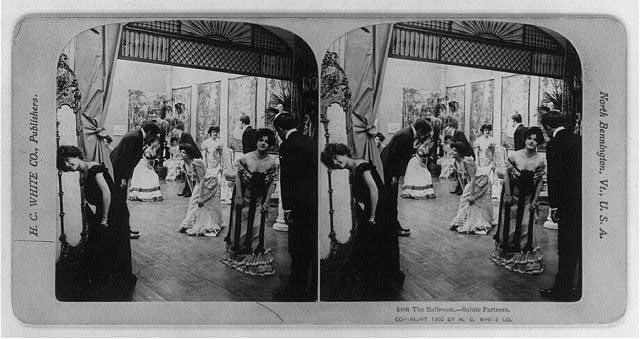
The ballroom, - salute partners
Unknown artist
- Collection:
- Prints & Photographs
- Source:
- Library of Congress
- Rights:
- Rights vary by item — check the source record before reusing this image. Source record ↗
- Recorded as:
- Library of Congress — no known restrictions (verify per item)
Stereoscopic photographs like this are among the richest visual records of everyday social life in the early 1900s, and this one directly documents ballroom culture at a moment when formal partner dancing was a central social practice for the middle and upper classes. The image shows the material conditions—the room, the dress, the etiquette—that made ballroom dancing possible, which is essential context for understanding how the dances themselves were performed and what they meant socially. For researchers studying the transition from 19th-century ballroom forms to early 20th-century styles like the foxtrot and tango, this photograph provides irreplaceable evidence of the setting and social code within which those innovations occurred.
What you are looking at
A stereoscopic photograph showing a crowded interior ballroom scene, likely from a formal evening social event. The space is decorated with potted plants and what appears to be draped fabric or decorative panels along the walls. Multiple couples are visible throughout the room, many in formal evening dress—men in dark suits and women in light-colored gowns with the characteristic silhouettes of the early 1900s. The composition captures a moment of greeting or social interaction, with couples and groups positioned at different depths within the room, creating a sense of layered activity. The lighting is bright and even, typical of early photographic flash technique, and the image is rendered in black and white with the characteristic detail and tonal range of turn-of-the-century photography.
The dancing
The couples visible in the frame stand in relatively upright, formal postures appropriate to ballroom protocol of the era. In the foreground, a couple near the left edge shows clear proximity and orientation toward each other in what appears to be a greeting or formal acknowledgment. Other couples throughout the space maintain similar formal stances and closed-proximity positioning. The women's skirts—full and voluminous—constrain lower-body movement and define the silhouette of the period. The men's postures are erect and controlled. No active dancing is visible; instead, the image captures the social choreography of arrival, introduction, and the interval between dances.
The dance depicted
This is a ballroom social scene rather than a documentation of dance in motion. The title 'The ballroom, - salute partners' explicitly references the formal etiquette of ballroom culture: the greeting and acknowledgment of dance partners before a dance begins. In the early 1900s, such partner-selection and formal salutation rituals were fundamental to ballroom social protocol. The photograph documents the social context in which the dances themselves—waltz, foxtrot, or similar period ballroom forms—would take place, but captures the moment before active dancing, not dancing itself. The work is valuable as a record of ballroom dress, setting, and social organization of the era.
How it was made
This is a stereoscopic photograph, a format designed for viewing through a stereoscope to create a three-dimensional effect. The double image visible here would have been mounted on a card and viewed through a hand-held optical device, producing the illusion of depth. Stereoscopic photographs were mass-produced and widely distributed in the late 19th and early 20th centuries, making them one of the most accessible forms of photography for the average household. The format was particularly popular for documentary and social scenes, as the 3D effect enhanced the sense of presence and participation. The technical quality—sharp focus, good exposure, fine detail—indicates professional production, likely by one of the major stereograph publishing houses active in 1902.
About this work
This is a stereoscopic photograph of a formal ballroom social gathering from 1902, capturing the moment when arriving couples greet their dance partners before the dancing begins. The image documents not the dance itself but the ritual and social context that framed ballroom culture in the Edwardian era: the dress codes, the interior settings, the formal comportment, and the protocol of partner acknowledgment. As a stereograph, it was one of thousands of such images produced for home viewing, making it a window into how early 20th-century audiences experienced and understood ballroom society.
The work belongs in a dance archive not as a record of choreography or technique, but as evidence of the social and material world that made ballroom dancing possible. The photograph shows us the architecture of the ballroom, the fashion that enabled and constrained movement, the gender roles embedded in partner selection, and the formal rituals that preceded the actual dances. For historians of dance, fashion, and social practice, it is documentary testimony to how ballroom culture was organized and experienced.
How to look at it
Look first at the density and arrangement of figures in the space: this is a crowded, organized social scene, not a spontaneous or intimate moment. Notice the formality of posture and dress—the uprightness, the distance maintained between men and women except in partnered pairs, the uniformity of silhouettes. Pay attention to the architectural setting: the potted plants, the decorative panels, and the bright, even lighting all speak to intentional curation of the ballroom as a social stage. The stereoscopic format, with its doubled image, was designed to be viewed through an optical device; understanding that this is a mass-produced image for home consumption changes how we read it—it is not a candid moment, but a carefully composed and commercially manufactured representation of ballroom life.
The period
In 1902, ballroom dancing was at a moment of transition. The Victorian ballroom traditions—the waltz, the quadrille, the polka—still dominated formal social dancing, but new dances from the Americas, particularly the foxtrot and the tango, were beginning to circulate among cosmopolitan urban dancers. Ballroom culture was organized around strict codes of dress, deportment, and gender roles; the formal salute or acknowledgment shown here was an essential ritual. Stereoscopic photography, at its commercial peak in the early 1900s, was the dominant medium for distributing images of social life to middle-class homes. Publishers competed to produce timely, fashionable scenes of urban and leisure life, and ballroom scenes were popular subjects because they combined fashion interest, social aspiration, and exotic appeal.
Where it lives
This is a stereoscopic photograph held in the Prints & Photographs collection at the Library of Congress. Stereographs were typically published and distributed by commercial firms; the Library's collection includes thousands of such images from the late 19th and early 20th centuries, many of them now undated or with the photographer and publisher unknown.
Dance in this work
Questions about this work
Is anyone actually dancing in this photograph?
No. The title indicates this captures the moment of greeting and salutation before dancing begins. The couples are standing in formal postures, properly spaced and dressed for dancing, but the photograph freezes the social ritual that preceded the actual dances. This makes it valuable evidence of ballroom etiquette and social protocol, even though no active dance movement is visible.
What would happen next after this 'salute'?
Once partners had acknowledged each other formally, they would take a closed hold—man's right hand on the woman's left shoulder blade, his left hand holding her right—and begin one of the standard ballroom dances: a waltz, foxtrot, or similar form. The formality of the salute was mandatory; one could not simply begin dancing without this ritual acknowledgment.
Why is it a double image?
This is a stereoscopic photograph, designed to be viewed through a handheld stereoscope, a device with two lenses that would present each image to one eye, creating the illusion of three-dimensional depth. Stereoscopes were common household items in the early 1900s, and stereographs were mass-produced and affordable, making them one of the most popular ways for ordinary people to see photographs of distant places and events.
What does this tell us about ballroom dancing in 1902?
The photograph documents the dress codes (formal evening wear for both men and women), the social setting (an interior, decorated space), the gender dynamics (men and women in separate social positions until formally paired), and the importance of etiquette and ritual. It also shows us that ballroom culture was prosperous and fashionable enough to attract the attention of commercial photographers, indicating its centrality to middle- and upper-class social life.
More dance artwork





