49 works in this view — arrow keys or swipe to move between them.
Dance in Art
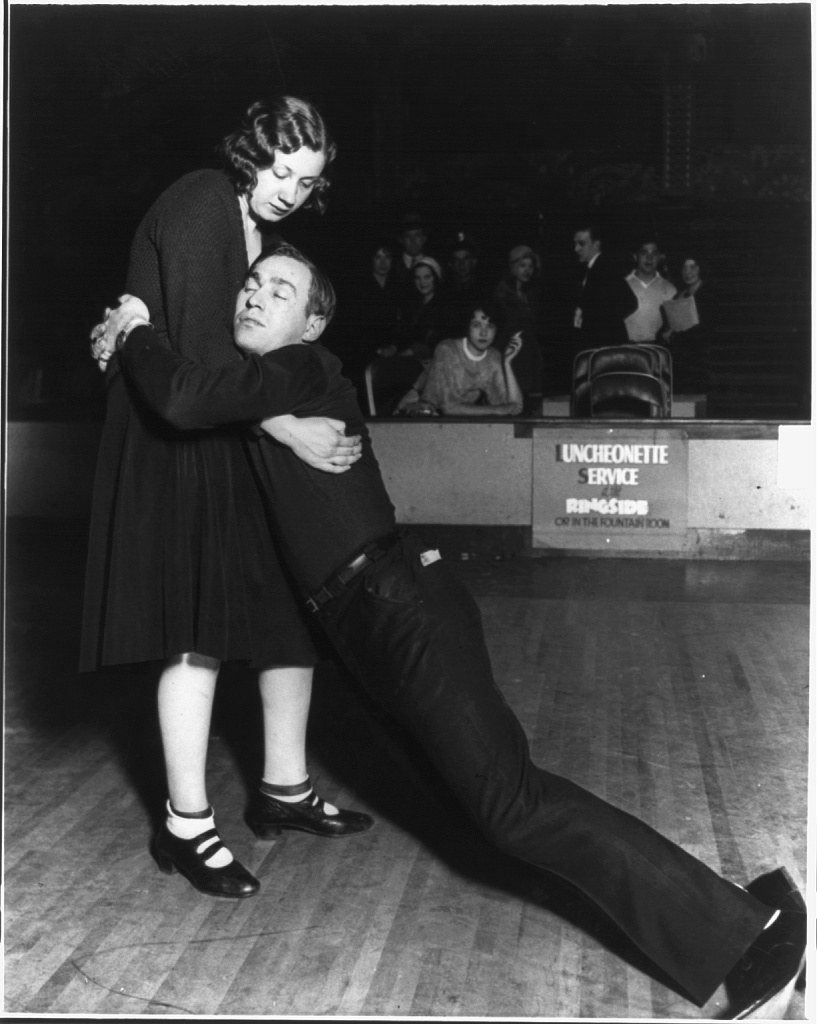
Marathon dancers still going
Unknown artist
- Collection:
- Prints & Photographs
- Source:
- Library of Congress
- Rights:
- Rights vary by item — check the source record before reusing this image. Source record ↗
- Recorded as:
- Library of Congress — no known restrictions (verify per item)
Marathon dances represent a significant but often-overlooked chapter in American dance history, revealing how the body was commodified and pushed to extremes in public competition during the Depression era. The photograph is evidence that matters to anyone studying dance as embodied labor, the history of endurance performance, and the darker economics of popular entertainment. It also provides insight into how dance competitions functioned before modern judging standards, and how spectacle—rather than artistry—drove mass participation in dance.
What you are looking at
A black-and-white photograph captures the moment during a marathon dance competition, showing a couple in the foreground with the male dancer collapsed or severely fatigued against a female partner who supports him. The setting is an indoor venue with a wooden dance floor; a sign reading "UNCHEONETTE SERVICE" is visible on what appears to be a booth or stand. The background shows spectators seated and standing, watching the event unfold. The lighting is stark and theatrical, emphasizing the exhaustion and drama of the moment. The couple's dark formal attire—suit and dress—contrasts with their physical state, suggesting the incongruity between ballroom dress codes and the brutal endurance test they are undergoing.
The dancing
The male dancer's body is bent sharply at the waist, his weight sagging downward and transferred almost entirely to his female partner, who stands more upright and grips his torso to keep him vertical. His posture shows complete muscular collapse; she maintains a dance frame with her arm around him, but her own strain is evident in the tenseness of her shoulders. Their feet remain in contact with the floor, and the positioning suggests they are moving or attempting to move continuously despite his apparent inability to support himself. The dynamic is one of pure endurance rather than choreographic partnering.
The dance depicted
This is a marathon dance, a popular endurance competition of the 1920s–1930s in which couples danced continuously for days or weeks with only brief rest periods, competing for prize money. The competitors were required to maintain near-constant motion to remain in the contest. The photograph documents the human cost of the competition—the male dancer is visibly at the breaking point of physical exhaustion, yet must continue or forfeit. Marathon dances were not ballroom dancing in the artistic sense but a commercialized spectacle of human suffering, drawing crowds willing to pay to watch dancers deteriorate over time.
How it was made
This is a black-and-white photograph, probably gelatin silver print or newspaper halftone, dated 1930. The documentary nature of the medium—its directness and immediacy—is crucial to the image's impact. Photography captures a moment that cannot be staged or repeated, giving the viewer the sense of witnessing an actual event rather than a posed or choreographed scene. The sharp focus and dramatic lighting typical of newspaper photography of the era suggest this was taken for press coverage, meaning it was intended for rapid circulation and public consumption.
About this work
This photograph documents a marathon dance competition of 1930, capturing the moment of physical collapse at what appears to be a mid-contest point. Marathon dances were a widespread commercial entertainment in Depression-era America, drawing both participants desperate for prize money and spectators drawn to the spectacle of human endurance pushed to its limits. The image serves as both a dance document and a historical record of a now-extinct form of popular entertainment—one that raises questions about labor, exploitation, and the boundaries between sport and spectacle. It belongs in any serious history of twentieth-century American dance because it shows how dance functioned outside the concert hall and ballet stage: as a brutal test of the body's capacity to move under economic and social pressure.
How to look at it
Look first at the male dancer's posture: his spine curves downward in a way that no ballroom frame permits, showing how far beyond any choreographic or athletic intention his body has moved. Then observe his partner's face and shoulders—note the effort required to keep him upright and moving. The photograph freezes not the peak moment of a choreographed phrase but the nadir of human endurance, capturing something closer to collapse than to dance. The spectators visible in the background are key too: they are watching not an aesthetic performance but a test of human limits, and the photograph was made and circulated precisely because that spectacle held public appeal.
The period
Marathon dances flourished in the United States during the 1920s and 1930s, peaking during the Great Depression when prize money offered desperate incentive to dancers and spectators sought affordable entertainment. The competitions were loosely regulated and often brutal; dancers faced rules requiring continuous motion, with rest periods of only minutes per hour. Some competitions lasted weeks or months. The form was eventually regulated out of existence in many states by the late 1930s, partly due to medical concern and partly due to growing recognition of the cruelty involved. The photograph dates to 1930, near the height of the marathon craze. In the broader context of 1930s American culture, marathon dances sat alongside other endurance spectacles (dance marathons, walkathons, flagpole sitters) that reflected both Depression-era desperation and the public's appetite for sensational entertainment.
Where it lives
The photograph is held in the Library of Congress Prints & Photographs Online Catalog (LOC). It is undated by the catalogue (marked 1930 here based on marathon dance history), lacks artist and photographer attribution, and represents the kind of documentary news photography that was widely circulated in newspapers and magazines of the era.
Questions about this work
What is a marathon dance?
Marathon dances were endurance competitions popular in 1920s–1930s America, in which couples danced continuously (with minimal rest) to win prize money. Dancers had to keep moving or be eliminated; competitions sometimes lasted weeks. They were regulated out of existence by the late 1930s due to medical and ethical concerns.
Why do marathon dances matter to dance history?
Marathon dances reveal how dance functioned outside concert and ballroom contexts—as commercialized spectacle and as labor under economic duress. They show the body's capacity for endurance, the economics of Depression-era entertainment, and the exploitation of dancers for profit and public amusement.
Is this an artistic dance form?
No. Marathon dances were not choreographed or judged on aesthetic grounds. They were endurance competitions that used dance as the vehicle for testing human limits under public observation. The 'dance' itself became almost incidental to the spectacle of exhaustion.
What does this photograph tell us that a written account wouldn't?
The photograph captures the visceral reality of the male dancer's physical state—the angle of his spine, the strain in his partner's arms, the raw collapse of the human body under sustained movement. No description conveys the visual shock of witnessing this moment as the photograph does.
More dance artwork





