49 works in this view — arrow keys or swipe to move between them.
Dance in Art
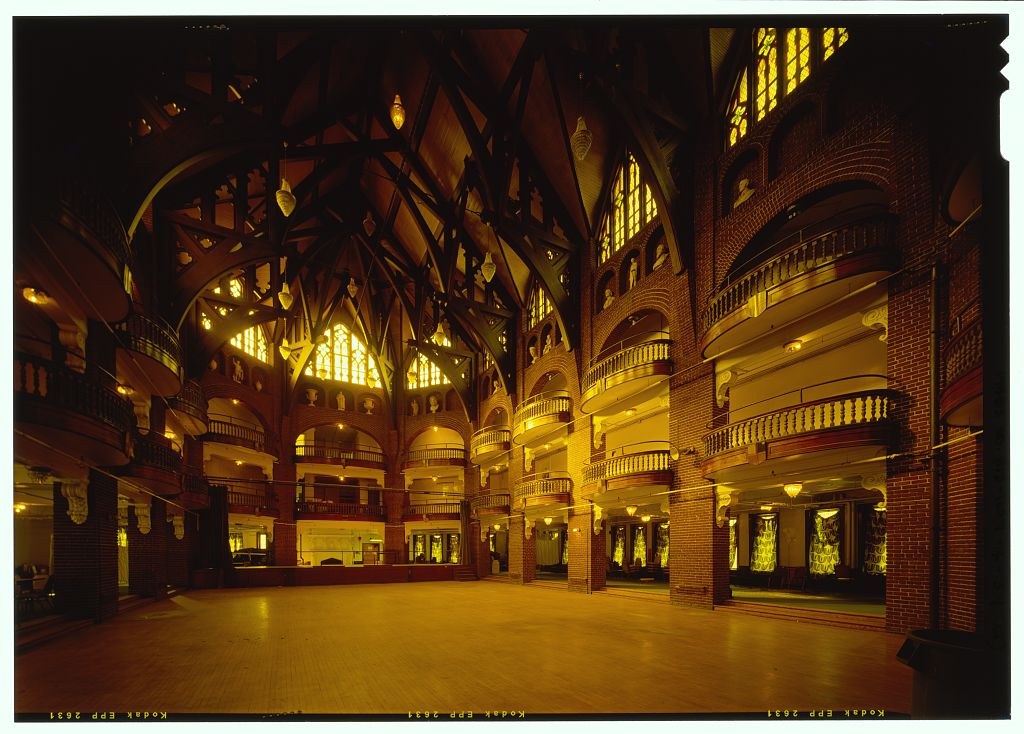
National Park Seminary, Ballroom, Linden Lane, Silver Spring, Montgomery County, MD
Unknown artist
- Collection:
- Prints & Photographs
- Source:
- Library of Congress
- Rights:
- Rights vary by item — check the source record before reusing this image. Source record ↗
- Recorded as:
- Library of Congress — no known restrictions (verify per item)
For historians and dancers, this image is essential documentation of a real ballroom where American social dances were performed in their original context. It shows how architectural space, materials, and design—the polished floor, the high ceilings, the multiple levels—shaped the ballroom dancing experience and what dancers expected when they entered such a venue.
What you are looking at
A photograph of an ornate ballroom interior, shot at night with artificial lighting that floods the space in warm golden tones. The room is vast and empty of dancers, revealing its architectural grandeur: soaring timber-frame ceiling with exposed dark beams creating dramatic triangular patterns, tall arched windows with multiple panes, ornamental brick walls with decorative balustrades and curved balconies at multiple levels, and a polished wooden floor that reflects the overhead lighting. The lighting design itself—carefully positioned to highlight the vaulted ceiling and architectural details—transforms the ballroom into a theatrical space. The photograph documents the venue itself as a dance environment rather than capturing dance in progress.
The dancing
No figures or dancers are present in this image. The photograph is a record of the empty ballroom architecture and spatial dimensions rather than a representation of embodied dance or movement.
The dance depicted
This is not a depiction of dance in progress but rather an architectural document of a ballroom built to host social dances. The National Park Seminary Ballroom was a substantial American dance venue from the early twentieth century. The space's design—with its high ceilings, polished floor, balconies for observers, and capacity for couples in closed and open holds—indicates its function as a venue for ballroom styles common to the era: waltzes, foxtrots, and the full range of early American smooth and rhythm dances. The photograph preserves the physical context in which dance occurred, not the dance itself.
How it was made
This is a photograph, likely a professional or documentary photograph given its careful lighting and composition. The warm color cast suggests either color film or digital processing, though the record does not specify the photographic process. The night-time interior lighting and the clarity of detail across such a large space suggest either long exposure with available lighting or supplementary flash. As a photograph rather than a drawing or painting, it functioned as an architectural record—valuable for preservation, historical documentation, and perhaps promotional purposes—and would have circulated among preservationists, historians, and researchers rather than as an artwork for public exhibition.
About this work
This is an architectural photograph of the National Park Seminary Ballroom in Silver Spring, Maryland—a now-historic venue built in the early twentieth century to host social ballroom dancing. The image documents the spatial and visual environment in which American social dances were performed, capturing the scale, materials, and lighting design that shaped the dancer's experience. Rather than showing dancers in motion, the photograph preserves the ballroom as a historical object: a built structure that embodied the era's ideals of refined social dance and commercial leisure.
How to look at it
Attend to the spatial dimensions: the height of the ceiling and the distance across the floor define the scale at which dancers would have moved. The multiple levels of balconies indicate that spectatorship and social hierarchy shaped the space—some people danced while others watched. The polished floor is visible and crucial, as it directly affects how social ballroom dancers could glide and turn. The symmetry and formality of the architecture—the repeated arches, the regular window pattern—reflect the structured, rule-based nature of the ballroom dances performed within it.
The period
The National Park Seminary was a historic resort community near Washington, D.C., developed in the early 1900s as a recreational and educational facility. The ballroom represents the American Gilded Age and Progressive Era enthusiasm for purpose-built social dance venues, when ballroom dancing was a central form of middle and upper-class social life. The photograph itself likely dates from the late twentieth century—after the venue had closed—as part of a preservation, documentation, or adaptive reuse project, since the Library of Congress holds it as an architectural record.
Where it lives
This photograph is held by the Library of Congress Prints & Photographs Collection. It is catalogued as an architectural document of the National Park Seminary in Montgomery County, Maryland, and entered the LOC collection through its ongoing efforts to document American historic buildings and sites.
Questions about this work
Is this a painting or a photograph?
This is a photograph—likely a professional architectural photograph. The record does not specify the photographic process, but the clarity of detail, controlled lighting, and composition indicate intentional documentation rather than casual snapshot photography.
Why is there no one dancing in this image?
This photograph documents the ballroom as a historic architectural space rather than capturing a dance event. It preserves the venue itself—its scale, materials, and design—which is the context in which social ballroom dancing occurred. Such architectural photographs were typically taken after the venue's active use, as part of preservation or historical documentation.
What dances would have been performed in this ballroom?
The ballroom's design—polished floor, high ceilings, open floor plan—is consistent with early twentieth-century American social ballroom dances: waltzes, foxtrots, and the full range of Gilded Age and Progressive Era smooth and rhythm ballroom styles. The venue's architecture was purpose-built to accommodate these partner dances and their spatial and movement requirements.
What was the National Park Seminary?
The National Park Seminary was a resort and educational community developed near Washington, D.C., in the early 1900s. It included hotel facilities, classrooms, and recreational spaces—including this grand ballroom—designed to serve middle and upper-class visitors seeking refined social and cultural activities. The complex is now largely historic.
More dance artwork





