49 works in this view — arrow keys or swipe to move between them.
Dance in Art
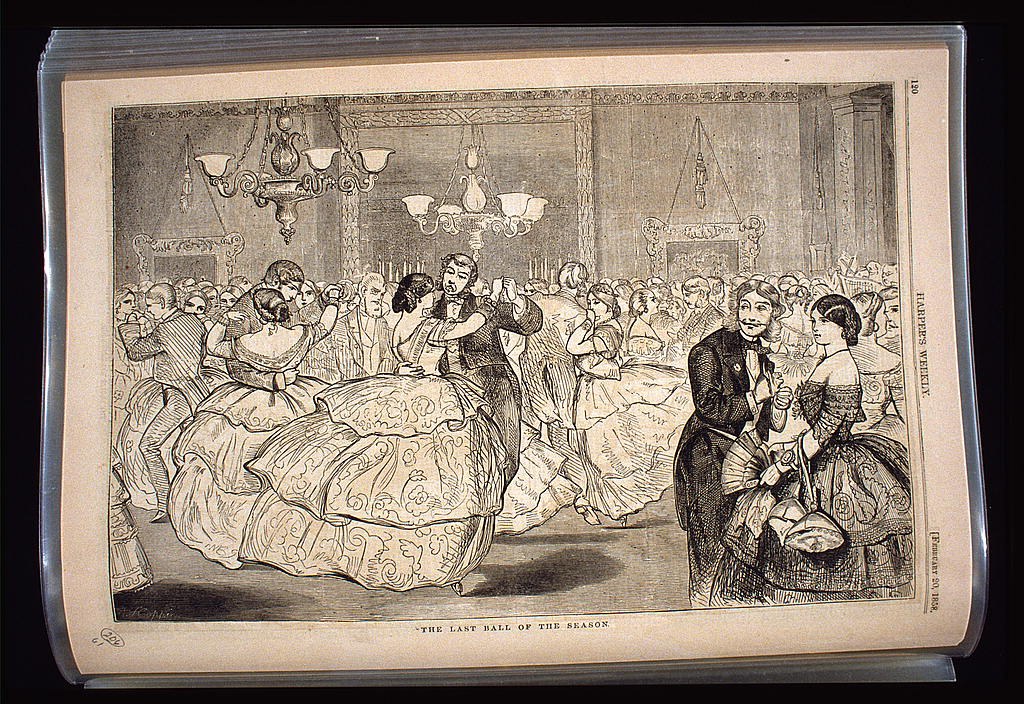
The last ball of the season
Unknown artist
- Collection:
- Prints & Photographs
- Source:
- Library of Congress
- Rights:
- Rights vary by item — check the source record before reusing this image. Source record ↗
- Recorded as:
- Library of Congress — no known restrictions (verify per item)
This engraving is evidence of how ballroom dancing functioned as a visual marker of social status and refinement in the mid-Victorian era. It shows not just what the waltz looked like in motion, but how it was framed, interpreted, and circulated through mass media as a symbol of proper conduct. For historians of dance and material culture, it documents the relationship between fashion, architecture, and movement in a vanished social world.
What you are looking at
A crowded ballroom at the height of an evening's festivity, captured in a wood engraving with dense cross-hatching that conveys lamplight and atmosphere. The room is packed with formally dressed couples and onlookers; in the foreground, women in elaborate skirts with pronounced crinolines dominate the composition, their voluminous skirts rendered with intricate parallel lines to suggest fabric and movement. The men wear dark evening coats and are distributed throughout the scene—some dancing, some conversing, some observing from the margins. Three large chandeliers hang from a coffered ceiling, and tall paneled walls frame the space. The artist has chosen a moment of high activity: multiple couples are in motion simultaneously, creating a sense of synchronized yet individual participation. The title identifies this as the final ball of the social season, and the composition conveys both the glamour and the slight fatigue of an event near its conclusion.
The dancing
The dancers are depicted in upright, formal posture characteristic of mid-19th-century ballroom propriety. Most visible couples maintain closed position with the man's right hand on the woman's back and her left hand on his shoulder, though the engraver has softened the precision of holds in favor of capturing the sweep of movement and the drama of skirts in motion. Arms are extended but not rigidly so; there is a sense of gliding rather than vigorous stepping. The women's bodies incline slightly into their partners, and their skirts swirl outward from the centripetal motion of turning. A few figures on the periphery stand in conversation, framing the dancers and emphasizing the social nature of the occasion. The density of figures and the overlapping of forms suggests crowding and liveliness.
The dance depicted
This is almost certainly a waltz or quadrille, the two dominant ballroom dances of the 1850s in polite European and American society. The upright carriage, the closed position, the emphasis on circular motion (evident in the swirl of the women's skirts), and the formal setting all point to a waltz. The context of 'the last ball of the season' suggests this was a ballroom dance at an elite social gathering—precisely the milieu in which the waltz had become the central social dance of the mid-Victorian era. The clothing, the setting, and the compositional choices all reflect the conventions of fashionable ballroom dancing as a marker of social status and refinement.
How it was made
This is a wood engraving, a relief printing technique that allowed for fine detail and mass reproduction. The engraver has used close parallel hatching to model form and suggest the gleam of lamplight on fabric and faces, and the delicacy of the line work conveys both the ornate furnishings of the ballroom and the textures of silk and satin. The medium's capacity for tonal subtlety through line density makes it ideal for rendering the atmospheric crowding of the scene. Wood engravings like this were typically published in newspapers, illustrated journals, and books, making them accessible to a broad audience interested in society fashion and conduct.
About this work
This is a mid-19th-century social document rendered as high art, capturing the ballroom waltz or quadrille at the moment of its cultural dominance. The image records not merely the dance itself but the etiquette, dress, architecture, and gender dynamics of elite ballroom culture in the 1850s. The 'last ball of the season' was a conventional subject in period illustration, signaling both the glamour and the underlying melancholy of social cycles.
For dance historians, the engraving is valuable because it preserves the posture, spacing, and social arrangement of ballroom dancers at a moment before photography became the dominant medium. The artist's choices about which moment to freeze—mid-turn, with skirts splayed and bodies in motion—reveal how the waltz was understood and idealized by visual culture. The work belongs in a gallery about dance because it makes the invisible visible: the posture and propriety, the class markers, and the gendered choreography of an institution that shaped social life.
How to look at it
Attend to the moment the artist has chosen: the dancers are in motion, their bodies inclined into turns, their skirts caught mid-swirl. This is not a static parade but an image of dancing. Notice how the formal poses of the men contrast with the more elaborate visual display of the women's costumes—the engraver has lavished more linear detail on the skirts and fabrics than on the men's bodies. The crowding and overlapping of figures creates a sense of social density and animation. The architectural framing—the paneled walls, the chandeliers, the scale of the room—situates the dance within a specific social institution, not nature or myth.
The period
The 1850s were the apex of the waltz's prestige in European and American ballroom culture. The dance, which had faced moral opposition in earlier decades as supposedly licentious because of the closed position and physical proximity, had become the defining social dance of the respectable classes by mid-century. Illustrated newspapers and journals—the mass medium of the day—regularly featured ballroom scenes as markers of social news and fashion. The engraving of ballroom life served both documentary and aspirational functions: it recorded what fashionable people actually wore and did, and it idealized that world for a broader readership. The 'last ball of the season' was a stock theme in period illustration, evoking the social calendar of the urban elite and the bittersweet transition from winter entertainment to the summer dispersal of society.
Where it lives
Held in the Prints & Photographs Online Catalog at the Library of Congress. The work is catalogued as a print from 1858; the lack of attribution suggests it may have been a commercial or newspaper engraving rather than a gallery work.
Dance in this work
Questions about this work
What dance are they doing?
Almost certainly the waltz, the dominant ballroom dance of the 1850s. The closed position, the upright carriage, the emphasis on turning, and the formal ballroom setting all point to the waltz. The quadrille was also danced at balls of this period, and some couples in the background may be performing it, but the foreground action and the title's emphasis on a grand ball suggest the waltz as the primary spectacle.
How do we know this is the 1850s?
The women's fashions—the crinolines, the off-shoulder necklines, the voluminous skirts—are unmistakably mid-Victorian. The men's evening dress, the style of the chandeliers and wall paneling, and the engraving technique all corroborate a date of approximately 1850–1860.
Why is this the 'last' ball?
The social season in 19th-century cities was a winter phenomenon, ending in spring or early summer when society dispersed to country estates or seaside resorts. The 'last ball of the season' was a culturally significant event—a grand finale tinged with melancholy—and was a favorite subject for period newspapers and illustrated journals.
What can we learn about ballroom dancing from this image?
The image shows the waltz as a dance of formal, upright carriage and controlled turning, performed in a crowded but orderly social space. It documents the gendered spectacle of the dance—the emphasis on the woman's elaborate costume and the man's role as her partner and frame. It also reveals the social density and the visual pleasure of observing and being observed in ballroom culture.
More dance artwork





