49 works in this view — arrow keys or swipe to move between them.
Dance in Art
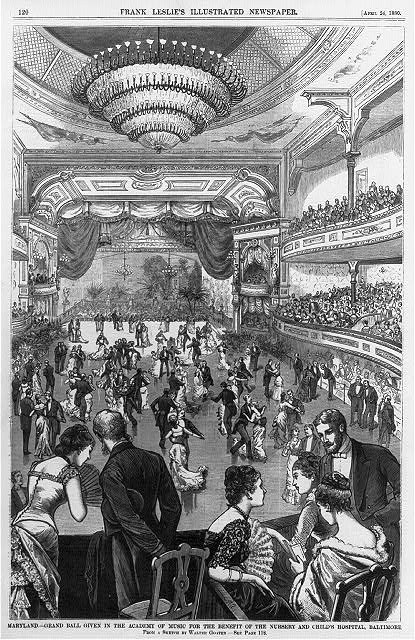
Maryland - Grand ball given in the Academy of Music for the benefit of the Nursery and Child's Hospital, Baltimore
Unknown artist
- Collection:
- Prints & Photographs
- Source:
- Library of Congress
- Rights:
- Rights vary by item — check the source record before reusing this image. Source record ↗
- Recorded as:
- Library of Congress — no known restrictions (verify per item)
For historians of American ballroom culture and Gilded Age society, this engraving documents the physical and social setting in which ballroom dancing took place, showing the scale of formal urban venues and the mixed-gender assemblies where such dancing happened. It also reveals what newspaper editors considered worth illustrating about such events—not the dance technique itself, but the spectacle of the crowd and the architectural frame, reflecting contemporary attitudes about the news value of high society.
What you are looking at
A grand ballroom in the Academy of Music in Baltimore during a charity ball, likely from the 1880s. The architectural frame dominates: a richly decorated ceiling with concentric ornamental rings converges to a chandelier of impressive scale, while draped curtains flank a stage or main focal point in the middle distance. The floor is crowded with hundreds of formally dressed figures—men in dark tailcoats and women in bustled gowns typical of the Gilded Age—standing, promenading, and gathering in clusters. The composition emphasizes the social spectacle of the occasion rather than active dancing; the crowd is distributed across the floor in groups and pairs, many apparently in conversation or movement between positions. The engraving captures the scale and architectural magnificence of the venue as much as the assembled company, with the ornate ceiling drawing the eye upward and then down through the crowd.
The dancing
The figures are rendered in the dense, compressed style of period newspaper wood engravings—individual bodies are suggested rather than fully detailed. Most are shown standing upright, some in pairs or small groups, few in closed dance positions. Many of the women's silhouettes show the pronounced bustles characteristic of 1880s evening dress; men are uniformly dark-suited. In the foreground right, a few couples appear to be in closer proximity suggesting possible dancing, but the prevailing gesture across the scene is one of social circulation—upright posture, movement through space, and gathering, rather than rhythmic partnered movement.
The dance depicted
This is a ballroom scene documenting a formal social charity event rather than depicting a specific dance style in action. The event was a grand ball held in Baltimore's Academy of Music to benefit the Nursery and Child's Hospital. While the title specifies a ball, the engraving does not show choreographed dance in progress but rather the social occasion of which dancing would have been a part. The dominant activity appears to be promenading, socializing, and the spectacle of assembly—the kind of mixed social activity that occurred at Gilded Age charity balls. If dance is occurring, it is dispersed and not emphasized; the focus is architectural and social rather than kinetic.
How it was made
This is a wood engraving, a relief printing technique that was the dominant method for newspaper and periodical illustration in the 1880s. The fine cross-hatching and tonal control visible in the ceiling and drapery are characteristic of skilled wood-engraving practice. The technique allowed rapid reproduction for weekly or daily publication, and the compressed composition and crowd density are typical of how engravers packed complex scenes into limited column widths. The source attribution to Frank Leslie's Illustrated Newspaper confirms it was made for mass circulation—this was a major American weekly news magazine, placing the work in the realm of topical reportage rather than artistic fine print.
About this work
This is a news engraving from Frank Leslie's Illustrated Newspaper documenting a high-society charity ball at Baltimore's Academy of Music in 1880. The image records not a specific dance style but the spectacle of a Gilded Age formal social occasion—the architecture, the crowd, the dress, and the social choreography of urban philanthropy. It belongs in a gallery of dance imagery because it captures the context in which ballroom dance occurred in this era: not as isolated technique but as one element of a larger social performance. The image is valuable precisely because it resists focusing on dancing itself; it shows us what mattered at such an event—the venue, the assembly, the fashionable dress, and the public nature of the occasion.
How to look at it
Study the architectural frame first—the ornate ceiling and the formal balance of the composition—then observe how the human figures are distributed and what their posture tells us. Notice that most figures are standing or in transit rather than in closed dance positions; the engraver has chosen to emphasize the social circulation and gathering rather than any moment of active movement. The few couples that appear closer together in the foreground right suggest dancing might be occurring, but it is subordinate to the larger spectacle. This choice reflects what the original audience—readers of a news magazine—was expected to find interesting: not technique, but status and scale.
The artist
The engraving is uncredited in the catalogue record. It was produced as one of the weekly illustrations for Frank Leslie's Illustrated Newspaper, the most widely circulated pictorial news magazine in America during the 1870s and 1880s. The work is typical of the publication's house style: crowded composition, skilled tonal work in the ceiling detail, and the standardized figure types used to depict large assemblies. Leslie's employed a team of staff engravers rather than publishing individual artists' names, so attribution to a specific engraver is difficult without additional research.
The period
In the 1880s, American ballroom dance was dominated by the Waltz (especially the Viennese Waltz), the Polka, the Galop, and the Quadrille—dances that had been established since mid-century. Formal balls in major cities were prestigious social events, often organized for charitable purposes and extensively covered by the illustrated press as markers of urban high society. The Gilded Age saw the rise of large public assembly spaces like Baltimore's Academy of Music (opened 1875), which made the formal ball accessible to a broader segment of the wealthy and socially ambitious. Simultaneously, illustrated newspapers were at the height of their influence before photographic reproduction became standard in the 1890s, making wood engravings like this the primary way Americans saw images of current events and social life.
Where it lives
The work is held in the Prints & Photographs collection of the Library of Congress, sourced from Frank Leslie's Illustrated Newspaper, a major American weekly illustrated publication (1855–1922). This was a mass-circulation periodical, making the engraving a product of journalistic rather than fine-art practice, and it would have been distributed to tens of thousands of subscribers.
Dance in this work
Questions about this work
Was this a real ball, or did the artist invent the scene?
It was a real event—a charity ball held at Baltimore's Academy of Music to benefit the Nursery and Child's Hospital. As a news illustration, the engraving was intended to document an actual social event. However, the engraver worked from a sketch or description rather than from life, so the specific positions and groupings of figures were partly reconstructed and arranged for compositional effect.
What dances would people have danced at a ball like this?
In 1880 Baltimore, the standard ballroom dances were the Waltz (especially the Viennese Waltz), the Polka, the Galop, and Quadrilles. These dances filled the evening in a prescribed order, alternating lively and stately forms. A formal charity ball typically lasted several hours and might include 12–20 dances.
Why doesn't the engraving show people actively dancing?
The engraver's focus is on the crowd and the occasion rather than the dance itself. This reflects both practical constraints—capturing a crowd in motion is difficult in an engraving—and editorial judgment about what made news. For contemporary readers, the prestige and scale of the event mattered more than seeing the dancers move.
How many people are shown?
Hundreds of figures are suggested through dense crowd rendering, though exact counting is difficult in the compressed style of wood engraving. The effect is one of substantial assembly—a major public event—rather than an intimate gathering.
More dance artwork





