49 works in this view — arrow keys or swipe to move between them.
Dance in Art
Tango tee
Unknown artist
- Collection:
- Prints & Photographs
- Source:
- Library of Congress
- Rights:
- Rights vary by item — check the source record before reusing this image. Source record ↗
- Recorded as:
- Library of Congress — no known restrictions (verify per item)
This work is a window into how tango was understood and consumed in early-20th-century America: not as a technique to be mastered, but as a visual style of intimacy that could be borrowed, parodied, and applied to other contexts. The fact that the joke works at all—that a courtship scene on a beach could evoke tango simply through proximity and posture—shows how completely the dance had entered the visual language of courtship and modernity within a decade of its arrival.
What you are looking at
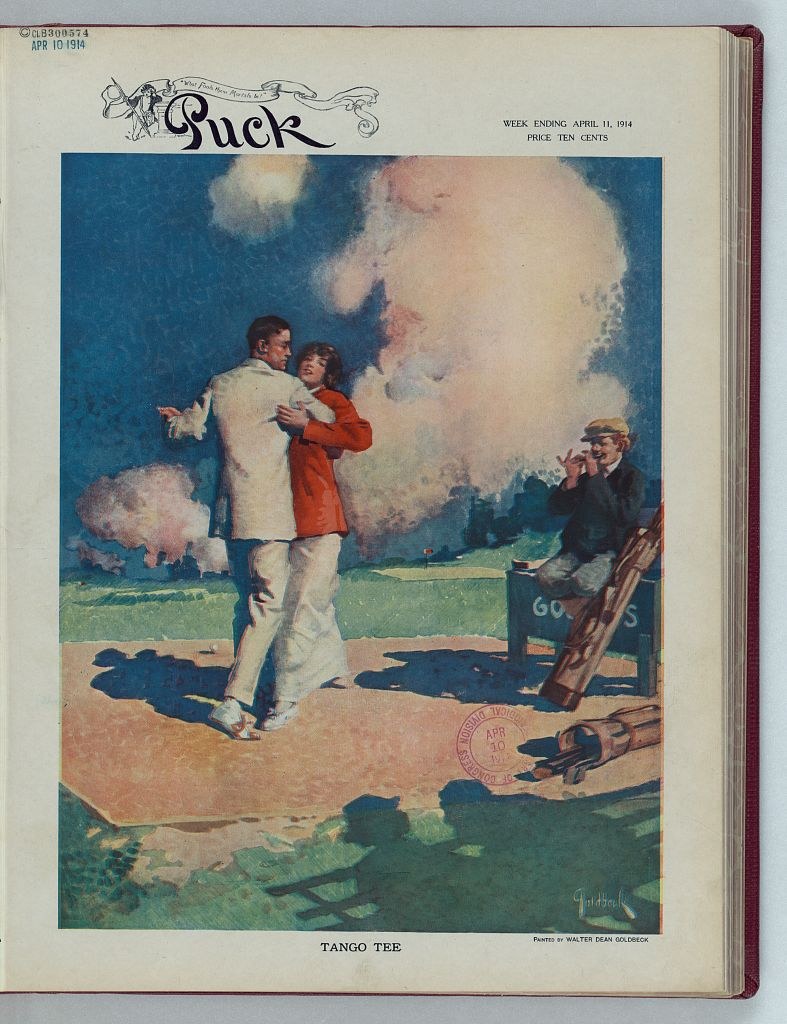
A man in a cream linen suit and a woman in a red coat stand together on a sandy beach, his arm around her shoulder as they gaze toward a dramatic seascape. Behind them, puffy white clouds billow above a blue-green horizon; in the middle distance, military fortifications or coastal defenses are visible. To the right, a man in dark clothes sits on a wooden crate or bench, smoking a pipe and observing the couple. The composition is divided horizontally—sand and beach in the foreground, sea and sky above—creating a sense of leisure and romance set against a backdrop of military readiness. The light is bright and clear, with strong shadows cast on the sand. The print is signed by the artist in the lower right.
The dancing
The couple are not in a dance hold but in an intimate, romantic embrace. The man's posture is upright and relaxed, his arm draped protectively around the woman's shoulders; she leans into him slightly, her body angled toward his. Neither figure shows the trained alignment or frame of ballroom dancers. The observer on the right is stationary, his body language detached and amused. There is no footwork visible, no technique of any kind—these are social figures, not dancers executing steps.
The dance depicted
This image does not depict dance. The title 'Tango Tee' is a pun: it refers to a golf tee on the beach, not to the tango, the Argentine ballroom dance. The couple's embrace mimics the closed hold of tango without being a dance moment—they are posed as if dancing, or as if the romantic closeness of tango has spilled into courtship and leisure. The work plays with the visual language of tango (proximity, intimacy, the frame) to create a humorous image about modern romance and social ritual rather than to document actual dance practice.
How it was made
This is a color lithograph or color print, as evidenced by the soft, atmospheric quality of the clouds, the smooth gradations of the blue sky, and the hand-tinted character of the foliage and costumes. The technique allowed for rapid commercial reproduction and wide circulation through magazines and prints. The signature and style are consistent with early-20th-century American magazine illustration, designed for a mass audience. The crisp linework and bold color fields are typical of chromolithography or offset color printing of the period.
About this work
This is a humorous illustration from a 1914 issue of *Puck*, a satirical American magazine. The 'Tango Tee' is a visual joke: a couple pose in tango-like closeness on a beach near a golf tee, collapsing romantic and sporting leisures into a single image. The work belongs in a dance archive not because it documents tango as a practice, but because it shows how tango—a dance that had only recently arrived in America and was controversial for its close proximity and sensuality—had become a cultural reference point for illustrating modern courtship and intimacy. The pun works only if the reader recognizes tango as a recognizable visual gesture, a way of being close. The image reveals how dance imagery functioned in popular media to signal modernity, romance, and social transgression.
How to look at it
The joke depends on visual recognition: the viewer must see the couple's posture and understand it as a reference to tango before the pun with 'tee' makes sense. Notice how the artist has used the couple's closed embrace and the man's formal posture to evoke tango without depicting actual footwork or technique. The observer on the right, smoking and amused, serves as a proxy for the viewer—he knows the joke and invites us to laugh with him. The beach setting, the leisured atmosphere, and the detachment of the observer all work together to present tango not as a disciplined art form but as a fashionable gesture, a way of being close that has become part of modern courtship.
The artist
The work is credited to Walter Dean Goldbeck, who worked as an illustrator for *Puck* and other American magazines in the early 1900s. Goldbeck specialized in social satire and romantic scenes aimed at a middle-class readership. His style is characteristic of the commercial illustration of the period: accessible, witty, and skilled in the rendering of fabric, light, and landscape. The signature in the lower right indicates the artist's professional standing and the value placed on magazine illustration in this era.
The period
In 1914, tango was at the height of its cultural moment in America. The dance had arrived from Buenos Aires only a few years earlier and had provoked intense debate: it was celebrated as modern and sophisticated by some, condemned as immoral and overly sensual by others. Major newspapers ran articles about tango and its social effects; dance halls advertised 'tango teas'; respectable women were warned against its embrace. By 1914, tango was famous enough and visually distinctive enough that it could serve as shorthand for modern romance and transgression. At the same time, illustrated magazines like *Puck* were at the height of their cultural influence, using humor and satire to comment on contemporary social and moral anxieties. The combination of tango and golf—one a dance, one a sport—represented two spheres of modern leisure that preoccupied the American middle class.
Where it lives
This is a color print from *Puck* magazine, volume 75, week ending April 11, 1914. *Puck* was one of the most widely circulated American humor magazines of its time, and this issue cost ten cents. The print is held in the Library of Congress Prints and Photographs Online Catalog.
Questions about this work
Is this really about tango?
Not exactly. The title is a pun: 'Tango Tee' plays on the similar sound of 'tango' and 'tee' (golf tee). The couple's pose echoes tango's visual language—the close embrace and romantic intensity—but they are on a beach near a golf tee, not dancing. The work uses tango as a reference point for modern romance and courtship rather than documenting the dance itself.
When and why did tango arrive in America?
Tango came to America from Argentina via Europe in the early 1910s, becoming a sensation in New York and other cities by 1912–1913. It was embraced by fashionable society and caused considerable moral panic: the dance's close embrace was seen as scandalous and overly sensual. By 1914, when this print was made, tango was famous enough to be instantly recognizable to readers of *Puck*, making it ideal material for satire.
What is *Puck* magazine?
*Puck* (1876–1918) was the leading American humor and satire magazine of its era, published weekly with chromolithographed color illustrations. It targeted a middle-class, educated readership and used humor and caricature to comment on politics, social manners, and contemporary anxieties. Magazine illustration was a major art form in this period, and *Puck* employed skilled artists and writers.
Who is the observer on the right?
He is a figure of detached amusement, perhaps a golfer or a beach attendant. His role is to establish the joke: he knows what we are seeing and invites us to laugh with him. In the visual language of magazine illustration, the knowing observer often serves as a proxy for the reader's own position of understanding and ironic distance.
More dance artwork





