49 works in this view — arrow keys or swipe to move between them.
Dance in Art
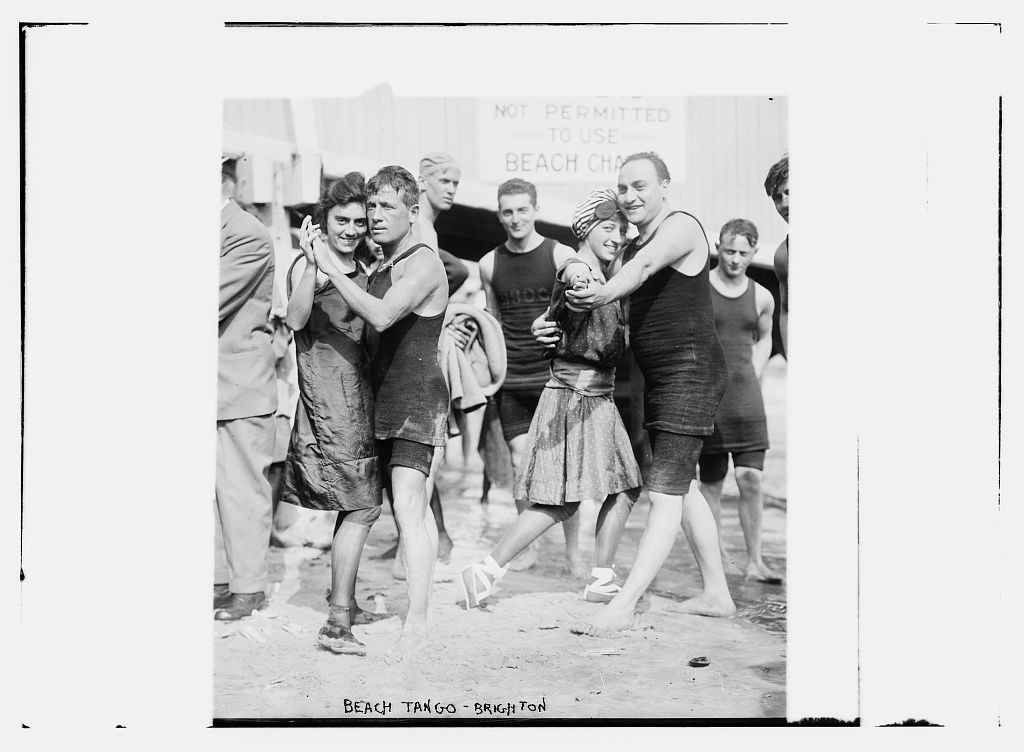
Beach Tango -- Brighton
Unknown artist
- Collection:
- Prints & Photographs
- Source:
- Library of Congress
- Rights:
- Rights vary by item — check the source record before reusing this image. Source record ↗
- Recorded as:
- Library of Congress — no known restrictions (verify per item)
This photograph is rare evidence of how tango—a dance form that exploded across European and American culture in the 1910s—was adapted and absorbed into popular leisure culture, not confined to ballrooms. It shows that early 20th-century dance history was not only a history of theatrical innovation or competitive ballroom technique, but also of how dance became a form of public courtship and social pleasure in mixed-sex seaside settings. The image also documents the beach as a site of social and sexual liberalisation, where new forms of physical contact between unrelated men and women were becoming visible and tolerable.
What you are looking at
A lively beach scene at Brighton shows a mixed group of bathers in early 20th-century swimming dress gathered on the sand near the water's edge. The photograph captures a moment of social interaction and entertainment, with men in sleeveless tank tops and women in modest one-piece bathing costumes arranged in loose clusters. A sign reading "NOT PERMITTED" and partial text mentioning "BEACH CHA[NGE]" is visible in the background, suggesting this was a managed public beach with rules about conduct. The sand is wet and reflective, indicating the tide is high or the group has recently been in the water. The figures are relaxed and engaged with one another, some with arms around shoulders or waists, suggesting a moment of courtship or companionship rather than formal posing. The black-and-white photograph has the soft focus and fine grain typical of early 20th-century gelatin silver prints.
The dancing
The composition shows approximately eight to ten figures distributed across the frame, with several couples or pairs in close physical contact. A woman on the left wears a darker bathing suit and leans into a man beside her; another couple in the center are similarly paired. The poses are informal and social rather than choreographed—bodies are angled toward one another, arms are linked or placed around waists and shoulders, and the overall bearing is one of ease and flirtation. The posture and gesture suggest these are not trained dancers performing for the camera, but bathers enjoying social interaction. The wet sand and the casual dispersal of the group indicate this is documentary rather than staged.
The dance depicted
This is not a formal dance performance but rather a document of social dancing or courtship behavior at a public bathing beach. The physical contact and positioning of the couples suggest the possibility of informal dancing—the "beach tango" of the title—as a seaside amusement or courtship practice. Early 20th-century beaches were sites of social mixing and new forms of heterosexual public interaction, and tango had recently become a fashionable social dance across Europe and America. Whether the photographer captured an actual tango performance or a moment of flirtation styled to evoke tango's romantic associations is unclear from the still image alone. The informality of the scene and the documentary quality of the photograph suggest this is social dancing or dancing-adjacent behavior rather than a staged theatrical performance.
How it was made
This is a gelatin silver photographic print, likely from a glass negative, showing the fine grain and tonal range characteristic of early 20th-century photography. The soft focus and even lighting suggest daylight photography on a bright day, possibly using a portable camera. The print's presence in the Library of Congress collections indicates it was circulated as a documentary or journalistic image—beach scenes were popular subjects for photography in the 1910s, whether as postcards, magazine illustrations, or archival records. The photograph's documentary quality and technical execution suggest it was made by a professional or semi-professional photographer rather than an amateur snapshot.
About this work
This 1910 Brighton beach photograph documents a moment of early 20th-century seaside social life and courtship, capturing bathers engaged in what the title suggests was dancing—specifically, the newly fashionable tango adapted to the beach setting. The image is valuable as a record of how dance moved beyond concert halls and ballrooms into public leisure spaces, and how dance functioned as a mode of courtship and social bonding in the Edwardian era. It belongs in a gallery of dance in art not because it shows trained dancers or a formal performance, but because it captures dance as a lived social practice: the gestures, holds, and physical proximities of courtship performed in everyday dress on an everyday beach. The photograph also documents the complex negotiation of propriety on public beaches in this period—the sign visible in the background enforces rules about conduct and dress, yet the photograph itself shows bodies in close contact in ways that would have been transgressive in other contexts.
How to look at it
Look at the physical contact between the figures and the informality of their arrangement: no one is in the rigid frame or closed hold of a formal ballroom dance, yet couples are clearly paired and in close contact. Notice how the photograph captures a moment of pleasure and ease rather than performance—the bathers are not striking poses for the camera, but are absorbed in interaction with one another. The sign in the background, with its prohibition, invites you to think about what behavior was being policed at the beach and what the photographer was documenting: a moment of social transgression or liberation, depending on your perspective. The wet sand and the proximity to the water suggest this was a real moment of leisure, not a staged tableau.
The period
The tango craze swept Europe and America in the years immediately following 1910, sparking moral panic and enthusiastic adoption in equal measure. What had begun in Argentine dance halls reached Vienna, Paris, and London through both theatrical performance and social dancing. The beach was a new site of leisure and social mixing in the Edwardian era, particularly after railway expansion made seaside towns like Brighton accessible to middle-class and working-class Londoners. Bathing dress itself had only recently relaxed enough to allow the kind of informal movement shown in this photograph—women's bathing costumes in the 1890s had been so restrictive as to make any actual swimming or dancing nearly impossible. By 1910, this more liberated dress was becoming standard, enabling new forms of physical interaction in public. The photograph captures a moment of cultural transition: the intersection of tango's fashionability, the beach as a democratic leisure space, and the gradual relaxation of Victorian constraints on public display of the body.
Where it lives
The photograph is held in the Prints & Photographs Online Catalog at the Library of Congress, a primary source collection focused on documentary images and visual records rather than fine art. Its presence in this collection indicates it was valued as a record of social history and public life rather than as an artistic photograph per se.
Dance in this work
Questions about this work
Is this actually tango, or just a catchy title?
The photograph alone cannot prove that these bathers are dancing tango specifically. The couples are in close contact and appear to be moving together, but a still photograph cannot capture the characteristic hip movement and walking pattern of tango. The title suggests tango—which was a fashionable craze in 1910—and tango's romantic associations may have made it an appealing label for seaside courtship dancing. What the photograph definitely shows is social dancing or dancing-adjacent behavior on the beach.
Why was dancing on the beach controversial?
The sign visible in the background reading "NOT PERMITTED" suggests that public authorities were attempting to regulate behavior on the beach. In the Edwardian era, the beach was a new and contested space of public leisure where the usual social conventions did not automatically apply. Close physical contact between unrelated men and women was far less acceptable in drawing rooms or churches. Dancing, with its intimacy and rhythmic movement, may have been seen as too forward, too loose, or too suggestive of lower-class or foreign (Argentine) behavior.
What does this tell us about early 20th-century attitudes to women's bodies and leisure?
The photograph is evidence of significant changes in women's dress, mobility, and participation in public leisure. The bathing costumes on display would have been shocking a generation earlier. That women were visible at the beach in mixed company, dressed for swimming, engaged in physical activity and courtship, marks a shift in what was considered appropriate. Yet the "NOT PERMITTED" sign reminds us that this liberation was contested and policed—respectability still mattered, and authorities still attempted to control what happened on the beach.
More dance artwork





