49 works in this view — arrow keys or swipe to move between them.
Dance in Art
Devils dance [i.e. Devil Dancers]
Unknown artist
- Collection:
- Prints & Photographs
- Source:
- Library of Congress
- Rights:
- Rights vary by item — check the source record before reusing this image. Source record ↗
- Recorded as:
- Library of Congress — no known restrictions (verify per item)
This image is significant as both a historical document of ceremonial performance and as an artifact of colonial-era anthropological photography. It demonstrates how non-Western dance traditions were recorded, displayed, and often exoticized in Western collections, raising questions about documentation ethics and the authority of images to represent living cultural practices.
What you are looking at
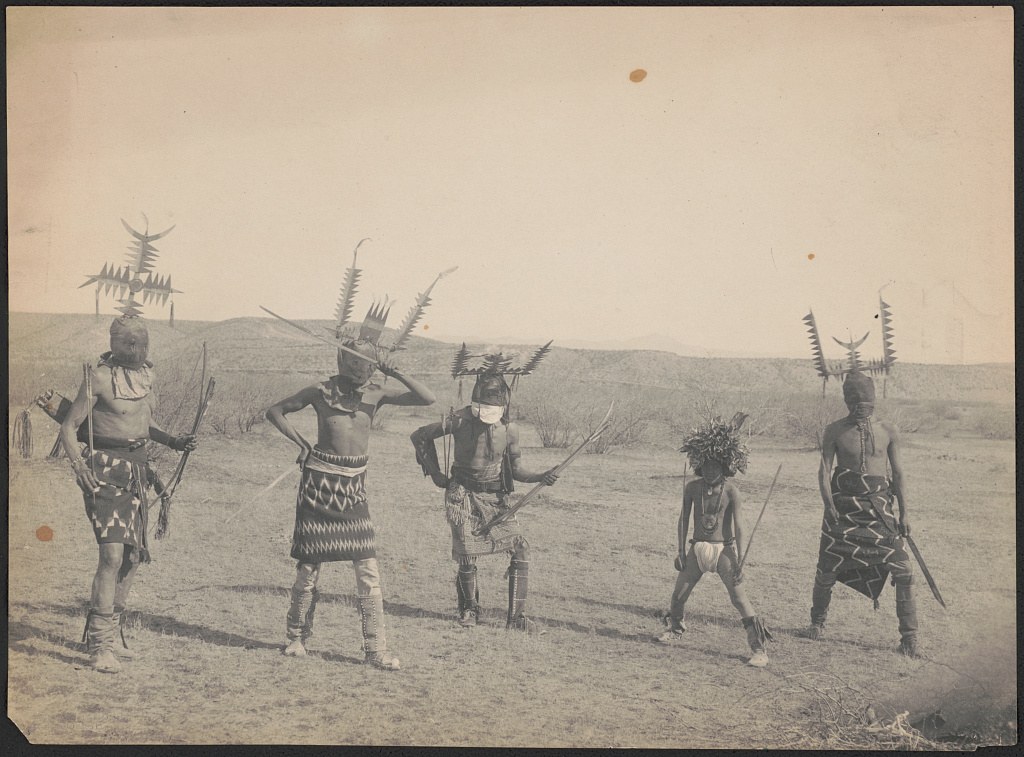
Five male figures stand in an open landscape under hazy light, arranged roughly in a line across bare ground with low hills visible in the distance. Each wears minimal clothing—fitted geometric patterned skirts or loincloths—and all bear elaborate headdresses made of multiple upright feathered or quill-like projections rising from their heads. Some figures hold long staffs or spears. The poses are frontal and relatively static, with arms held at various angles—some akimbo, some raised. The photograph's age and sepia tone suggest late 19th-century documentation. The setting appears to be ethnographic field photography, and the figures' bearing and regalia suggest a ceremonial or performative context rather than domestic life.
The dancing
All five figures face the camera in relatively upright, grounded stances with minimal weight shift or dynamic lean. Arms are positioned expressively but not in unison—some raised, some held at the sides, some across the body. The headdresses dominate the visual composition, rising vertically from each dancer's head. No closed holds or partner connection is evident; this appears to be a formation of individual performers rather than a coupled or coordinated ensemble movement. The body language suggests a pause or presentation rather than a moment caught mid-movement.
The dance depicted
The title 'Devils dance' and the regalia suggest this documents a sacred or ritual performance, possibly from Central African or South African traditions. The elaborate headdresses, minimal dress, spears, and open-ground setting are consistent with ceremonial dances associated with spiritual or warrior traditions. Without additional provenance, the specific dance form cannot be confirmed, but the visual evidence points toward a sacred-ceremonial or global-african tradition involving ritual body adornment and processional or presentational performance. The photograph appears to document performers in costume or regalia rather than capturing movement itself.
How it was made
This is a photograph, likely a gelatin silver or albumen print from 1899 based on the tonal range and surface quality visible in the sepia reproduction. The documentary style and composition suggest ethnographic or colonial-era field photography, a genre that circulated widely in the late 19th century through museums, scholarly publications, and popular illustrated journals. The fixed viewpoint and frontal arrangement of subjects is typical of anthropological photography of the period, which prioritized documentation of dress and body ornamentation over action or movement.
About this work
This 1899 photograph documents five performers in ceremonial dress and headdresses, standing in a landscape setting. The work is presented under the title 'Devils dance,' suggesting a sacred or ritual performance tradition, though the specific cultural origin and dance form cannot be determined from the image alone. The photograph is an example of late 19th-century ethnographic documentation, a visual practice that recorded non-Western performance traditions often with limited contextual information or respectful interpretation. It offers a freeze-frame view of regalia and physical bearing rather than a dynamic record of movement or technique.
How to look at it
Attend first to the headdresses and their geometric precision—these are the focal point and the marker of the performers' status and role. Then observe the variation in arm positions and the lack of synchronization among the five figures, which suggests individual rather than unified movement, or a moment of presentation rather than active choreography. The open landscape and the frontality of the arrangement reflect the conventions of ethnographic photography, which prioritized legibility and documentation of material culture (dress, ornament, weaponry) over the capture of movement or emotional intensity.
The period
In 1899, ethnographic photography was a dominant visual practice for Western documentation of non-Western peoples and their cultural practices. Photography was considered an objective recording tool, though photographers made selective choices about composition, framing, and presentation. The title 'Devils dance' reflects late 19th-century Western terminology for African spiritual performances, often marked by colonial assumptions and the conflation of religious or ritual practice with exoticism. Dance was documented primarily through still photography, which captured costume and formation but not the temporal and kinetic dimensions of performance itself.
Where it lives
This is a photographic print held in the Prints & Photographs collection of the Library of Congress. It is catalogued as an example of documentary or ethnographic photography from 1899, part of a large body of late 19th-century images created to record and circulate visual knowledge of non-Western peoples and their practices.
Dance in this work
Questions about this work
What dance tradition does this photograph document?
The title 'Devils dance' and the regalia suggest a sacred or ceremonial performance, possibly from Central or South African traditions, but the catalogue record provides no specific cultural attribution. The elaborate feathered headdresses, minimal dress, spears, and open-ground setting are consistent with ritual or warrior dances, but without additional documentation or provenance, the specific form cannot be confirmed.
Why are the performers not moving?
This is a still photograph, not a video or sequence of images. The photographer has captured the performers in a posed or presentational arrangement, which was standard practice in ethnographic photography of the period. The image records costume and bearing rather than the kinetic or temporal dimensions of the performance.
What do the headdresses represent?
The elaborate feathered or quill-like projections likely signify spiritual authority, warrior status, or ritual role within the performance tradition. However, without cultural and historical context, the specific symbolic meaning cannot be stated. The headdresses are the dominant visual marker of the performers' identities and function.
More dance artwork





