49 works in this view — arrow keys or swipe to move between them.
Dance in Art
Dancing.
Unknown artist
- Collection:
- Prints & Photographs
- Source:
- Library of Congress
- Rights:
- Rights vary by item — check the source record before reusing this image. Source record ↗
- Recorded as:
- Library of Congress — no known restrictions (verify per item)
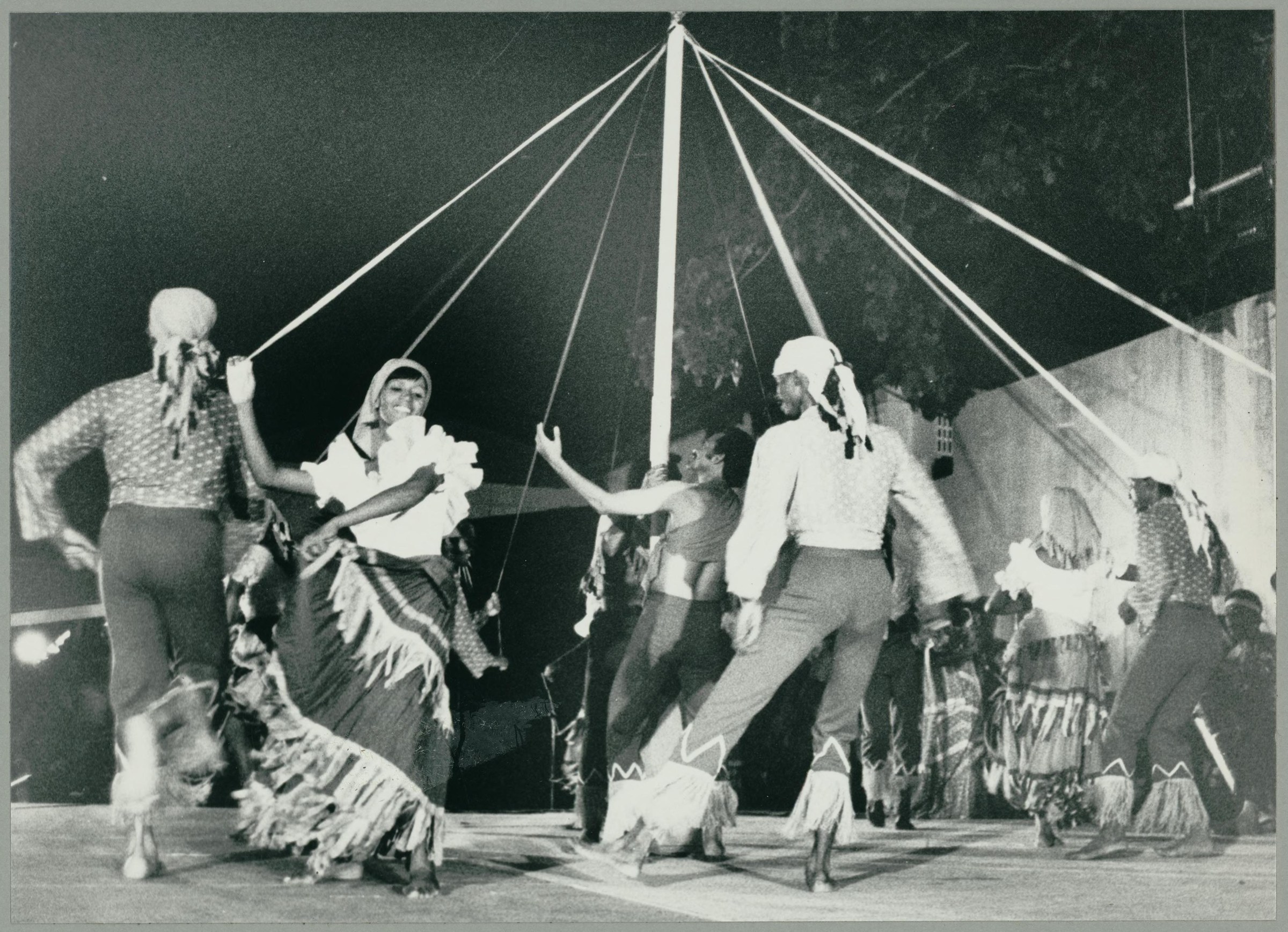
The maypole is one of the oldest documented participatory circle dances in European culture, and this photograph provides rare visual evidence of how it was performed, taught, and staged in the modern era. The image shows the physical and spatial literacy required to execute the form—a knowledge embedded in bodies rather than written notation. For dance historians, it documents a moment when folk traditions were being actively revived and performed in theatrical contexts, a crucial shift in how such dances circulated and were understood.
What you are looking at
A maypole dance captured in black and white photography, likely from a theatrical or folk festival production. A tall central pole topped with a white finial radiates multiple cords toward a circle of dancers arranged around its base. The dancers wear patterned costumes—the women in light-colored bodices and dark skirts with distinctive fringe or tassel trim at the hem, the men in white shirts and dark breeches with similar decorative leg wrappings. The lighting is theatrical, with the dark background suggesting an indoor stage or studio setting. The dancers are positioned at varying distances from the pole, some closer, some further back, creating depth and a sense of active circular movement. The photograph captures the moment mid-sequence, with bodies angled and arms extended, suggesting the plaiting and weaving action characteristic of the dance.
The dancing
The dancers form a circle around the central maypole, each holding one of the suspended cords. Their bodies are animated and turned, showing clear weight shifts appropriate to circular, rotational movement. The women's skirts catch the light and appear to be swinging outward from their bodies, suggesting momentum and spinning. The men maintain upright posture with extended arms gripping the cords. The costume elements—particularly the fringed or tasseled leg wrappings and patterned bodices—are consistent with European folk or festival dance traditions rather than classical ballet technique. The arrangement suggests coordinated directional movement rather than ballet positions.
The dance depicted
This appears to be a maypole dance, a form of folk celebration with deep European roots, though the specific cultural origin is unclear from the photograph alone. The costume style and staging suggest a theatrical or educational revival rather than a purely traditional village celebration. Maypole dances typically involve dancers moving in circular patterns while holding ribbons or cords attached to a central pole, with the goal of plaiting or weaving the decorations. The visible technique here shows participants managing directional movement while maintaining tension on the cords—fundamental to the form. The theatrical staging and photographic documentation indicate this was a formal performance or demonstration rather than a spontaneous folk practice.
How it was made
This is a black and white photograph, likely created using mid-20th-century printing or darkroom techniques given the grainy texture and tonal range. The photographic medium allowed documentation of the three-dimensional spatial arrangement and the moment-specific positioning that would have been difficult to capture in drawing. The theatrical lighting and carefully composed frame suggest this was a professional or semi-professional documentation of a staged performance. The quality and context indicate this may have been published or distributed as a print—possibly as part of educational or archival materials on folk dance or theatrical practice.
About this work
This photograph documents a maypole dance, a form of participatory circle dance with historical roots in European folk tradition. The image captures the physical choreography of the form—the circular arrangement, the management of suspended cords, the rotational momentum visible in the dancers' bodies and skirts. The theatrical staging and professional documentation suggest this was a revival or formal performance of the maypole tradition, rather than a spontaneous folk practice. The work belongs in a dance gallery both as a record of a specific historical performance and as visual evidence of how maypole dancing was understood, taught, and performed in the 20th century.
The photograph is historically significant as a document of how European folk forms were translated into theatrical and educational contexts. The costume details, staging choices, and photographic technique all reflect early-to-mid 20th-century attitudes toward folk revival and cultural preservation. For contemporary dancers and historians, the image provides concrete evidence of spatial organization, movement quality, and the material culture (rope, costume, pole) that structures this participatory form.
How to look at it
Observe how the photographer has captured the circular geometry of the dance—the pole as a fixed center point and the dancers arranged in a circle around it, each holding a cord. Notice the varying body positions and the way the women's skirts swing outward, indicating the rotational momentum of the movement. Watch how the costume details—the fringed leg wrappings and patterned fabrics—move with the bodies, creating visual rhythm. The theatrical lighting emphasizes the three-dimensional spatial arrangement and draws attention to the coordinated positioning that makes the weaving and plaiting action possible. The photograph freezes a moment of activity mid-sequence, showing how dancers manage simultaneous circular and directional movement.
The period
Maypole dancing has medieval and early modern roots in English and European spring festivals, but experienced a major revival during the 19th and 20th centuries as part of the broader folk revival movement. In the early-to-mid 20th century, maypole dances were frequently taught in schools, performed at festivals, and documented in educational contexts as a way to preserve and transmit folk traditions. The theatrical staging visible here is consistent with 1920s–1950s revival practices, when folk forms were often translated into formal performance contexts. The photograph itself dates from 1981 according to the catalogue record, though it may document a performance or revival production from an earlier era, or it may represent a late 20th-century reconstruction or educational enactment.
Where it lives
The photograph is held in the Prints & Photographs collection of the Library of Congress. The catalogue record provides minimal documentation: the title 'Dancing,' the date 1981, and the medium and era remain unrecorded. The sparse cataloguing is typical of large institutional collections where photographic documentation of folk or theatrical performance has been acquired without full contextual metadata.
Dance in this work
Questions about this work
What is a maypole dance?
A maypole dance is a participatory circle dance, traditionally performed around a central pole decorated with ribbons or cords. The dancers each hold one cord and move in synchronized circular patterns, typically weaving or plaiting the cords around the pole. The form has medieval roots in European spring festivals and was revived extensively during the 19th and 20th centuries as part of folk traditions education and cultural preservation.
How do dancers coordinate the weaving?
Dancers maintain tension on the cords they hold while moving in synchronized patterns around the pole—typically alternating direction or moving in specific geometric sequences. The shared rhythm and directional understanding allow the group to plait or weave the decorations without individual instruction at each moment. The visible costume details in this photograph—particularly the way the skirts swing—show how the rotational movement creates and sustains the weaving action.
Why is this a theatrical performance rather than a folk tradition?
Several visual cues indicate staged revival rather than village tradition: the theatrical lighting, the carefully arranged formal circle, the professional costume construction, and the photographic documentation itself. The context suggests this is a formal performance, educational demonstration, or archival documentation of the maypole form—a common practice during the 20th-century folk revival movement, when traditional forms were preserved and performed in institutional settings.
More dance artwork





