49 works in this view — arrow keys or swipe to move between them.
Dance in Art
Dance.
Unknown artist
- Collection:
- Prints & Photographs
- Source:
- Library of Congress
- Rights:
- Rights vary by item — check the source record before reusing this image. Source record ↗
- Recorded as:
- Library of Congress — no known restrictions (verify per item)
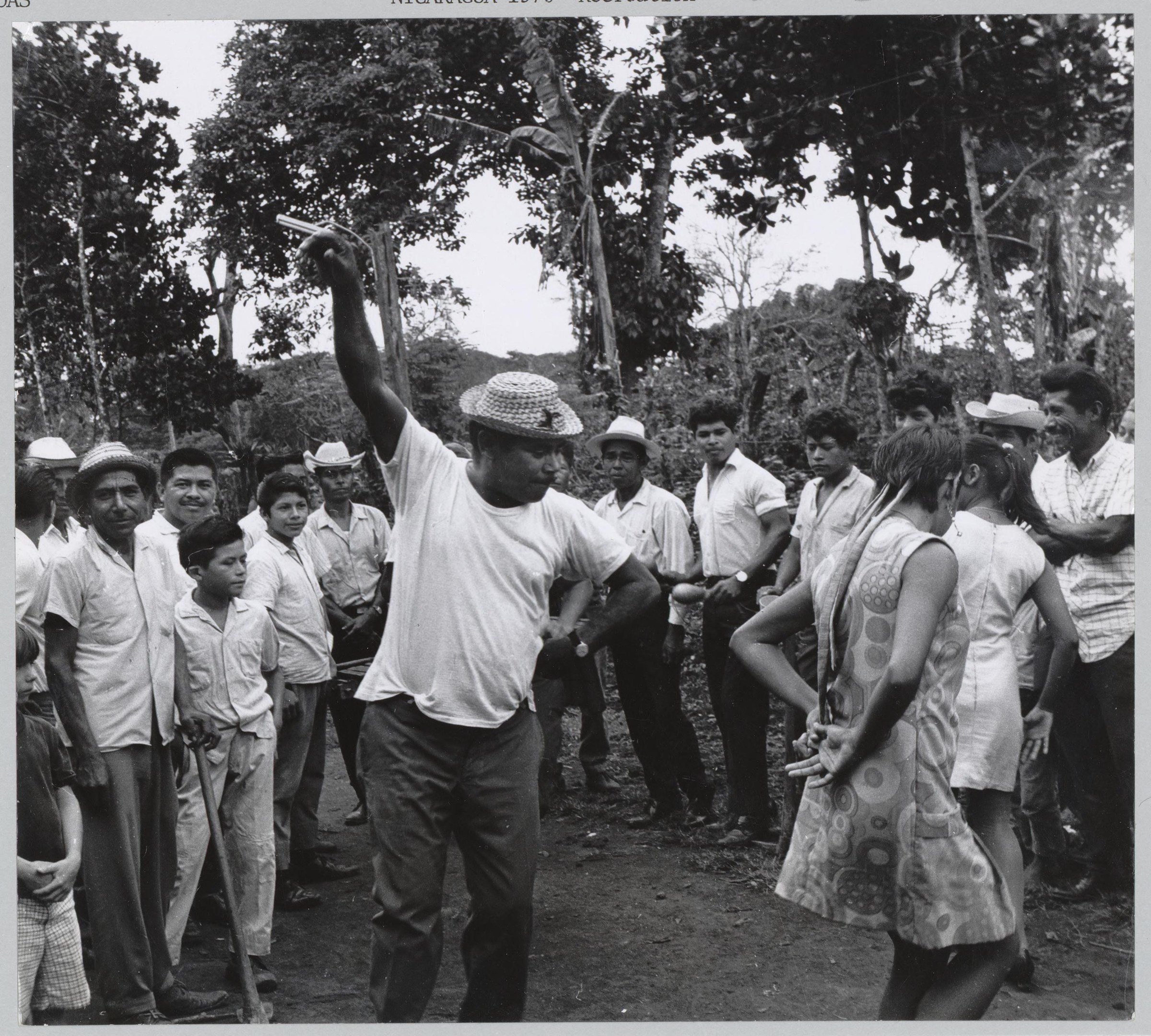
The photograph documents dance not as spectacle but as lived social practice and pedagogy, offering a counterpoint to studio and stage-based documentation. It records a teaching moment that would otherwise leave no trace, and raises questions about who photographs dance, from what perspective, and how documentary images shape our understanding of non-Western movement practices.
What you are looking at
A large group of people, approximately twenty to thirty adults and children, gathers in a forest clearing among tall trees. The photograph captures an outdoor moment of collective movement or instruction, with the participants arranged in a loose circle or gathered formation. A man in the center, wearing a white t-shirt, light-colored pants, and a woven hat, has one arm raised with palm open in a gesturing or teaching position. The other participants wear simple cotton clothing—white or cream-colored shirts predominate—and several wear similar woven hats. The setting is clearly tropical or subtropical, with dense forest vegetation visible in the background and dappled natural light filtering through the canopy. The ground is bare earth. The composition suggests an instructional or participatory moment rather than a formal performance.
The dancing
The central male figure stands with his weight evenly distributed, his raised arm extended at approximately shoulder height with an open palm facing outward—a gesture consistent with teaching, beckoning, or demonstration. The surrounding figures stand or rest in varied positions, some upright and attentive, others with more relaxed posture, suggesting they are watching or waiting for instruction. No two people are in a formal closed hold or symmetrical formation. The age range spans from young children to adults, and both men and women are present, distributed throughout the space without clear hierarchical arrangement.
The dance depicted
The photograph most likely documents a moment of dance instruction, cultural transmission, or participatory community movement in a non-Western context. The teaching posture of the central figure, the attentive gathering, and the outdoor forest setting suggest this may record a moment of learning or demonstration of traditional movement practice. Without visible specialist costume, musical instruments, or formal staging, this is not a theatrical dance performance but rather a documentary image of dance or movement practice in its social or educational context. The specific dance tradition cannot be identified from the photograph alone.
How it was made
This is a black-and-white photograph, likely taken with film and printed as a gelatin silver print, consistent with documentary or ethnographic photography of the 1960s–1970s. The composition and exposure suggest a portable camera and natural light; the depth of field and slight graininess are typical of field photography from this era. The medium's directness and indexical relationship to the moment—it records actual people in an actual place—gives it the authority and immediacy of documentary evidence, though photographs are always shaped by framing, timing, and the photographer's position.
About this work
This is a documentary photograph of what appears to be a moment of dance or movement instruction or practice in a tropical or subtropical forest community. The image records a teaching gesture, attentive participants, and a non-Western setting without formal theatrical staging. It sits within the broader tradition of ethnographic and anthropological photography that aimed to document cultural practices of non-industrialized societies. The work belongs in a gallery of dance in art because it captures a moment of dance transmission and social participation—the ways communities teach and learn movement—rather than dance as performance for external audiences.
How to look at it
Attend to the gesture of the central figure—the raised arm and open palm are classic teaching or demonstrative positions, freezing a moment of transmission. Notice the varied attentiveness and body positions of the surrounding participants; this is not a coordinated group performing in unison. The forest setting, the informal dress, and the documentary framing suggest you are witnessing dance or movement as a social and educational practice embedded in community life, not extracted into a theater or studio.
The artist
The photographer is not recorded in the available catalogue information. The image is housed in the Prints & Photographs collection of the Library of Congress, suggesting it entered an American institutional archive, possibly as part of a field research project or donation. The style and framing are consistent with mid-to-late-twentieth-century documentary or anthropological photography.
The period
The photograph dates to 1970, a moment when ethnographic and documentary photography was increasingly used to record cultural practices from non-Western communities, often with anthropological or UNESCO-affiliated agendas. Dance scholarship and anthropology in this period were beginning to recognize dance as a cultural and social phenomenon worthy of serious study, though much of this documentation was created by outsider photographers and researchers. At the same time, modern and contemporary dance in Western contexts was beginning to engage with and sometimes appropriate non-Western movement vocabularies.
Where it lives
The photograph is held by the Prints & Photographs Online Catalog (loc) of the Library of Congress, an American institutional archive. It entered the collection as a documentary or archival image, though the specific circumstances of its acquisition and the photographer's name are not currently recorded.
Questions about this work
What dance tradition is this?
The catalogue record does not identify the dance tradition or the community. The forest setting, clothing, and social context suggest a tropical or subtropical region, possibly in Central America, South America, Africa, or Southeast Asia, but the photograph alone does not permit definitive identification.
Is this a performance or a lesson?
This appears to be a moment of instruction or participatory community practice rather than a formal staged performance. The teaching gesture of the central figure, the varied body positions of the group, the outdoor non-theatrical setting, and the informal dress all suggest documentation of dance as a living social and educational practice.
Who took this photograph?
The photographer's name is not recorded in the available catalogue information. The image is dated 1970 and held by the Library of Congress, but its original source and creator remain unattributed in the publicly available record.
More dance artwork





