49 works in this view — arrow keys or swipe to move between them.
Dance in Art
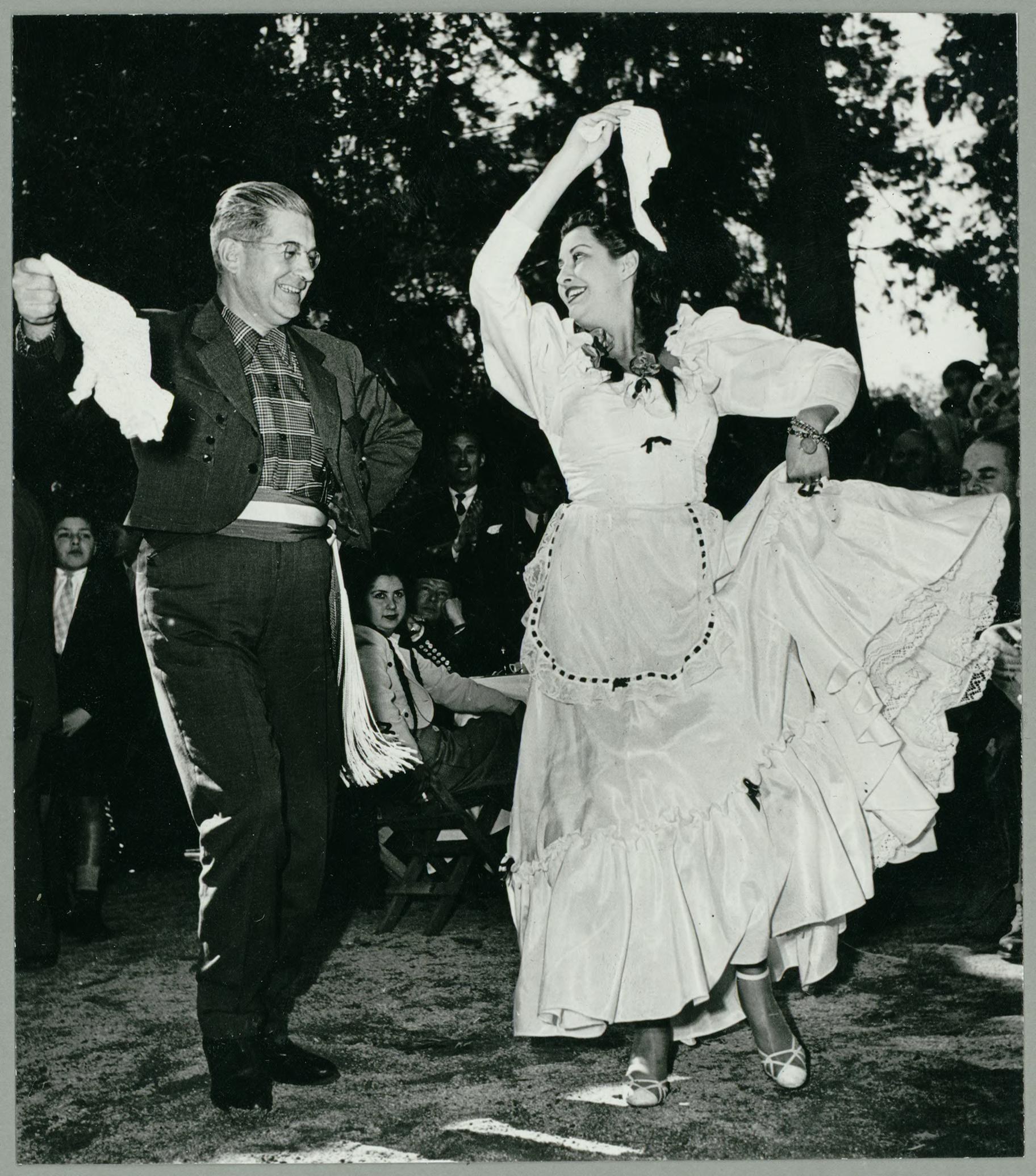
Dancing Zamba, Argentina.
Unknown artist
- Collection:
- Prints & Photographs
- Source:
- Library of Congress
- Rights:
- Rights vary by item — check the source record before reusing this image. Source record ↗
- Recorded as:
- Library of Congress — no known restrictions (verify per item)
The photograph documents zamba as a living social practice in late-twentieth-century Argentina, preserving a moment when the dance remained embedded in everyday festive life. For historians of Argentine culture and folk dance, it offers concrete evidence of how the handkerchief work, partnering, and atmosphere of the zamba functioned in real time, outside the conventions of theatrical representation.
What you are looking at
A man and woman dance outdoors at night under trees, surrounded by seated spectators. The woman wears a full white cotton dress with a fitted bodice, puffed sleeves, and a voluminous skirt decorated with dark stitched details around the hem; her dark hair is styled up. The man wears a dark suit jacket with a plaid shirt and a white gauze neckerchief or scarf draped around his neck. Both hold white handkerchiefs aloft—the woman's raised above her head, the man's at chest height—and appear mid-movement. The setting is intimate and informal, with onlookers seated close by in ordinary clothes, their faces partly visible in shadow. The photograph is black and white, shot at night or in low light, with foliage visible overhead and bare ground underfoot.
The dancing
The dancers stand close but not in a closed ballroom hold; their posture is upright and energetic rather than formal. Both grip and wave white handkerchiefs as primary gestures, with the woman's arm extended upward in a celebratory or signalling motion. The woman's full skirt suggests she may be turning or stepping with some vigor. The man's stance is grounded and engaged, watching his partner. Their body language conveys joy and informality rather than the precision of staged performance.
The dance depicted
This is a zamba, a couple dance from Argentina, characterized by the use of handkerchiefs (pañuelos) as central props and by a flirtatious, playful dynamic between partners. The zamba emerged in colonial Argentina and remains a folk dance of courtship and celebration. The handkerchief work visible here—held aloft and waved rather than dragged—is typical of the dance. The informal outdoor setting, casual audience, and the dancers' evident pleasure suggest this is a social or festive context rather than a rehearsed performance, capturing the dance as it was lived in Argentine communities.
How it was made
This is a black-and-white photograph, likely taken with available light or flash photography, given the nighttime outdoor setting and the visible grain and contrast. The photograph preserves the immediacy and spontaneity of the moment, including the animated expressions and gesture of both dancers and the ambient presence of spectators. The technical limitations of the era mean the image captures fleeting movement in a single frame, making it a documentary record of the dance as practiced rather than a posed portrait.
About this work
This photograph documents a zamba being danced in Argentina in 1978, capturing one of Latin America's enduring folk dances in an unscripted social setting. The zamba is a couple dance of flirtation and joy, in which partners dance with handkerchiefs, engaging in rhythmic and playful interaction. The image shows the dance alive in its community context—outdoors, among friends, with visible pleasure and informality—rather than as an artifact of stage or studio. It is a record of how this dance was actually danced at the time, with all the warmth and spontaneity that implies.
How to look at it
Observe the handkerchief work: how the dancers hold and wave the white scarves as a means of communication and flirtation, and how this prop shapes their movement and posture. Note the woman's full skirt and the way it responds to her movement—the zamba is a dance in which the skirt becomes part of the visual language. Watch the relationship between the dancers: they are connected by attention and playfulness rather than by a formal hold, and the handkerchiefs create distance even as the dance creates intimacy. The presence of the audience, close and engaged, reminds us that this is a social dance, meant to be seen and celebrated by a community.
The period
By 1978, the zamba had a long history in Argentina, dating to the colonial period and the fusion of Spanish, Indigenous, and African dance traditions. In the late twentieth century, folk dances like the zamba were experiencing renewed interest and documentation as markers of national and regional identity. Simultaneously, these dances remained genuine social practices in rural and community settings, where they were danced for pleasure and celebration rather than as formal performances. The photograph captures this liminal moment—the dance was being documented and studied even as it continued to be lived.
Where it lives
The photograph is held in the Prints & Photographs collection of the Library of Congress and catalogued as a record of Argentine dance. It is one of a body of documentary photographs of regional and folk dances, likely acquired as part of the Library's effort to document cultural practices across the Americas.
Dance in this work
Questions about this work
What is the white cloth the dancers are holding?
These are handkerchiefs (pañuelos), essential props in the zamba. In the dance, partners use the handkerchiefs to flirt and communicate with one another, waving and twirling them as they dance. The handkerchief work is one of the dance's defining features.
Is the zamba still danced today?
Yes. The zamba remains a living folk dance in Argentina and other parts of South America, danced at festivals, celebrations, and cultural events. It is taught in dance schools and preserved as part of Argentine cultural heritage, though the contexts in which it is danced have shifted from primarily social and festive to include formal performances and competitions.
Why is this photograph in black and white?
Color photography existed in 1978, but black-and-white film was still standard for documentary and news photography, and it was cheaper and more practical for field work. The black-and-white medium gives the image a timeless, archival quality.
What is the setting of this dance?
The dance is taking place outdoors at night, under trees, with spectators seated nearby on the ground. This informal, community setting is typical of how folk dances like the zamba were (and are) danced in Argentine villages and celebrations—not on a stage, but among friends and neighbors.
More dance artwork





