49 works in this view — arrow keys or swipe to move between them.
Dance in Art
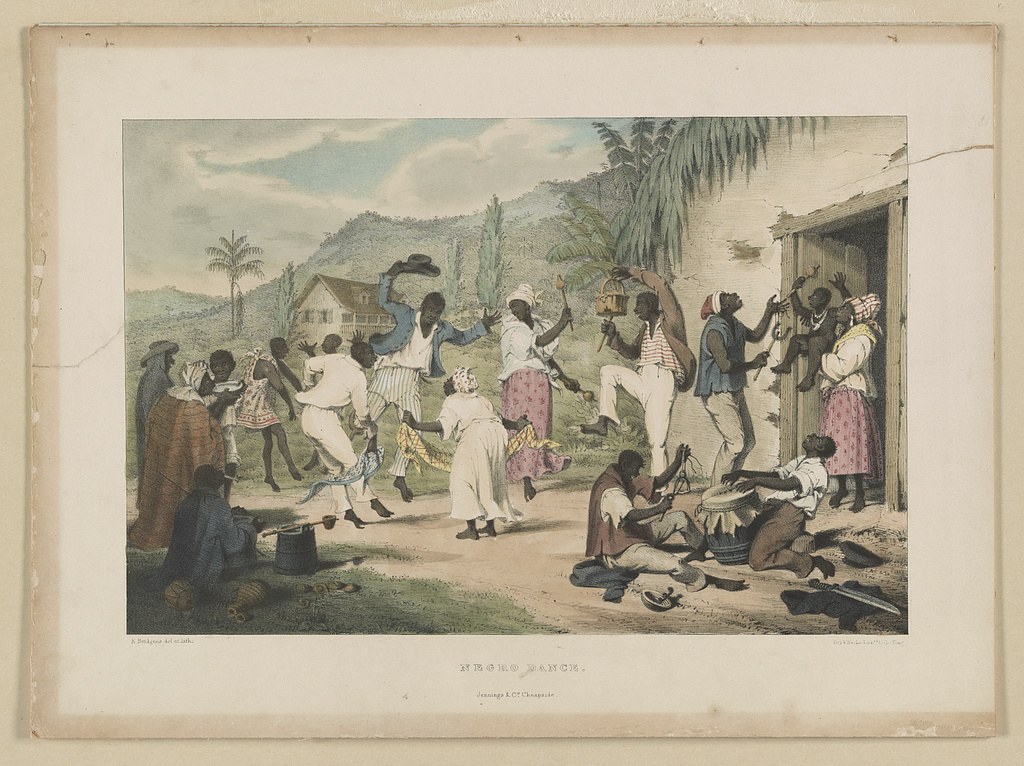
Negro dance
Unknown artist
- Collection:
- Prints & Photographs
- Source:
- Library of Congress
- Rights:
- Rights vary by item — check the source record before reusing this image. Source record ↗
- Recorded as:
- Library of Congress — no known restrictions (verify per item)
This engraving documents African diaspora dance at a moment when such practices were actively suppressed or marginalized in colonial and slaveholding societies, yet performed with communal significance. It is one of few contemporary visual records of secular African-descended dance before late 19th-century photography. For dance historians, it provides evidence of movement vocabulary, spatial organization, and the integration of music and dance in diaspora communities.
What you are looking at
A hand-colored engraving depicting a festive gathering in a tropical or Caribbean setting, likely from the early 19th century. The scene unfolds in a village compound with simple structures visible in the background and lush vegetation including palm trees. A large group of figures—men, women, and children of African descent—occupy the foreground and middle ground. Some are actively dancing in the center, while others sit, stand, or prepare food at the edges. The composition centers on dynamic movement: several figures leap, spin, or gesture with arms raised, while seated figures in the lower right appear to be playing drums or percussion instruments. The lighting is naturalistic, with warm tones suggesting afternoon sun. The title "NEGRO DANCE" appears below the image, and the work is credited to "Arranged & C° Chagorin" in small text.
The dancing
The dancing figures display exuberant, high-energy movement with knees bent, torsos tilted, and arms raised or extended outward—characteristic of African diaspora dance forms. Bodies are depicted in asymmetrical, dynamic poses rather than the aligned posture of European ballroom dance. Several figures appear to be in mid-leap or mid-spin, with feet off the ground or weight shifting. The seated musicians at lower right lean forward over their instruments, bodies engaged with the rhythm-making. There is no closed-hold partnering visible; dancers move individually or in loose groupings, some appearing to move toward or away from the central music-makers.
The dance depicted
This depicts social dancing in an enslaved or formerly enslaved African diaspora community, most likely in the Caribbean or Americas, probably early 19th century. The style is consistent with ring dances, stick dances, or other secular social forms documented among African-descended peoples of the era—characterized by solo and group improvisation, call-and-response music, and percussive accompaniment. The energy and composition suggest celebration or festive gathering rather than courtship or formal ceremony. The image captures the dance as a communal event integral to daily or ritual life, with music-making and dancing as simultaneous, participatory activities.
How it was made
This is a hand-colored engraving, identifiable by the linear hatching visible in the background and the characteristic line work of the medium. The coloring appears to have been applied after printing, with watercolor or similar pigment. Hand-coloring was the standard method of adding color to engravings before chromolithography became widespread. This technique allowed for relatively rapid production of multiple colored copies from a single engraved plate, making such images affordable for middle-class European and colonial audiences. The quality of the engraving—detailed figure work, landscape recession, naturalistic anatomy—suggests a skilled practitioner working for a commercial print publisher.
About this work
This work is a hand-colored engraving depicting African diaspora social dance, dated 1838, in a Caribbean or American colonial setting. It is a documentary artifact of early 19th-century dance culture, created for European viewers in the era of slavery and abolitionism. The image captures the vitality and social centrality of African-rooted dance practices during a period when such forms were largely excluded from European fine art and theater. As visual ethnography—however mediated by the engraver's eye and the print market's conventions—it provides rare pictorial evidence of how diaspora dance was understood and represented in the Atlantic world.
How to look at it
Observe the compositional focus on the central dancers and musicians: the engraver has chosen a moment of active, celebratory movement rather than stillness, emphasizing the participatory and musical nature of the dance. Note the contrast between the relaxed, grounded lower body and the expansive arm and torso gestures—this is not the lifted, balletic carriage of European dance. Look at how the seated figures and standing onlookers integrate the scene; dance and music-making are not separated from social life but embedded in it. The hand-coloring—particularly the warm flesh tones and the varied clothing—adds specificity and humanity that the engraved line alone would lack.
The artist
The artist is not recorded in the catalogue. The credit line reads "Arranged & C° Chagorin," suggesting either a publisher's mark or the name of the arranger or engraver. The work appears to be a commercial print, likely published in London or another European print center. The style and subject matter align with early 19th-century ethnographic or travel-related print production aimed at European audiences curious about colonial territories and non-European peoples.
The period
The engraving dates to 1838, a period of intense abolitionist activism in Britain (slavery abolished in British colonies in 1833) and ongoing slavery in the Americas. European visual culture was beginning to document, categorize, and often exoticize non-European peoples and practices. In dance, this was the height of Romantic ballet in Europe, characterized by ethereal, otherworldly aesthetics and white, corseted female dancers—a stark contrast to the earthed, dynamic, communal dance shown here. The image sits at the intersection of ethnographic documentation and commercial exotica, shaped by both scientific interest and racial ideology.
Where it lives
The work is held in the Prints & Photographs Online Catalog (Library of Congress). It is catalogued as a print—a commercial engraving hand-colored and distributed as a single sheet or part of a portfolio. Such prints were affordable, portable, and widely circulated among educated European and colonial audiences.
Dance in this work
Questions about this work
Where was this dance performed?
The tropical vegetation and architectural style suggest the Caribbean or Atlantic colonial Americas, but the engraving does not specify a precise location. The title simply identifies it as 'Negro dance'—a term then applied broadly to African diaspora practices across European colonies.
Is this a documentary image or an artist's fantasy?
It is likely both. The engraver has observed or worked from descriptions of actual diaspora dance practices, but the composition, proportions, and exoticizing framing reflect European aesthetic conventions and commercial print culture. It should be read as a mediated document rather than direct evidence.
What instruments are being played?
The image shows hand drums or percussion in the lower right, held and struck by seated figures. The exact instrument types are not clearly distinguishable, but they are consistent with African-derived percussion instruments documented in diaspora communities of the era.
Was this dance suppressed under slavery?
Yes. Many slaveholders restricted drumming and communal dance because they recognized such practices as expressions of African cultural continuity and as potential focal points for resistance. This engraving thus documents a practice that existed despite prohibition or under careful concealment.
More dance artwork





