49 works in this view — arrow keys or swipe to move between them.
Dance in Art
Indian Dancers
Unknown artist
- Collection:
- Prints & Photographs
- Source:
- Library of Congress
- Rights:
- Rights vary by item — check the source record before reusing this image. Source record ↗
- Recorded as:
- Library of Congress — no known restrictions (verify per item)
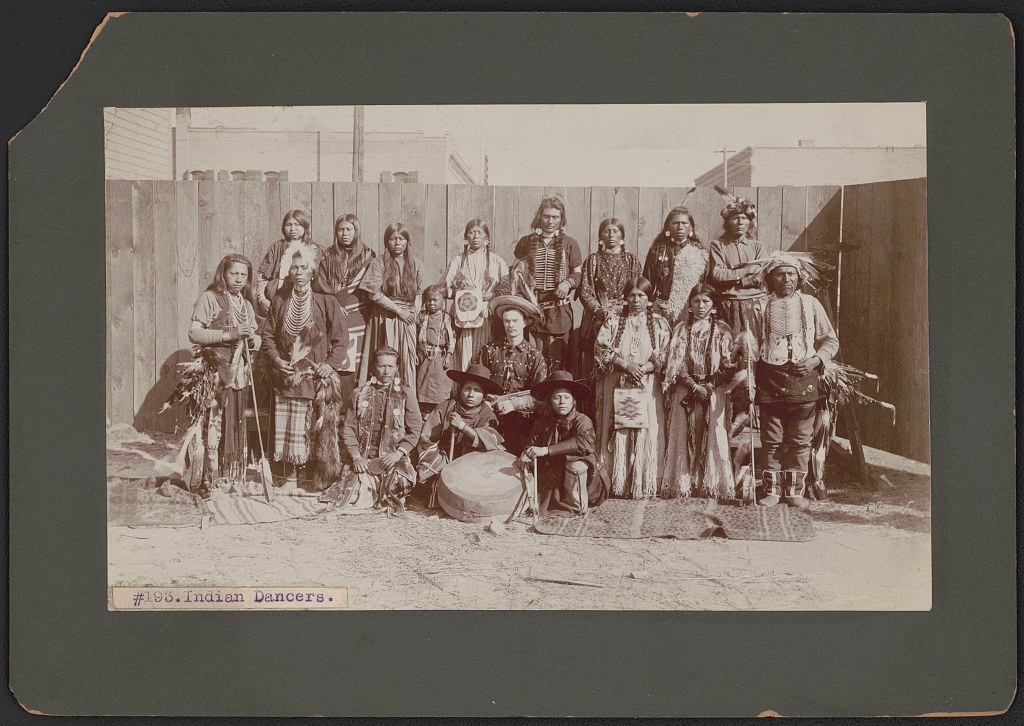
The photograph documents the visual appearance of Native American dance regalia at a specific historical moment, and it illustrates how Native American dances and dancers were presented to and circulated among settler audiences in early-twentieth-century America. The posed, static nature of the image is itself significant—it reflects the conventions and limitations of early photographic practice, and the power dynamics of documentation, where Native American subjects were arranged and displayed for the camera rather than represented in the act of ceremony or performance.
What you are looking at
A staged photograph showing approximately twenty Native American dancers arranged in formal rows against a wooden palisade fence. The photograph is taken in daylight, with the subjects posed rather than captured mid-movement. The front rows sit or kneel; the back rows stand. All wear elaborate regalia including fringed leather garments, decorative vests with geometric patterns, headdresses, and feathered ornaments. Several hold large circular drums or drum-like objects. The composition is frontal and symmetrical, with a large cloth or canvas backdrop visible behind the fence. The print shows the brown tones and soft focus characteristic of early photographic processes, and appears to have been mounted or bound into an album or archive collection.
The dancing
The dancers are posed statically for the camera rather than dancing. Those seated in front hold their bodies upright and formal; those standing are ranged in rigid lines. The poses are primarily frontal, with arms at rest or holding instruments. There is no visible weight transfer, active footwork, or the dynamic frame one would expect in an action photograph of a dance. This is a documentary group portrait in costume rather than a capture of movement.
The dance depicted
The photograph is titled 'Indian Dancers,' identifying the subjects as Native American. The regalia—fringed leather, geometric beadwork, feathered headdresses—suggests powwow or intertribal ceremonial dress. However, the image does not document actual dancing. It is a posed studio or camp photograph, likely created for display or publication. Without evidence of movement, footwork, or the ceremonial context in which such dances occurred, we cannot identify a specific dance tradition. The photograph may document what dancers wore, or it may simply be a formal group portrait of Native American performers or community members in traditional dress.
How it was made
This is a photograph, likely a gelatin or albumen silver print from circa 1900 based on the soft focus, tonal range, and mounting style. The image shows the characteristic warm brown tones and slight diffusion of hand-tinted or naturally aged photographic prints of the period. The photograph has been mounted on stiff board with an archival caption or identifier. Early photographic printing technology of this period produced works suitable for circulation as documentation, publication, or display—formats that suggest this was made for institutional or commercial use rather than as a private record.
About this work
This is a documentary photograph of approximately twenty Native American people in full regalia, formally arranged for the camera in what appears to be a studio or outdoor enclosure circa 1900. It is titled as a photograph of 'Indian Dancers,' but the image itself does not show dancing—it is a posed group portrait. The photograph likely served as ethnographic documentation or publicity material, capturing the appearance and costume of Native American performers or community members during a period when such images were widely collected by institutions and the press. It belongs in a dance archive as a record of how Native American regalia and dance traditions were documented and presented to non-Native audiences at the turn of the twentieth century, and as evidence of the performance and display contexts in which these traditions were practised during the early years of anthropological photography.
How to look at it
Attend to the formal, static arrangement of the figures and the direct address to the camera—this is a posed group portrait, not a document of movement. Notice the quality and detail of the regalia: the geometric beadwork, fringe, feathered ornaments, and headdresses are the subjects of this photograph as much as the people wearing them. The photograph's title claims these are 'dancers,' but the image tells a different story about documentation, display, and the gap between ceremonial practice and ethnographic representation.
The period
This photograph was made around 1900, a period of intense documentary and ethnographic interest in Native American cultures by non-Native photographers, museums, and the US government. The Indian Wars had concluded in the 1890s, and reservation systems were firmly established. Photographers travelled to reservations and powwows, and Native American performers also travelled to expositions and Wild West shows, where they were photographed in costume. These images circulated widely in illustrated newspapers, ethnographic publications, and museum archives. Powwows and intertribal gatherings were becoming more formally organized events by this time, though the distinction between ceremonial dance, performance, and display for non-Native audiences was increasingly blurred.
Where it lives
The photograph is held in the Prints & Photographs collection of the Library of Congress. The identifying label '#108.Indian Dancers' suggests it was part of a larger numbered series, consistent with institutional or government photographic surveys of the period.
Questions about this work
Are these people actually dancing in this photograph?
No. This is a posed group portrait taken for the camera. The subjects are arranged in static rows and do not show active movement, footwork, or dynamic gesture. It is a documentary photograph of dancers or performers in their regalia, not a photograph of dancing itself.
What dance tradition does this photograph document?
The regalia and the context suggest powwow or intertribal ceremonial traditions, but the photograph alone does not show specific dances or movements. Without documentation of the actual ceremony, performance, or context, we cannot identify the specific tradition or style.
Why was this photograph made?
Likely for ethnographic documentation, institutional archives, or publication in illustrated newspapers and magazines. Early-twentieth-century photographs of Native Americans were widely collected by the US government, museums, and the press as part of broader projects to document and display Native American cultures.
What does the posed, static nature of this image tell us?
It reflects both the technical limitations of early photography (long exposures and the need for subjects to remain still) and the power dynamics of representation. Native American subjects were arranged and displayed for non-Native audiences, a practice that shaped how their cultures and traditions were understood and circulated.
More dance artwork





