49 works in this view — arrow keys or swipe to move between them.
Dance in Art
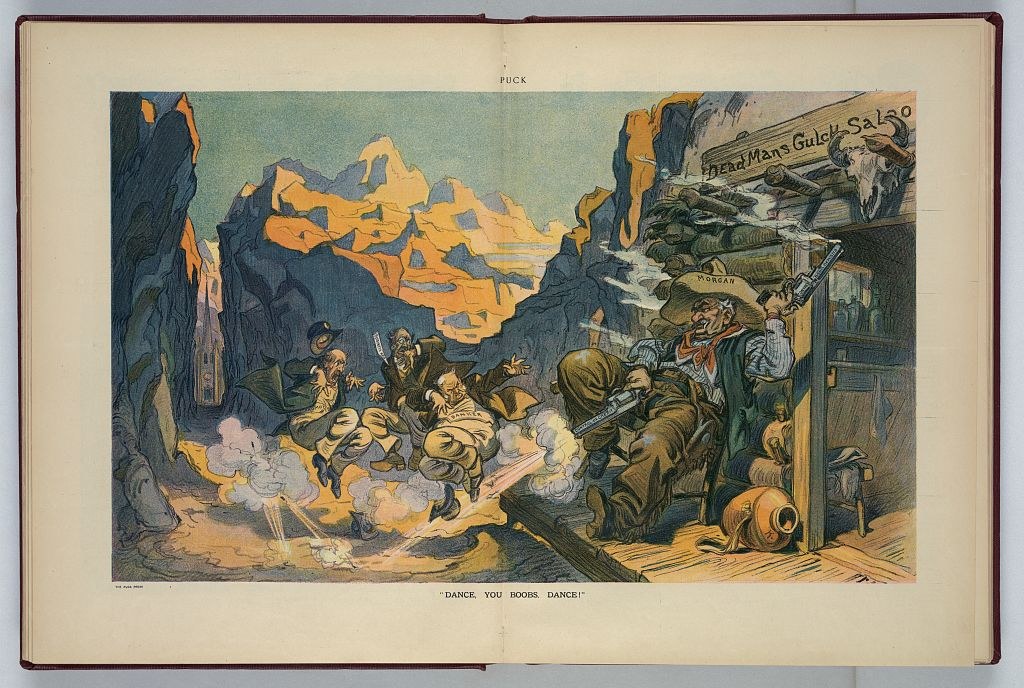
"Dance, you boobs. Dance!"
Unknown artist
- Collection:
- Prints & Photographs
- Source:
- Library of Congress
- Rights:
- Rights vary by item — check the source record before reusing this image. Source record ↗
- Recorded as:
- Library of Congress — no known restrictions (verify per item)
This work documents how dance—or the failure to dance—was used as a vehicle for social and political satire in American popular culture. It reveals contemporary attitudes toward masculinity, military discipline, and the perceived vulgarity of frontier life, offering insight into class anxieties and cultural hierarchies of the Progressive Era.
What you are looking at
A satirical color print depicts soldiers in military uniform dancing vigorously around a campfire in a mountainous landscape. The scene is set in what appears to be a canyon or rocky gorge, with steep ochre and blue rock formations rising behind them. On the right, a ramshackle wooden structure labeled "Dead Man's Gulch Saloon" leans precariously, its door ajar. The soldiers—at least a dozen visible—are captured mid-motion in exuberant, ungainly postures: some with legs kicked high, others bent forward or backward, arms flailing. The campfire burns between them, sending up plumes of white smoke that obscure the lower halves of several figures. The soldiers wear olive drab uniforms and campaign hats typical of the early 20th century. The title "Dance, you boobs. Dance!" is inscribed below the image. The artistic style employs bold outlines and flat color washes, with careful hatching in the shadows of the rock face.
The dancing
The soldiers display no unified dance formation or ballroom posture. Instead, each figure adopts an individual, exaggerated stance—legs splayed, knees bent at sharp angles, torsos twisted. Several appear to be attempting high kicks or jumps; others seem to stumble or lose balance. The bodies are stocky and stiff rather than fluid, conveying clumsiness rather than grace. There is no partnering or closed hold visible; each man dances in isolation, indifferent to the others' movements. The cumulative effect is anarchic and uncoordinated, emphasizing bodily awkwardness rather than skill.
The dance depicted
This is not a depiction of any recognizable historical or ballroom dance form. Rather, it is a satirical scene of forced revelry, most likely representing soldiers compelled to dance as entertainment or morale-boosting exercise. The title's pejorative "boobs" suggests mockery of military culture and the indignity of enforced merriment. The exaggerated postures and lack of any dance vocabulary indicate the artist's intent to ridicule the soldiers' inability or unwillingness to dance gracefully. The setting—a remote mining camp or outpost—and the saloon reference situate this in the American West, possibly alluding to frontier life or military garrisons in remote territories. This appears to be political or social satire rather than documentation of actual dance practice.
How it was made
The work is a color lithograph or chromolithograph, evident from the layered color application, bold outlines, and flat tonal areas characteristic of the medium. The technique allowed for mass reproduction and was widely used for popular prints and satirical commentary in the early 20th century. The bold linework and exaggerated forms are well-suited to caricature and social satire. The print's inclusion in the Library of Congress collection and its survival in bound form suggest it was part of a popular illustrated publication or portfolio, likely circulated widely among American audiences.
About this work
This 1912 satirical print mocks military culture through the image of clumsy soldiers forced to dance in a remote outpost. The exaggerated, uncoordinated movements convey the artist's contempt for the spectacle of enforced revelry and the soldiers' apparent inability to perform even basic social graces. The composition and style place it squarely in the tradition of early 20th-century American satirical illustration, using bodily grotesquerie and social critique as its primary tools.
How to look at it
Attend to the radical lack of synchronization among the figures: each soldier moves in isolation, oblivious to or indifferent to the others' movements. This is the opposite of military drill or ballroom formation. Note the artist's use of exaggeration—the impossibly bent legs, the flailing arms, the twisted torsos—to convey not joyful abandon but humiliation and bodily incompetence. The campfire and isolated setting strip away the civilizing context of the ballroom, leaving only raw, uncontrolled movement. The saloon's ramshackle state mirrors the soldiers' disorder.
The period
This print was created in 1912, during the height of American military expansion and the Spanish-American War's aftermath. The early 20th century saw a flourishing of satirical illustration in American newspapers and periodicals, with artists using exaggerated human figures to critique military life, labor conditions, and social institutions. The composition and style reflect the influence of European caricature traditions, particularly German and French models, adapted for American audiences. Simultaneously, ballroom dancing was becoming increasingly popular and codified in American urban culture, making the contrast between refined social dance and the grotesque movements depicted here particularly pointed.
Where it lives
This chromolithograph is held in the Prints & Photographs collection of the Library of Congress, catalogued without attributed artist or recorded medium. It survives as a bound page, suggesting it was part of a larger illustrated publication or portfolio, now disassembled. Its presence in a major institutional collection indicates it was deemed culturally significant—either as satire, as a document of military life, or as an example of American popular illustration.
Questions about this work
What kind of dance is this?
This is not a depiction of a recognized dance style. It is a satirical scene showing soldiers dancing badly or being forced to dance. The artist has deliberately made their movements ungainly and uncoordinated to ridicule military culture and social hierarchy.
Is this a real historical event?
Probably not a specific documented event, but rather a satirical commentary on military life and frontier culture. The exaggerated, grotesque figures and the mocking title indicate the artist's intent to criticize, not document actual practice.
Why would this be relevant to dance history?
This print reveals how dance—or the failure to dance well—was used as a tool for social satire and class critique in early 20th-century America. It also documents attitudes toward masculinity, discipline, and social refinement of the period.
More dance artwork





