49 works in this view — arrow keys or swipe to move between them.
Dance in Art
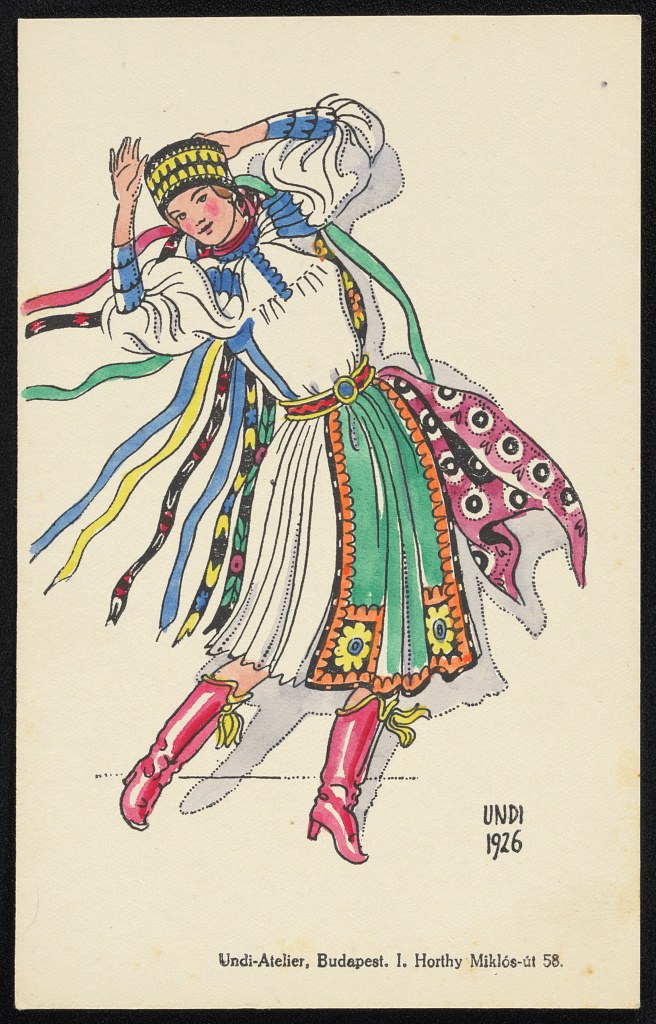
[Woman dancing in folk dress]
Unknown artist
- Collection:
- Prints & Photographs
- Source:
- Library of Congress
- Rights:
- Rights vary by item — check the source record before reusing this image. Source record ↗
- Recorded as:
- Library of Congress — no known restrictions (verify per item)
The work documents the emergence of folk dance as a subject for popular commercial art in the early twentieth century, and specifically the role of Budapest as a center for theatrical folk costume and choreography. It shows how a working artist translated the energy and costume specificity of actual folk movement into a graphic language designed for reproduction and sale, creating a hybrid between ethnographic record and theatrical fantasy.
What you are looking at
A young woman in theatrical folk dress performs a dynamic jumping or leaping pose against a plain cream background. She wears a white linen chemise with a fitted blue bodice and a striking skirt composed of multiple panels in contrasting colors—white, green, and a deep pink or mauve—each panel decorated with geometric patterning in yellow, orange, and white. The skirt panels fan outward dramatically, suggesting rapid rotation or a suspended moment mid-leap. A yellow and black striped headscarf or headdress sits atop her head, and she wears bright pink boots with decorative trim. Her left arm is raised overhead in an arc, while her right arm extends outward. Multiple colored ribbons stream from her bodice and waist—in blue, yellow, red, and green—creating an impression of energetic movement. The figure is suspended in space with no visible ground, emphasizing the lift and buoyancy of the pose.
The dancing
A single dancer, captured mid-leap or jump with both feet off the ground. The body is held with considerable extension: the torso is upright, the left arm reaches high and curves overhead, the right arm extends to balance, and the legs are tucked or extended beneath. The pose suggests either a preparatory moment or the apex of an ascending jump. The ribbons and multiple skirt panels are deployed to create visual emphasis on the rotational energy and height of the movement. The dancer's weight appears fully committed to the jump, with no apparent contact with the ground.
The dance depicted
This appears to depict a Central or Eastern European folk dance, most likely Hungarian or Austro-Hungarian based on the costume elements, the architectural style of boots and embroidered panels, and the celebratory energy. The jumping motif, colorful skirts, and streaming ribbons are consistent with Transylvanian and Hungarian folk dance traditions where high, suspended jumps with spinning motion are signature elements. The multiple panel skirts and ribbon work suggest a stylized theatrical version of traditional regional folk dress rather than historical documentation. The pose does not correspond to any ballroom or staged theatrical technique; it belongs to a vigorous, athletic folk idiom.
How it was made
This is a color-printed illustration, likely a lithograph or chromolithograph based on the flat color planes, precise outlines, and hand-colored or mechanically separated color application visible in the crisp registration. The technique was well-suited to commercial reproduction and circulation as postcards, advertising materials, or theatrical documentation in the 1920s. The signature 'UNDI 1926' appears in the lower right, and the notation 'Undi-Atelier, Budapest. I. Horthy Miklós-út 58.' identifies the Budapest workshop of production. This was a commercial art product, not a unique work, and was designed for wide distribution.
About this work
This is a 1926 lithograph from a Budapest print workshop depicting a single female dancer in an energetic mid-leap pose, dressed in theatrical folk costume with multicolored skirt panels, ribbons, and decorative boots. The artist has chosen to freeze the dancer at the apex of a jump, emphasizing height, spin, and joyful exuberance through the radiating ribbons and fanned skirt panels. The work sits at the intersection of ethnographic documentation and theatrical design—it shows genuine costume knowledge (the embroidered panels and regional boot style are specific) but stages it in a dramatically artificial way (the levitation, the ribbon display, the flattened chromolithographic planes). As a commercial product from interwar Budapest, it represents how European folk traditions were being packaged, visualized, and circulated for urban audiences during a period of intense interest in national identity and cultural heritage.
How to look at it
Observe how the artist has used the skirt panels to suggest rotational energy: they radiate outward like a pinwheel, and the contrasting colors and patterns draw the eye around the figure. Notice how the ribbons stream from the waist and bodice, following lines of movement that the body itself might not convey if static. The lifted, extended left arm and the balance of the right create an upward momentum that the levitation of the figure reinforces. The artist has chosen the moment of maximum extension and lift—not the takeoff, not the landing, but the apex—which was a common choice for depicting joy and virtuosity in folk dance imagery.
The artist
The work is signed 'UNDI' and attributed to the Undi-Atelier (Workshop) in Budapest, located at Horthy Miklós-út 58. This was a commercial art and publishing business operating in the 1920s, producing chromolithographed prints, theatrical designs, and costume illustrations for circulation as postcards and promotional materials. The practice was typical of interwar Budapest: workshops combining commercial printing with theatrical design, often drawing on Hungarian and Transylvanian folk traditions as a source of national cultural identity. No further biographical information on the artist has been recorded.
The period
The 1920s saw a widespread European revival of interest in folk dance and regional costume, driven by nationalist movements, theatrical innovation, and the commercial possibilities of ethnic tourism. Hungary, as a newly sovereign state after World War I and the collapse of the Austro-Hungarian Empire, was particularly invested in recovering and standardizing folk traditions as markers of national identity. Simultaneously, dance was becoming a major subject for commercial art and theatrical design; lithography and chromolithography were the dominant technologies for reaching middle-class urban audiences with images of performance and costume. The Ballets Russes and other avant-garde companies were exploring folk themes, creating demand for images that documented traditional movement and dress.
Where it lives
The work is held in the Prints & Photographs collection of the Library of Congress. It is catalogued as a loose print, likely part of a larger acquisition of interwar Central European theatrical and commercial chromolithographs. The notation of the Budapest workshop on the print itself suggests it was produced for commercial distribution and sale, not commissioned for a specific institutional collection.
Dance in this work
Questions about this work
What dance is this?
The costume and movement style are consistent with Hungarian or Transylvanian folk dance traditions, in which high, spinning jumps are central to the idiom. However, the theatrical presentation—the levitation, the ribbons, the stylized costume—suggests this is a theatrical or commercial interpretation rather than documentation of a specific named dance. It is best understood as a choreographed or staged version designed for urban audiences.
Is this a real person dancing, or an illustration?
This is a colored lithograph or chromolithograph, a commercial print made in a Budapest workshop. It depicts an imagined or stylized version of a folk dancer, not a photograph of an actual performance. The artist may have drawn from life, costume collections, or theatrical performances, but the image itself is a designed graphic work, not documentation.
Why are there so many ribbons?
The ribbons are both historically accurate—folk costume in the region did include ribbons, often attached to headdresses or waistbands—and theatrically exaggerated for visual impact. In the print, they serve to emphasize the speed and direction of the movement, fanning outward to show rotation and energy.
What was the Undi-Atelier?
The Undi workshop was a commercial art and printing business in interwar Budapest. Like many such enterprises, it specialized in producing chromolithographed prints—postcards, theatrical designs, costume illustrations—for sale to the public. These workshops were centers of theatrical design and cultural production in European cities during the 1920s–1930s.
More dance artwork





