49 works in this view — arrow keys or swipe to move between them.
Dance in Art
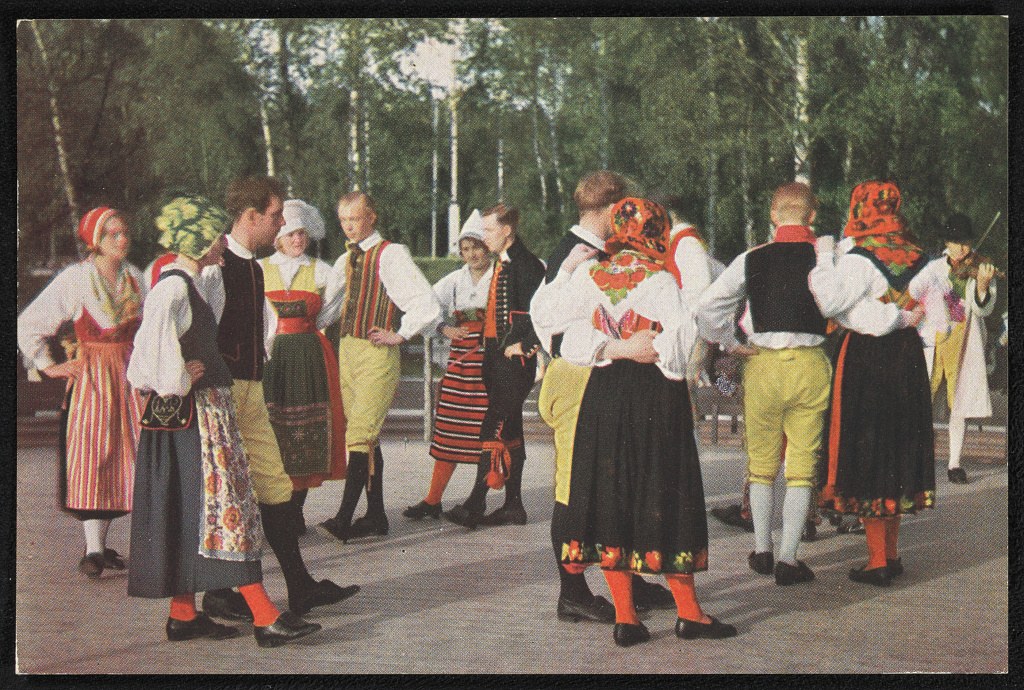
Skansen, Stockholm. The folk dancers of Skansen
Unknown artist
- Collection:
- Prints & Photographs
- Source:
- Library of Congress
- Rights:
- Rights vary by item — check the source record before reusing this image. Source record ↗
- Recorded as:
- Library of Congress — no known restrictions (verify per item)
This image is among the earliest color-photographic records of Scandinavian folk dance in performance context, capturing both the lived tradition and the emerging museological practice of folk preservation. For dancers and historians, it shows how regional folk costume was understood and displayed in an institutional setting in 1900, and it documents Skansen's pioneering role in making folk dance visible to urban audiences.
What you are looking at
A large group of people in vibrant traditional Scandinavian folk dress stand outdoors in what appears to be Skansen, the open-air museum in Stockholm. The setting is a paved area lined with birch trees in the background. The photograph is hand-colored, with saturated reds, yellows, and blues dominating the palette. The dancers wear an array of regional costumes: striped aprons in red and yellow, embroidered vests in contrasting colors, white linen shirts, and distinctive headdresses—some women in red and orange patterned scarves, others in white bonnets. The composition shows roughly fifteen to twenty figures arranged in a loose gathering rather than a formal formation, suggesting either a moment between dances or a posed ensemble portrait. The natural lighting and color saturation indicate this is an early autochrome or hand-tinted photograph, a technology that would place it squarely in the early 1900s.
The dancing
The figures stand in a relaxed, informal arrangement with no clear partnering or hold structure visible. Most stand upright with arms at rest or gesturing naturally; a few figures appear to be in conversation or mid-gesture. The dress is decidedly folk-regional in character—the knee-length breeches on the men, the full-length skirts and layered vests on the women, and the emphasis on woven patterns and embroidery suggest Scandinavian peasant costume rather than formal ballroom training. There is no visible evidence of close-couple ballroom technique, pointe shoes, or theatrical staging.
The dance depicted
This is a documentation of Swedish folk dancing as practiced and preserved at Skansen, the pioneering open-air museum founded in 1891 to collect and perform regional Swedish traditions. The image captures an ensemble of folk dancers in authentic regional costume, though it does not freeze a moment of active dancing—it functions more as a costume and participant documentation. The variety of dress suggests dancers from different Swedish regions, consistent with Skansen's mission to represent the full spectrum of folk culture. Without visible movement or footwork detail, the specific regional variants cannot be identified with confidence, but the overall context anchors this firmly to Swedish folk-regional traditions.
How it was made
This is a hand-colored photographic print, most likely an autochrome or hand-tinted gelatin silver print from the early 1900s. The color saturation, the slight softness of detail in the background, and the documentary quality all point to early color photography. The hand-coloring technique allowed rich, saturated hues while maintaining photographic fidelity—important for costume documentation where color and pattern were essential to regional identity. This type of colored photographic record became a standard tool for folklore and museum documentation in the early twentieth century, enabling wide circulation and preservation of cultural memory.
About this work
This is a documentary photograph of Swedish folk dancers assembled at Skansen, the Stockholm open-air museum, captured around 1900 in hand-tinted color. The image records an ensemble of performers in authentic regional costume, representing the diversity of Swedish folk tradition across different geographical areas. It belongs in a gallery of dance imagery both as a record of choreographic practice—folk dance as ensemble tradition—and as a window into early museum practice: the idea that folk culture could and should be preserved, performed, and displayed for a modern public. The photograph documents not just the dancers but the costume, staging, and curatorial ambition of Scandinavian cultural nationalism at the turn of the century.
How to look at it
This is a posed ensemble portrait rather than a freeze-frame of active dance, so look first at the costume: the careful variation in dress across the group, the embroidery and weaving detail, the regional headwear. Notice how the photograph serves as a record of material culture—the color and pattern of each apron, vest, and headdress is legible and saturated. Second, observe the informality of the pose: there is no symmetrical or formal line, no corps de ballet alignment. The dancers stand as a community rather than as a theatrical ensemble, which reflects both the folk tradition and Skansen's documentary mission. The birch trees and natural outdoor setting underscore that this is understood as a cultural landscape, not a stage.
The period
Skansen opened in 1891 as the world's first open-air museum, founded by Artur Hazelius to preserve Swedish folk culture in response to rapid industrialization and rural depopulation. By 1900, it had become a major tourist attraction and a model for similar institutions across Europe. Folk dance was central to Skansen's curatorial vision: dancers performed traditional regional dances in costume in reconstructed period settings. This coincided with a broader Scandinavian romantic nationalism that celebrated peasant tradition as the authentic root of national identity. The use of hand-colored photography for documentation reflects both the technological moment and the curatorial importance of visual authenticity—color was essential to the regional specificity that made folk costume meaningful.
Where it lives
This is a hand-tinted photographic print in the Library of Congress Prints & Photographs collection, catalogued as a record of Skansen and its folk dance program around 1900. It is one of a body of early color photographs documenting Scandinavian museums and folk traditions.
Dance in this work
Questions about this work
Is this photograph actually showing dancing, or just people in costume?
The photograph is a posed ensemble portrait rather than a moment of active choreography. The figures stand in an informal group arrangement with no visible footwork or partnering. It functions as a costume and personnel documentation—a record of who performed and what they wore—rather than a choreographic record. This was typical of early museum photography: the focus was on the authenticity and visibility of costume and tradition.
What is Skansen and why does it matter for dance history?
Skansen, founded in 1891 in Stockholm, was the world's first open-air museum. It was designed to preserve Swedish folk culture—including dance, music, and crafts—through performance and display in reconstructed period settings. Skansen pioneered the practice of museum-sponsored folk dance performance and became a model for cultural preservation across Europe. For dance history, it marks the moment when folk tradition began to be systematized, curated, and presented to urban audiences as cultural heritage.
How can I identify which Swedish regions these dancers represent?
The costume details—particularly the specific patterns of embroidery, the color combinations of aprons and vests, and the regional headdress styles—would allow a Scandinavian costume specialist to identify regional origin. The photograph's strength is precisely that it preserves these visual distinctions in color and detail. However, without documentation of who these performers were or which regions they represented, a definitive identification would require comparison with museum records or contemporary Skansen documentation.
Why is this a hand-colored photograph and not a color film?
Practical color film stock did not become widely available until the 1930s-40s. In 1900, the only way to produce color photographs was autochrome (a complex, expensive process) or hand-tinting a black-and-white print. Hand-tinting allowed museums and documentarians to capture color information—crucial for folk costume—while remaining affordable and practical. The saturated, somewhat stylized colors visible here are typical of early twentieth-century hand-tinting.
More dance artwork





