49 works in this view — arrow keys or swipe to move between them.
Dance in Art
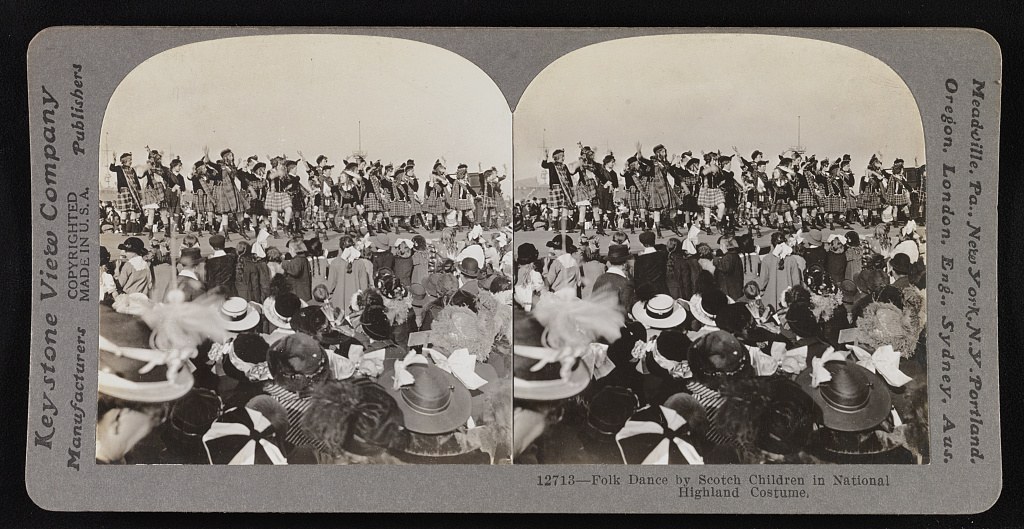
Folk dance by Scotch children in National Highland costume
Unknown artist
- Collection:
- Prints & Photographs
- Source:
- Library of Congress
- Rights:
- Rights vary by item — check the source record before reusing this image. Source record ↗
- Recorded as:
- Library of Congress — no known restrictions (verify per item)
This photograph is a rare stereoscopic record of how Scottish folk dance was institutionalized and presented to public audiences in the 1860s, revealing the visual culture surrounding Highland tradition during a period when such dances were becoming formalized and codified. It shows the gap between dance as living practice and dance as staged spectacle, a tension that continues to shape how folk traditions are preserved and presented. For historians of dance documentation, it exemplifies the power of photography—even in static form—to establish and circulate images of cultural performance across vast distances.
What you are looking at
A stereoscopic photograph showing a large outdoor gathering of children and adults arranged in two rows. The foreground is densely packed with spectators seated or standing on the ground, many wearing light-colored clothing and hats typical of the 1860s. In the background, elevated on what appears to be a platform or stage, a line of children in dark Highland dress stands ready to perform. The lighting is natural daylight, creating strong contrast between the figures and the pale background sky. The composition captures both the performers and the substantial crowd assembled to watch them, suggesting this was a public event or festival.
The dancing
The children in the background stand in a roughly linear formation, dressed uniformly in dark Highland costume including what appear to be kilts and jackets. Their posture is upright and formal, suggesting they are positioned for a group performance rather than in dynamic motion. The spectators in the foreground are seated or crouching, creating sightlines toward the performers. The bodies are static and arranged for visibility rather than caught mid-movement, indicating this is a preparatory moment or formal positioning before or after the dance rather than a capture of active dancing.
The dance depicted
This depicts a folk dance performance by Scottish children in traditional Highland dress, likely at a public festival or celebration. The title identifies it as a folk dance in National Highland costume, though the photograph does not capture the dancers in active motion. Given the formal positioning and large audience, this appears to be a staged public performance rather than social dance. The Highland costume and outdoor festival setting suggest this could be a reel, strathspey, or other Scottish country dance, forms that were performed competitively and ceremonially in Scotland during this period. However, the static nature of the image means the specific dance form cannot be determined from movement alone.
How it was made
This is a stereoscopic photograph, a format that creates a three-dimensional effect when viewed through a stereoscope—a popular visual medium of the 1860s designed for domestic consumption and public education. The dual side-by-side images are characteristic of stereocards, which were mass-produced and widely distributed. The photograph's clarity and composition suggest professional production, and the publisher credit (Keystone View Company, visible on the mount) indicates commercial distribution. Stereoscopy allowed audiences to experience distant events and exotic cultures in immersive detail, and this image served both documentary and entertainment purposes.
About this work
This stereoscopic photograph documents a public performance of Scottish Highland dance by children, captured during the height of the Victorian era's fascination with folk traditions and ethnic costume. The image is evidence of how Highland dance was presented and consumed in the nineteenth century—as a formal, staged spectacle for public viewing rather than as social practice. The large assembled crowd and professional photographic treatment indicate that such performances were significant public events, worthy of documentation and commercial reproduction for viewing in homes and exhibitions across Britain and beyond.
As a stereograph, this work occupies a unique position in dance history: it is neither a painting nor a theatrical photograph, but rather a mass-produced visual document designed to bring distant performances into intimate domestic space. It captures not just the dance itself but the entire apparatus of Victorian folk performance—the costumes, the staging, the audience participation, and the commodification of cultural tradition.
How to look at it
The stereoscopic format requires viewing through a stereoscope to see the intended three-dimensional effect, which would make the scene appear to recede in space and give the crowd volume and depth. Without the viewer, the dual images can be cross-eyed or studied separately. Notice the careful composition: the performers are elevated and central, the audience carefully positioned to frame them, suggesting this is a deliberately arranged photograph rather than a candid document. The formal arrangement of the children and the large public attendance indicate this was a significant civic or cultural event, not an impromptu village gathering. The photograph prioritizes the spectacle of viewing—it documents not just dance but the social occasion of watching dance performed.
The artist
The photographer is not named in the record. The image is credited to the Keystone View Company (or Keystone Publications), a major American publisher of stereoscopic views founded in the 1890s and active through much of the twentieth century. Keystone produced thousands of stereographs on travel, culture, dance, theater, and daily life, employing networks of photographers to document subjects of public interest. They were known for both original photography and acquisition of images from other sources, making them one of the largest distributors of stereoscopic content to American and international audiences.
The period
The 1860s saw intense Victorian interest in folk traditions, ethnic costume, and 'national' dances. Highland dress, suppressed after the 1746 Act of Proscription, had been rehabilitated as a symbol of Scottish identity following the Highland regalia acts of the 1780s and intensified by Scott's romantic writings. Public Highland Games and dance competitions were growing in popularity, and Highland dance was being formalized into competitive disciplines. Simultaneously, photography was revolutionizing how distant performances could be experienced; stereoscopy made three-dimensional tourism possible from the parlor. This photograph sits at the intersection of these trends—the Victorians' hunger for authentic folk culture, their enthusiasm for visual documentation, and the emerging codification of Highland dance as a formal performance genre.
Where it lives
This stereograph is held in the Prints & Photographs collection at the Library of Congress and originates from the Keystone View Company archive, a collection of over 200,000 stereoscopic views documenting global culture, geography, and events from the 1890s onward. The catalogue number 12713 places it within the Keystone system. As a mass-produced stereograph, it would have been available for purchase by private collectors and institutions throughout the early twentieth century.
Dance in this work
Questions about this work
Was this a real performance or posed for the camera?
This appears to be a real public performance or festival event, given the large assembled crowd and the formal staging. However, the photograph itself is posed—the moment is arranged for the camera rather than captured candidly. The children stand in formation ready to perform or having just performed, and the spectators are arranged to be visible to the photographer.
Why is this a stereograph rather than a single photograph?
Stereographs were the dominant form of photographic entertainment and education in the nineteenth and early twentieth centuries. The dual images create a three-dimensional effect when viewed through a stereoscope, making the scene appear vivid and immersive. This made distant events feel present to viewers at home, and stereographs were produced and sold commercially by the millions.
Can you tell what dance they are performing?
The Highland costume and the Scottish context suggest this could be a reel, strathspey, or other traditional Scottish country dance, but the static nature of the photograph means the specific footwork and movement patterns are not visible. Without seeing the dancers in motion, only the costume and setting point toward the dance form.
Why were children dressed in full Highland costume?
By the 1860s, Highland dress had become a symbol of Scottish national identity and cultural pride. Public performances by children in traditional costume served both educational and patriotic purposes, allowing communities to celebrate and transmit cultural heritage to younger generations.
More dance artwork





