49 works in this view — arrow keys or swipe to move between them.
Dance in Art
Bokor (Cambodge). Folk-dance in Cambodia
Unknown artist
- Collection:
- Prints & Photographs
- Source:
- Library of Congress
- Rights:
- Rights vary by item — check the source record before reusing this image. Source record ↗
- Recorded as:
- Library of Congress — no known restrictions (verify per item)
The misclassification of labor as dance reveals how ethnographic archives have historically absorbed economic and domestic work into dance categories to make non-Western cultures legible to Western audiences. For dance historians, it documents the genre boundaries in flux in the 1960s and the danger of relying on archival labels without visual analysis. For Cambodian researchers, it preserves a record of mid-20th-century material culture and women's agricultural knowledge.
What you are looking at
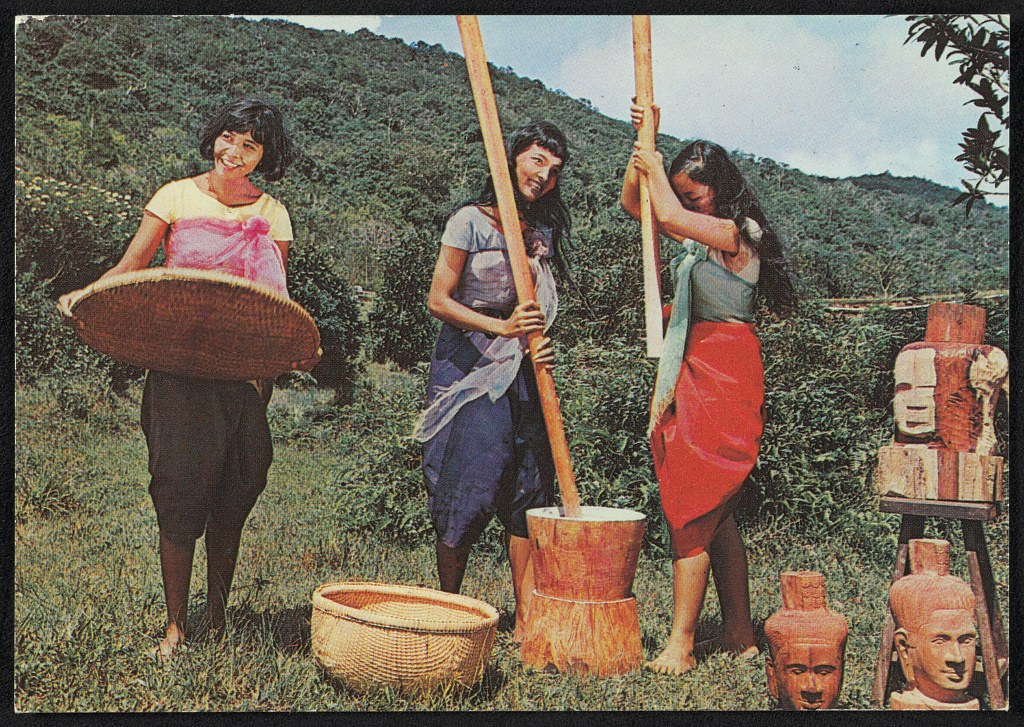
Three women work in an outdoor setting with dense, forested hills rising behind them. They are processing what appears to be grain or similar crop material using traditional methods: the woman on the left holds a large, shallow woven basket; the center figure grips a long wooden pole or pestle; the woman on the right steadies another tall pole. Woven baskets sit on the ground between them. The photograph is hand-colored, with the women's sarongs rendered in deep reds and blues, their upper bodies bare or wrapped in lighter cloth. To the right, carved wooden statues or ritual objects are partially visible—heads and torsos of human figures with distinctive features. The setting and objects suggest this is ethnographic documentation of daily work practices and ritual culture, possibly from the 1950s based on the style of the print.
The dancing
The three women are positioned in active, purposeful stances rather than posed stillness. Their bodies lean into the work: the center figure bends forward, gripping the tall wooden implements with both hands; the woman on the left extends her arms to balance the large woven tray; the woman on the right leans back slightly to manage her pole. All three are barefoot and engaged in synchronized or complementary labor rather than partnered dance movement. Their postures and spacing suggest collaborative work rhythm rather than choreographed dance formation.
The dance depicted
The photograph is catalogued as 'Bokor (Cambodge). Folk-dance in Cambodia,' but the image depicts labor—winnowing or grinding grain using traditional woven baskets and wooden poles—rather than dance in the conventional sense. However, ethnographic practice of the 1960s often classified sustained rhythmic work, especially women's collective labor with material tools, as 'folk-dance' when documented in colonial or postcolonial frameworks. The term 'bokor' does not correspond to documented Cambodian dance forms and may be a transcription error or misattribution by the cataloguer. What is visible is the embodied knowledge and synchronized timing required for agricultural processing.
How it was made
This is a hand-colored photograph, likely a color transparency or print from the mid-20th century. The careful application of color to the women's clothing (saturated reds and blues) and the warm tones of the carved wooden figures suggest either hand-tinting of a black-and-white photograph or an early color process. The print's composition, documentary framing, and ethnographic caption indicate it was produced for an archive or educational collection—not as fine art. The technique allowed circulation of images of non-Western labor and ritual practices to Western audiences, though the interpretation ('folk-dance') reflects the compiler's assumptions rather than local categorization.
About this work
This is a color photograph from the Library of Congress documenting Cambodian women engaged in grain processing or similar agricultural labor in a forested setting. The work is catalogued under 'folk-dance,' a classification that reflects mid-20th-century ethnographic practice of treating sustained collective labor with rhythmic components as a dance form. The image is valuable not as documentation of dance proper but as evidence of how Western archives categorized and represented Southeast Asian women's embodied work, and as a record of traditional processing techniques and tool design. The presence of carved wooden figures in the frame suggests the photographer intended to link daily practice with ritual or ceremonial context.
How to look at it
Attend to the women's feet and the ground—they are engaged in steady, repetitive work that requires balance and synchronized timing but is fundamentally instrumental labor, not performance. Notice the wooden implements: the poles and baskets are not props but the primary actors in the image. The carved figures to the right suggest the photographer was making a deliberate connection between daily practice and sacred or commemorative objects. The hand-coloring of the photograph was itself a labor-intensive process, indicating the image was valued enough to merit individual treatment for circulation.
The period
In the 1950s–1960s, ethnographic photography and color transparency collections were expanding rapidly as tools of cultural documentation. The Library of Congress and similar institutions acquired thousands of images from fieldwork, tourism, and missionary activity. The cataloguing practice of labeling work, ritual, and daily life under dance headings reflects the era's aesthetic fascination with non-Western cultures as repositories of authentic movement and rhythm. Cambodia was documented during a period of relative stability before the political upheaval of the following decades, making such photographs now significant as records of a lost material world.
Where it lives
The photograph is held in the Prints & Photographs Online Catalog of the Library of Congress, a major archive of 20th-century documentary imagery. It was likely acquired as part of a collection documenting Southeast Asian culture, possibly from a missionary, academic, or commercial photographer working in Cambodia around 1960.
Questions about this work
Is this really a dance?
The image shows agricultural work—likely grain winnowing or processing—not dance in the modern sense. The cataloguing as 'folk-dance' reflects mid-20th-century ethnographic practice of classifying rhythmic collective labor as dance. The women are engaged in synchronized, coordinated work with tools, which shares the temporal and embodied qualities of dance but serves a productive, not performative, purpose.
What is 'bokor'?
The catalogue uses 'bokor' as a descriptor, but it does not correspond to known Cambodian dance forms or clearly documented labor practices. It may be a transcription error, a term from a local language that was not correctly translated, or a classifier applied by someone unfamiliar with Cambodian cultural categories. The image itself does not clarify its meaning.
Why is this in a dance gallery?
Because the archive catalogued it as folk-dance, and the gallery is examining how dance categories have been constructed and disputed. Including it raises questions about what counts as dance, whose definitions matter, and how archival labels shape what we see in images.
What can you tell about the tools and technique?
The women are using woven baskets (visible on the ground) and long wooden poles or pestles for processing grain or a similar commodity. The technique requires coordination between the three workers to manage the weight and rhythm of the poles while moving material in or through the baskets. This is traditional technology and knowledge that would have been passed down within families and communities.
More dance artwork





