49 works in this view — arrow keys or swipe to move between them.
Dance in Art
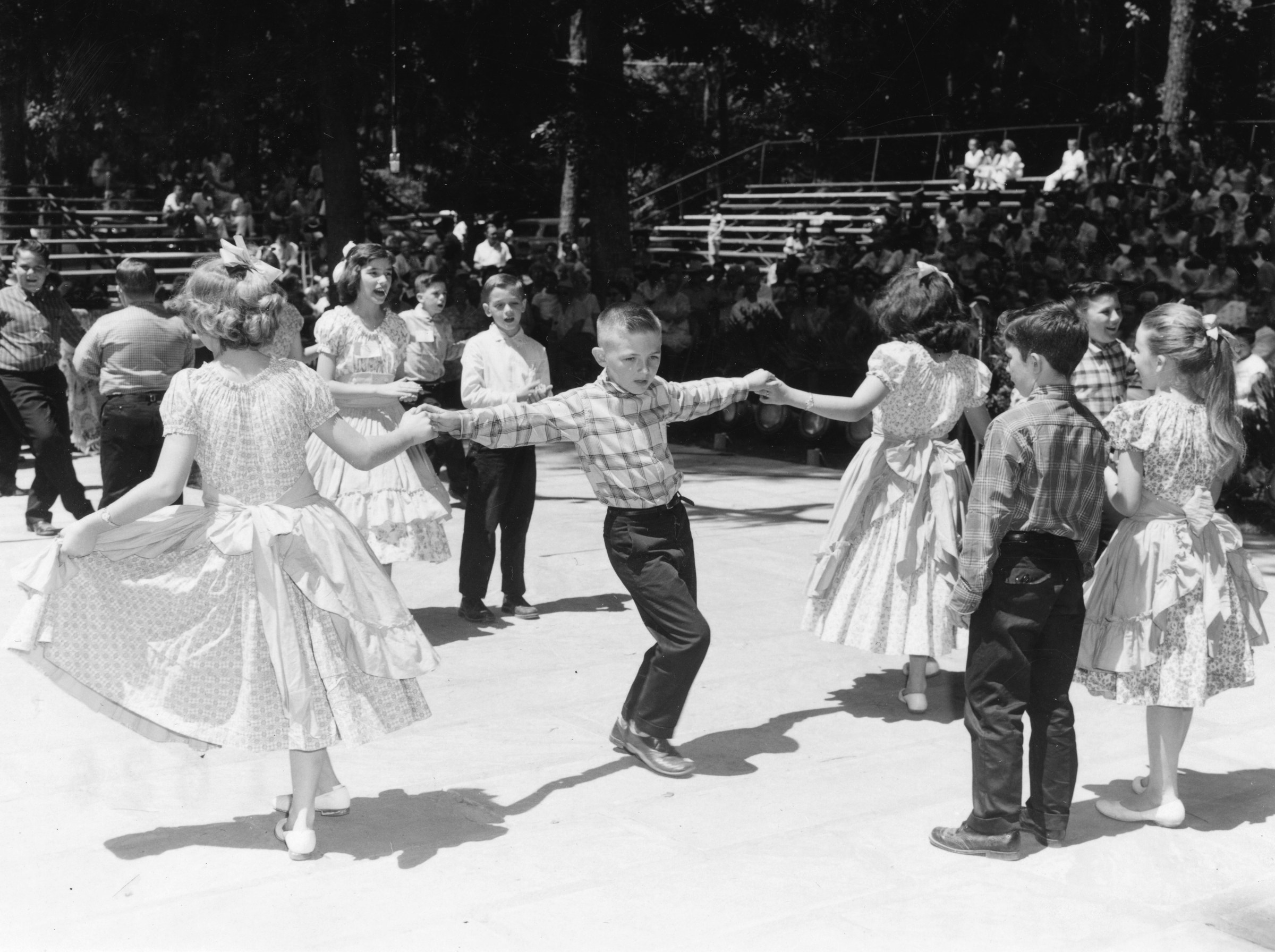
White Springs School 5th Graders Dancing.
Unknown artist
- Collection:
- Prints & Photographs
- Source:
- Library of Congress
- Rights:
- Rights vary by item — check the source record before reusing this image. Source record ↗
- Recorded as:
- Library of Congress — no known restrictions (verify per item)
This photograph is evidence of when and how American schools taught dance to children—not as an art form but as coordination and social play embedded in Physical Education. The image shows the gender integration, age appropriateness, and outdoor public presentation of school dance in this period, making it valuable for understanding both dance pedagogy and childhood experience in post-war America.
What you are looking at
A large outdoor gathering in bright sunlight, with bleachers full of spectators visible in the background among trees. In the foreground, a boy in a plaid shirt and dark trousers stands in the center of a circle of children, his arms extended outward in a wide open position. Surrounding him are approximately six girls in light printed cotton dresses, most with short puffy sleeves and gathered skirts typical of 1950s children's wear. The children stand in a rough circle on a paved ground, and the boy appears to be turning or spinning with his arms spread, while the girls on either side hold or reach toward his hands. The composition captures a moment of coordinated, playful movement—likely a schoolyard game or structured dance activity. The bright daylight casts clear shadows on the ground.
The dancing
The central boy is positioned with both arms extended fully to either side at shoulder height, palms open, in a position that suggests continuous rotation or sustained turning. Two girls on his left and at least two on his right appear to be holding or maintaining contact with his hands or arms. The girls' postures are upright and engaged, their bodies turned toward him, indicating they are actively participating rather than passively standing. There is clear weight distribution and balance in the circle formation, with no dancer appearing to fall or lose footing, suggesting this is an established, taught movement pattern rather than improvised play.
The dance depicted
This appears to be a structured circle dance, most likely a folk or social form taught in American elementary schools in the 1950s. The open-circle holding pattern and the spinning or rotating motion suggest games like 'London Bridge,' 'Ring Around the Rosie,' or similar American folk circle dances commonly taught in Physical Education or music classes. The formality of the setup—the organized bleachers and spectators, the deliberate spacing—indicates this is a scheduled school performance or demonstration rather than free-play recess activity. The mixed-gender group and age consistency suggest a fifth-grade class activity, as the caption notes.
How it was made
This is a black-and-white photograph, likely taken with available daylight and shot outdoors. The clarity of figures and shadows, combined with the grain structure visible at high magnification, indicates medium-speed film stock typical of mid-20th-century press or documentary photography. The depth of field keeps both foreground dancers and background bleachers in focus, requiring either a stopped-down aperture or a wide-angle lens. The photograph was taken from ground level at roughly the dancers' eye height, a compositional choice that places the viewer among the participants rather than above or distant from them.
About this work
This is a documentary photograph of elementary school children performing a circle dance during what appears to be a school assembly or physical education demonstration in 1959. The image records a moment in American public education when folk and circle dances were standard curriculum content, taught to children as both coordinated movement and social play. It belongs in a dance archive because it documents the actual practice of teaching dance to children in mid-20th-century America—not a professional or theatrical performance, but the everyday, pedagogical transmission of movement and coordination through structured games.
How to look at it
Watch the boy's extended arms: they suggest continuous rotation, not a static position held for the photograph. The girls' hand positions—some grasping, some reaching—capture the mechanics of the circle, where centripetal force and hand-holding maintain the formation. The real moment here is the spinning: the photographer has caught the children mid-movement, with weight shifting and momentum visible in their postures. This is not a posed 'say cheese' portrait but an action shot of an actual dance pattern unfolding.
The artist
The photographer is not credited in the catalogue record. The image is held in the Library of Congress Prints & Photographs collection, consistent with press photography, educational documentary, or WPA-era documentation, all of which produced similar outdoor school photographs in the 1950s.
The period
In 1959, American elementary schools routinely incorporated folk dances and circle games into Physical Education and music curricula, following Progressive Era educational theory that valued coordinated group movement and social cohesion. This practice had roots in early-20th-century pedagogical reform and continued through the mid-century, before being largely displaced by more structured sports and individual fitness models. The photograph was taken during a period when children's public performances—school assemblies, field days, and demonstrations—were common community events.
Where it lives
The photograph is held in the Library of Congress Prints & Photographs Online Catalog (loc.gov/pictures), identified as part of American documentary or educational photography collections. The lack of photographer attribution suggests it may be from an institutional or archival source rather than a named press photographer.
Dance in this work
Questions about this work
What dance is this?
It is most likely a circle dance or folk game commonly taught in American schools, such as 'London Bridge' or 'Ring Around the Rosie,' though the specific name is not documented. The held-hands circle formation and the central spinning motion are characteristic of this class of dances, which were standard in Physical Education curricula in the 1950s.
Why are they outdoors?
The bleachers and gathered crowd indicate this is a scheduled school demonstration or assembly, likely held outdoors for visibility and space. School performances of PE activities and folk dances were often public events, held in courtyards, athletic fields, or gymnasiums with tiered seating for parents and other classes.
Was this a professional performance?
No. This is an educational activity—a school class demonstration or PE unit. The children are students, not trained dancers, and the dance is a pedagogical exercise in coordination and social participation, not an artistic performance.
How do we know this is 1959?
The catalogue record dates it to 1959. The children's clothing, hairstyles, and the photograph's black-and-white film stock and color palette are consistent with the late 1950s, but the record is the primary source.
More dance artwork





