49 works in this view — arrow keys or swipe to move between them.
Dance in Art
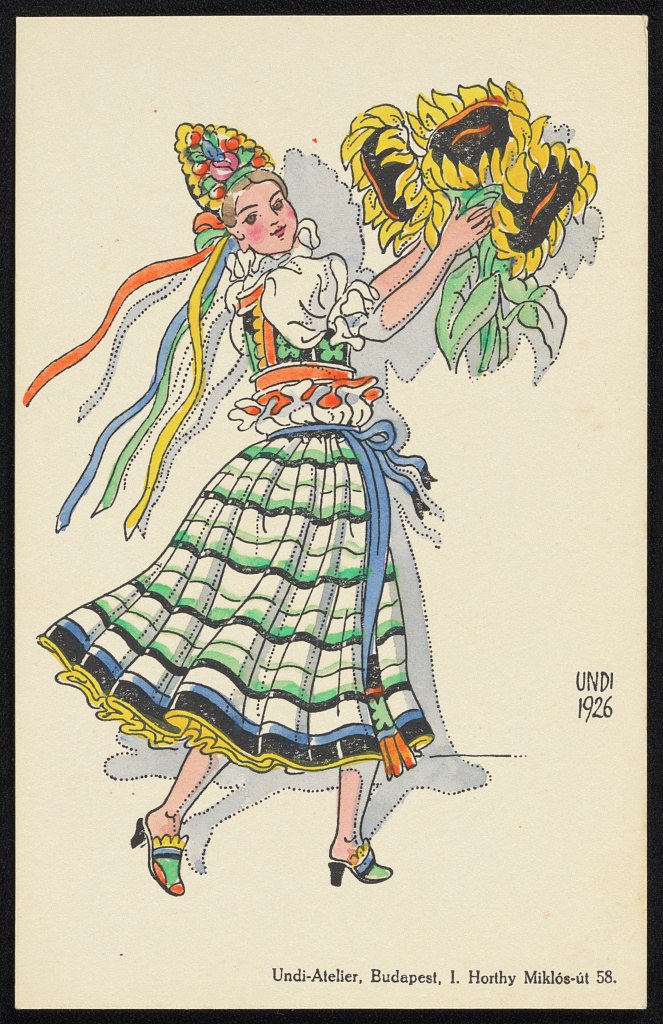
[Woman dancing in folk dress holding sunflowers]
Unknown artist
- Collection:
- Prints & Photographs
- Source:
- Library of Congress
- Rights:
- Rights vary by item — check the source record before reusing this image. Source record ↗
- Recorded as:
- Library of Congress — no known restrictions (verify per item)
Folk dance histories often rely on written description or performance records; visual documentation from the period of practice is rare and valuable. This image offers a record of how a Central European folk tradition looked and was valued in the 1920s—what colors, silhouettes, and gestures embodied regional identity at a specific moment. It also reveals how commercial artists and printmakers made folk traditions visible and circulated them beyond their communities of origin.
What you are looking at
A young woman in festive folk dress stands in a dynamic pose, holding a large bouquet of sunflowers aloft in both hands. She wears a richly decorated costume: a white blouse with puffed sleeves, a colorful headdress adorned with flowers and ribbons in red, yellow, and blue, and a voluminous skirt with horizontal stripes in green, white, and navy blue, trimmed with deep yellow at the hem. Flowing ribbons stream from her headdress—red, yellow, and blue—creating a sense of movement against the pale background. Her posture is energetic and buoyant, with weight distributed lightly on the balls of her feet in dark shoes. The composition is a three-quarter view, with the figure centered and slightly tilted, suggesting a moment of joyful motion or celebration. Dotted lines suggest a studio or promotional context rather than a narrative scene.
The dancing
A single standing figure with raised arms holding flowers, the body positioned in a spirited, upright stance. The weight appears lifted and forward, with the chest open and the limbs arranged to suggest both stability and exuberance. The raised arm position and the angle of the torso convey an improvisational or celebratory quality rather than a codified dance technique. The posture reads as festive and expressive rather than balletic or strictly formal.
The dance depicted
This is a folk or regional dance costume study, most likely Hungarian or Central European, given the style of dress and the signature's reference to Budapest (Undi-Atelier). The sunflowers, the striped skirt, the floral headdress, and the flowing ribbons are consistent with Hungarian folk celebration dress. The pose suggests a moment in a living folk tradition—possibly from circle dances, harvest celebrations, or performative demonstrations of regional identity—rather than a staged theatrical reproduction. The image appears to document or idealize this tradition rather than teach specific choreography.
How it was made
This is a hand-colored lithograph or chromolithograph, executed in the early 20th-century commercial art style. The delicate rendering of the figure, the careful attention to textile patterning (stripes, florals, ribbon folds), and the dotted outline suggesting a cut-out or promotional format are characteristic of theatrical or commercial costume illustration from the 1920s. The technique allowed for mass reproduction and wide circulation—this was commercial art, likely produced for theatrical, promotional, or ethnographic curiosity purposes, and distributed as a postcard or artist's promotional card.
About this work
This 1926 color lithograph documents or celebrates a moment in Hungarian folk dance culture, rendered by the Budapest-based Undi-Atelier as a commercial illustration. The figure is not performing choreography in the sense of a learned technique, but rather embodying the festive dress and celebratory spirit of Central European folk tradition. The work sits at the intersection of ethnographic documentation and commercial art—a window into how folk identity and regional costume were visualized and packaged for a mid-century European audience.
The image is valuable precisely because it captures not a formal stage dance but a living tradition in a moment of transition—when folk practices were being both documented and romanticized through the lens of early 20th-century commercial illustration. The artist has chosen a pose of exuberant stillness that conveys joy and celebration rather than technical expertise, reflecting how folk dance was understood and represented in its own time.
How to look at it
Attend to the quality of the pose: it is neither the precise line and stillness of ballet nor the grounded, hip-weighted posture of many other European folk forms. Instead, the artist has chosen an upright, buoyant moment that conveys joy and celebration. The floating quality of the ribbons and the high, open arm position suggest a moment of music and movement captured mid-gesture rather than a held technique. Notice also the extraordinary attention to textile pattern—the striped skirt, the floral headdress, the ribbon work—which dominates the visual interest and tells us that the costume itself, not the body's movement, was the primary subject. This is a portrait of dress and identity, not a lesson in choreography.
The artist
Undi-Atelier was a Budapest-based commercial art studio active in the 1920s, specializing in costume illustrations, theatrical designs, and ethnographic subject matter. The studio's work reflects the early 20th-century European fascination with regional folk traditions and their visual documentation. The style and production method—hand-colored lithography with professional finish—indicate a studio capable of serving theatrical, publishing, or tourist markets. The signature and address (Horthy Miklós-út 58, Budapest) confirm this was a professional, established operation.
The period
The 1920s saw a widespread European revival of interest in folk culture and regional identity, partly as a response to the displacement and cultural upheaval of the First World War. Hungary, as a newly reduced nation following the Treaty of Trianon (1920), was particularly engaged in documenting and celebrating its national and regional traditions. Costume illustration was a major vehicle for this work—commercial studios produced images of folk dress for theatrical productions, ethnographic exhibitions, tourism, and nostalgic consumption. The same period saw the rise of staged folk-dance ensembles and the professionalization of folk performance. This image sits within that context: it is both a celebration of authentic tradition and a product of the commercial apparatus that was already transforming folk practice into spectacle.
Where it lives
The work is held by the Library of Congress Prints & Photographs Online Collection. It is catalogued as a commercial color lithograph produced by a commercial art studio in Budapest and distributed as a postcard or promotional card in the 1920s, likely for theatrical, ethnographic, or tourist circulation.
Dance in this work
Questions about this work
Is this a real Hungarian folk dance?
The costume and pose draw from real Central European folk traditions, particularly Hungarian celebration dress. However, the image is a commercial illustration, not a documentary photograph or choreographic notation. It represents how folk tradition was idealized and imagined by early 20th-century commercial artists and their audiences, rather than how it was actually performed. The pose—buoyant, open, celebratory—conveys the spirit of the tradition but is not a record of specific steps or technique.
What are the sunflowers?
Sunflowers were strongly associated with Hungarian identity and harvest traditions by the early 20th century. In this illustration, they serve both as a symbol of Central European agricultural life and as a visual anchor—a recognizable marker of regional identity for viewers who might not be familiar with the costume details. The flowers also provide visual balance and movement, filling the upper part of the composition and creating a sense of exuberance.
Who was Undi-Atelier?
Undi-Atelier was a professional commercial art studio in Budapest active in the early-to-mid 20th century. They specialized in costume illustrations, theatrical designs, and ethnographic subjects. This work is typical of their output: a polished, hand-colored lithograph designed for mass reproduction and circulation. The studio name suggests a single artist or a small partnership working in a commercial mode rather than a fine-art context.
Why is this a lithograph?
Lithography was the dominant commercial color-printing technology of the early 20th century. It allowed for detailed, hand-colored images to be reproduced and distributed widely as postcards, theater programs, or promotional materials. The technique meant that this image could reach audiences far beyond Budapest and could be produced in quantity at a low cost per unit—making it an ideal medium for commercial culture and the distribution of images of folk tradition.
More dance artwork





