49 works in this view — arrow keys or swipe to move between them.
Dance in Art
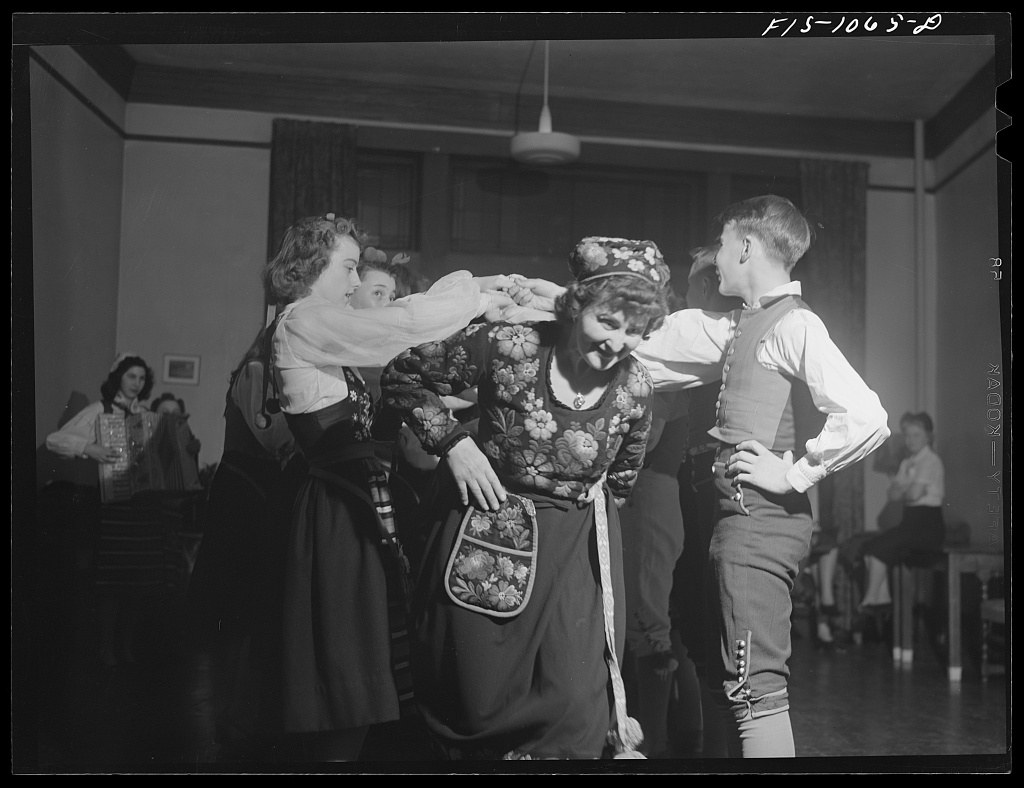
A Swedish folk dancing group in Minnesota
Unknown artist
- Collection:
- Prints & Photographs
- Source:
- Library of Congress
- Rights:
- Rights vary by item — check the source record before reusing this image. Source record ↗
- Recorded as:
- Library of Congress — no known restrictions (verify per item)
This photograph documents folk dance in its native habitat: not on a concert stage but in a community hall, with an elder transmitting knowledge to the next generation. For dance historians and educators, it provides rare evidence of how immigrant communities maintained traditional dance practice in America during the mid-twentieth century. For folklorists and cultural researchers, it captures a moment of living tradition at a time when such transmission was still primarily oral and embodied rather than mediated by video or notation.
What you are looking at
A black-and-white photograph captures a Swedish folk dancing group mid-performance in what appears to be an indoor community hall or gymnasium in Minnesota, circa 1942. The central figure is an older woman wearing a traditional floral-patterned dress with a matching headscarf and embroidered apron; she is surrounded by younger participants, including at least two boys and a girl, who are engaged with her in the dance. The woman's posture is animated—her body tilted slightly, her arms extended in active gesture—suggesting she is either leading the group or demonstrating steps. The children cluster around her with evident attention and participation, their bodies oriented toward the center. The setting is utilitarian: plain walls, a simple pendant light fixture overhead, and blurred figures of other spectators or participants visible in the shadowed background. The photograph's composition emphasizes the intergenerational transmission of dance, with the elder at the focal point and the children as active learners rather than passive observers.
The dancing
The central woman stands with weight distributed and arms raised in an open, gestural frame—neither a closed ballroom hold nor a rigid folk stance, but an expressive, teaching posture. The boy on the right stands with one arm extended toward her, his torso upright and engaged. The girl on the left mirrors this attentiveness, her body angled toward the center. A second boy appears behind, also oriented toward the woman. None of the figures show the tight coordination of a rehearsed formation; instead, they display the looser, individualized engagement typical of folk dance instruction or informal group participation. The woman's slight forward lean and arm position suggest she is actively guiding or demonstrating rather than executing a fixed choreographic pattern.
The dance depicted
This is almost certainly Swedish folk dancing, as the catalogue record states and as the woman's costume—particularly the floral dress, embroidered apron, and traditional headscarf—confirms. The dance style cannot be identified with precision from the photograph alone; the informal grouping and teaching context suggest this may be a Swedish folk dance being transmitted to younger Americans or second-generation Swedish Americans in Minnesota. The image documents folk dance not as performance but as living practice and cultural transmission. The children's direct engagement and the elder's teaching posture indicate this was a community activity rather than a staged spectacle.
How it was made
This is a black-and-white photographic print, likely a gelatin silver print given the date and archival context (Library of Congress Prints & Photographs collection). The photograph was taken indoors under artificial light, producing sharp detail in the foreground figures but softer focus in the background. The photographer has chosen a moment of active gesture rather than a static pose, capturing the dance as lived practice. The document-like quality and the intentional framing suggest this may be part of a New Deal-era cultural documentation project, consistent with the Library of Congress's holdings from the 1940s.
About this work
This is a photograph of Swedish folk dancers in Minnesota, documenting the transmission of traditional dance from an elder to younger community members in 1942. The image shows folk dance not as performance art but as cultural practice embedded in everyday community life. It belongs in a gallery about dance because it captures a crucial but often overlooked aspect of dance history: the informal, intergenerational teaching and maintenance of tradition in immigrant and ethnic communities. The photograph is visually specific enough to tell us something about how Swedish folk dance was taught and practiced in mid-twentieth-century America—how the elder's body became a teaching text, and how children learned through direct observation and mimicry.
How to look at it
Observe the woman's body as a teaching instrument: her arms are not executing a fixed step but reaching out and demonstrating. Notice how the children are positioned around her—not in a line or in pairs, but in a loose, flexible arrangement that allows each child to see her movement from slightly different angles and to engage at his or her own pace. The photograph freezes a moment of instruction, not a moment of synchronized execution. Look at the faces and body orientation of the children to see the seriousness of their attention; this is not play-acting but genuine transmission of cultural knowledge.
The period
In 1942, America was at war and experiencing intense migration and demographic change. Swedish immigrants and their descendants maintained folk traditions through ethnic societies, church groups, and community organizations, particularly in regions of heavy Scandinavian settlement like Minnesota. The New Deal era (1930s–early 1940s) had generated significant interest in American regional and ethnic folk cultures, and the Library of Congress's holdings suggest this photograph may be part of that broader cultural documentation effort. Meanwhile, in the concert world, European folk dance was being choreographed and staged for American audiences; this photograph shows the contrast between that theatrical practice and authentic community transmission.
Where it lives
The photograph is held in the Library of Congress Prints & Photographs Online Catalog. Based on its provenance code and archival context, it likely belongs to a larger collection of American cultural documentation from the 1940s, possibly related to New Deal-era ethnographic recording or to regional studies of immigrant communities.
Dance in this work
Questions about this work
What is Swedish folk dance?
Swedish folk dance encompasses a broad repertory of traditional dances—including couple dances like the hambo, group formations like the halling, and circle dances—that developed over centuries in Sweden and were maintained and adapted by Swedish immigrant communities worldwide. The costume visible in this photograph (floral dress, embroidered apron, headscarf) is a reconstructed or idealized 'traditional' dress worn for folk dance performances and teaching rather than everyday wear.
Why is this photograph important for understanding folk dance in America?
Most photographs of folk dance from this period show staged performances or dance troupes in formal costume. This image documents the informal, intergenerational transmission of tradition within a community—a much rarer and equally important aspect of folk dance practice. It shows how ethnic communities maintained cultural knowledge through direct embodied teaching rather than through notation or formal instruction.
Where was this taken?
The catalogue record identifies it as Minnesota, which had a significant Swedish immigrant population. The utilitarian indoor setting suggests a community center, church hall, or school gymnasium—spaces where ethnic organizations typically held cultural events and taught traditional practices to younger generations.
What does the woman's posture tell us?
Her forward lean, raised arms, and open frame suggest she is demonstrating or guiding the children through the dance rather than executing a formal pattern. Her body language indicates patience and clarity of teaching—she is making her movement visible and accessible to learners.
More dance artwork





