49 works in this view — arrow keys or swipe to move between them.
Dance in Art
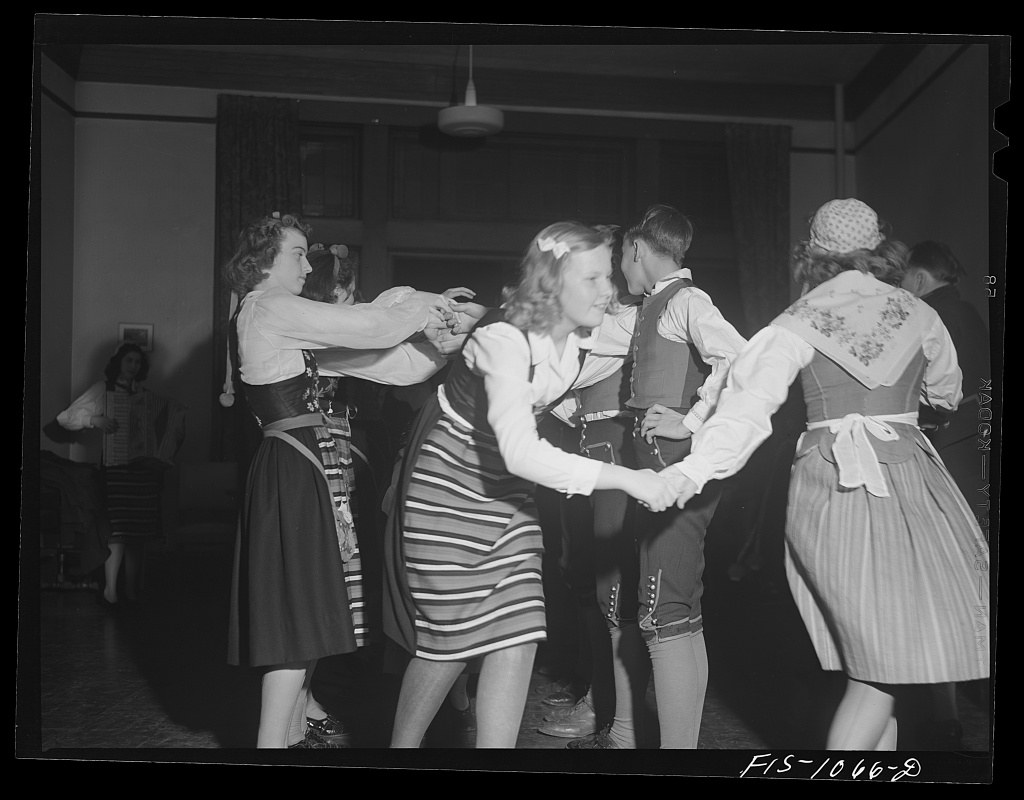
A Swedish folk dancing group in Minnesota
Unknown artist
- Collection:
- Prints & Photographs
- Source:
- Library of Congress
- Rights:
- Rights vary by item — check the source record before reusing this image. Source record ↗
- Recorded as:
- Library of Congress — no known restrictions (verify per item)
This is rare documentary evidence of how immigrant communities maintained and transmitted dance traditions outside formal performance contexts. It shows the actual bodies, spaces, and social conditions of folk dance practice in America, rather than the staged or theatrical versions that are more commonly photographed. The image testifies to dance as lived culture—central to community identity and social life—rather than as spectacle.
What you are looking at
A black-and-white photograph captures an indoor social dance in progress, likely in a community hall or similar space. Six people are visible—four actively dancing in the center, one seated at left, and another figure in the background. The four dancers form two couples in close embrace, moving together in what appears to be a turning or circular motion. The men wear dark vests and white shirts; the women wear striped and patterned dresses typical of 1940s casual wear, with one woman wearing a decorative head covering. The lighting is even and somewhat flat, characteristic of documentary photography of the era. A ceiling fixture and plain interior walls are visible, suggesting a utilitarian rather than formal venue. The composition captures the dancers mid-movement, their bodies leaning together with concentrated expressions, suggesting genuine participation rather than posed formality.
The dancing
The four central dancers are arranged in two couples, each pair in a closed ballroom-style hold with the man's right hand on the woman's back and her left hand on his shoulder, their other hands clasped at roughly chest height. Both couples are executing a turning movement—their bodies are angled and leaning slightly inward as if tracing a circular path. The weight appears to be forward and grounded, with upright posture rather than the extended frame of formal ballroom. The dancers' faces show focus and engagement rather than performance affect.
The dance depicted
This appears to be a folk or social dance typical of Swedish-American immigrant communities in the Upper Midwest during the 1940s. The closed-hold frame and turning motion are consistent with Swedish folk dances adapted for social dancing in America, such as variations of the polska or traditional couple dances performed in community settings. The casual, energetic tone suggests this is social recreation rather than formal performance or competition. Such dances were central to maintaining cultural identity in immigrant communities and were danced at gatherings, celebrations, and community events.
How it was made
This is a black-and-white photograph, likely a gelatin silver print given the date and source (Library of Congress Prints & Photographs collection). The even exposure and sharp focus suggest it was taken with a documentary or news camera. The lighting appears to be available indoor light, possibly supplemented by flash, creating relatively even illumination across the scene. As documentary photography from a federal collection (likely the Works Progress Administration or similar), it was made for public record and circulation rather than fine-art purposes.
About this work
This photograph documents the social dance practices of a Swedish immigrant community in Minnesota during the 1940s. It captures an actual moment of community gathering and cultural continuity—not a staged performance but a record of how Swedish folk dance traditions were maintained and adapted in American urban and small-town settings. The image shows the persistence of European dance traditions in immigrant communities and the role of social dancing as a form of cultural identity and leisure during the mid-twentieth century. For dance historians, it provides rare visual evidence of how traditional dances were actually performed in vernacular contexts outside of theatrical or concert settings.
How to look at it
Pay attention to the dancers' posture and frame: upright and closed but not rigid, suggesting comfort and familiarity rather than technical precision. Note the moment captured—mid-turn, with bodies leaning together—which suggests genuine participation in social movement rather than a 'smile for the camera' moment. The plain setting and casual dress indicate this is unrehearsed leisure activity. The expressions on the dancers' faces, visible despite the photograph's grain, show concentration and engagement with their partners and the music (which we cannot hear but must imagine).
The artist
The photograph is uncredited. It is housed in the Library of Congress Prints & Photographs Online Catalog, likely as part of a WPA-era documentation project or similar federal photography initiative from the 1940s. Many such photographs were taken by government photographers working for the Farm Security Administration, the WPA, or related agencies to document American life and communities.
The period
In the 1940s, Swedish-American communities in Minnesota were actively maintaining their cultural traditions during a period of increasing assimilation. Social dancing remained central to community gatherings, church socials, and celebrations. Simultaneously, photography was becoming an important tool for documentary and sociological record-keeping, with the U.S. government funding extensive photography projects to document American life. This photograph sits at the intersection of both trends: it records folk culture in an era before television and mass popular culture fully reshaped community recreation, and it does so using the documentary photographic practices that were becoming standard in the period.
Where it lives
The photograph is held in the Library of Congress Prints & Photographs Online Catalog (source: loc). It is catalogued as a documentary photograph from 1942. The identifier FLS-10067D suggests it is part of a larger federal documentation project, though the specific agency and photographer remain unknown.
Dance in this work
Questions about this work
What is Swedish folk dance, and how is it different from ballet?
Swedish folk dances are traditional social dances developed over centuries within rural and community contexts, typically danced in couples or groups, with varied rhythms and regional variations. They are fundamentally social and participatory, performed for pleasure and community connection rather than as theatrical spectacle. Unlike ballet, which is a codified theatrical art form with standardized technique and professional training, folk dances vary locally and are learned through participation and imitation rather than formal instruction.
Why is this photograph important for understanding dance history?
Most historical records of dance come from theatrical contexts, performance photos, or written descriptions. This image shows dance as it was actually lived in immigrant communities—in casual indoor spaces, in everyday clothes, as genuine social recreation. It provides visual evidence of how folk traditions persisted and adapted in American communities and how central dance remained to cultural identity during a period of significant social change.
How do we know this is Swedish dance?
The photograph's caption identifies it as a Swedish folk dancing group in Minnesota. The closed-hold couple dance frame and turning motion are consistent with traditional Swedish couple dances such as the polska. The clothing, setting, and era also align with Swedish-American community practices of the 1940s.
More dance artwork





