49 works in this view — arrow keys or swipe to move between them.
Dance in Art
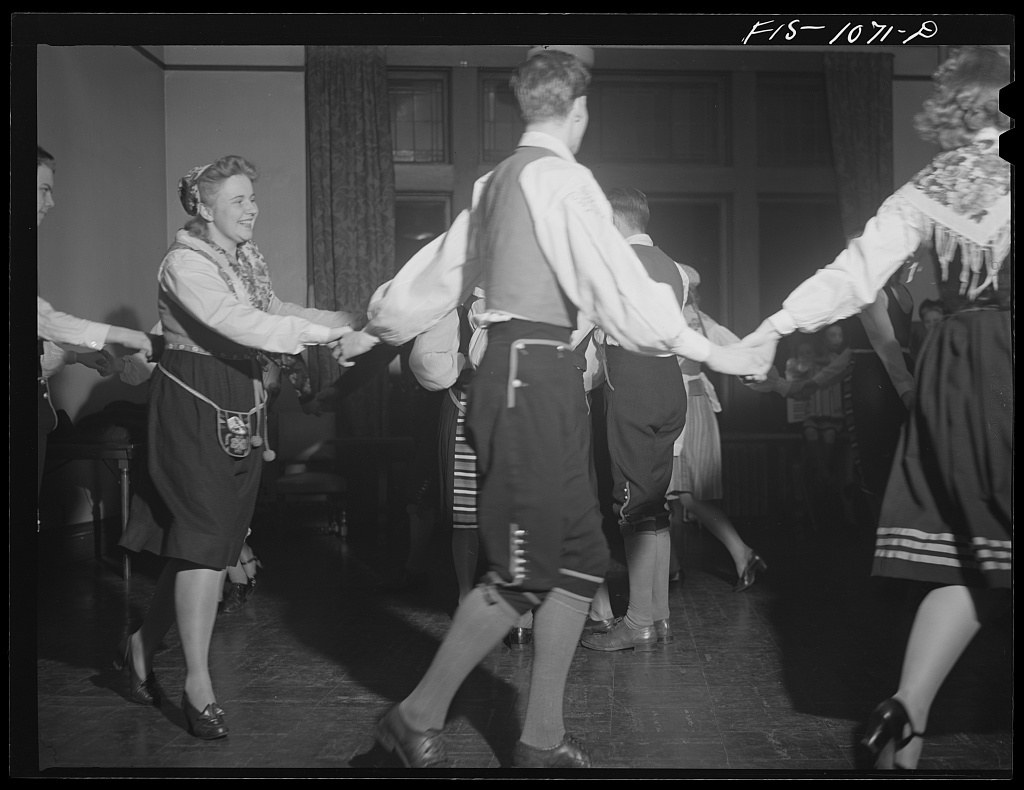
A Swedish folk dancing group in Minnesota
Unknown artist
- Collection:
- Prints & Photographs
- Source:
- Library of Congress
- Rights:
- Rights vary by item — check the source record before reusing this image. Source record ↗
- Recorded as:
- Library of Congress — no known restrictions (verify per item)
This photograph documents the living practice of European folk tradition in diaspora—how immigrant communities maintained and transmitted cultural identity through social dance. For historians of Swedish-American culture and of folk dance in the United States, it is primary source evidence of both the repertoire and the social contexts in which these dances survived the transition to America.
What you are looking at
Seven dancers arranged in a circle hold hands in what appears to be a community hall or institutional interior, their arms extended at shoulder height in a classic round-dance formation. The photograph captures them mid-movement, bodies angled slightly inward toward the circle's center. The dancers wear practical 1940s clothing: the women in dark skirts with patterned blouses or aprons, hair styled in period waves; the men in white or light-colored shirts with dark trousers and vests. The setting is plainly lit, with visible doorways and curtains in the background suggesting an indoor social or community gathering space. The photograph is black and white, the figures sharp against a darker background, the moment one of relaxed, rhythmic movement rather than climactic gesture.
The dancing
Seven dancers of mixed gender form a closed circle, hands joined at roughly shoulder height with arms extended. Their posture is upright and engaged, weight forward slightly into the circle. The nearest woman (left foreground) faces toward the center with a composed expression; those opposite face similarly inward. No pointe work, no extreme extension—the bodies suggest a ground-level, communal dance with weight on flat feet, the kind of hold and frame where social participation and group cohesion matter more than technical display.
The dance depicted
This appears to be a Swedish folk circle dance, most likely a traditional halling or springar variant, performed by a Swedish immigrant community in Minnesota. The circular formation with hands joined, the modest practical dress, and the indoor community setting all support this identification. Swedish folk dances were preserved and performed in immigrant communities throughout the American Midwest during the 1930s–1940s as markers of cultural identity. The photograph documents not a concert performance but a social gathering—the kind of dance that sustained community bonds among Swedish-Americans during the Depression and early war years.
How it was made
This is a black and white photograph, likely gelatin silver print, taken in available indoor light with a flash or bright fixed source. The sharpness and grain suggest professional or semi-professional documentation—this is not a casual snapshot but a deliberate record of the event. The photograph's clarity allows us to read the dancers' expressions and clothing detail, and the composition (the circle centered in frame, figures at readable distance) suggests the photographer understood the subject and had positioned themselves for clarity. Such photographs were commonly made by WPA photographers or local documentarians recording immigrant cultural practices during the New Deal era.
About this work
This is a documentary photograph of a Swedish folk dance circle performed by immigrants in Minnesota, captured around 1942. It records a moment of cultural preservation and community identity-building during a period when such traditions were maintained with deliberate care. The image belongs in a dance gallery because it shows us how traditional dance functioned in everyday immigrant life—not as staged performance but as embodied social practice, a way for people to stay connected to homeland while building life in America. The photograph is valuable precisely because it does not aestheticize the dance; it shows us what it actually looked like when Swedish-Americans gathered to dance together.
How to look at it
Notice the dancers' hands and arm position—joined at shoulder height, creating the tension and pull that defines circle-dance mechanics. Watch how their bodies angle inward; this is not a passive hold but an active one, where the circle's integrity depends on each dancer's weight and presence. The photographer has captured a moment mid-step, not a posed tableau, which gives us insight into the tempo and the dancers' engagement. The expressions on visible faces—calm, focused, unselfconscious—tell us this is a social dance, not a performance: the point is the circle itself, not the viewer.
The artist
The photographer is not recorded in the catalogue. The photograph bears a Library of Congress reference number (FIS-107-9) consistent with WPA documentary photography projects of the 1930s–1940s, when federal photographers systematically recorded American life, including immigrant communities and their cultural practices. If this was indeed a WPA photograph, it would have been taken by a photographer working under the Federal Writers' Project or similar New Deal initiative.
The period
The 1940s were a period when immigrant communities, facing pressure toward assimilation and the disruptions of World War II, often intensified efforts to preserve and perform their traditional dances. Swedish-American communities in Minnesota had maintained active folk-dance societies and annual celebrations since the late 19th century. The photograph dates to a moment when such practices were increasingly documented by American institutions—the Library of Congress, the Smithsonian, and regional archives—recognizing folk culture as worthy of preservation. At the same time, theatrical presentations of European folk dance were gaining popularity in American concert halls, though this image shows us the social, non-theatrical context from which such performances drew.
Where it lives
The photograph is held by the Library of Congress Prints & Photographs Online Catalog (loc.gov/pictures). The reference number FIS-107-9 suggests it is part of a larger documentation project, likely the WPA's Federal Writers' Project or similar New Deal cultural documentation initiative. The photograph would have been acquired as part of systematic American cultural documentation efforts of the 1930s–1940s.
Dance in this work
Questions about this work
What is the dance in this photograph?
It is most likely a Swedish folk circle dance, possibly a traditional halling, springar, or related form. These dances were central to Swedish-American community life, performed at social gatherings, celebrations, and cultural events. The circular formation with joined hands and the modest dress are characteristic of Swedish folk-dance tradition.
Where is this photograph from?
It is catalogued as a Swedish folk dance group in Minnesota, photographed around 1942. Minnesota had large Swedish-American populations, particularly in the Twin Cities and rural areas, and maintained active folk-dance traditions throughout the 20th century.
Why does this matter if it is just a social gathering?
Because social dancing is how cultural traditions actually survive and transmit across generations. This photograph shows us folk dance as lived practice, not as staged performance—it is evidence of how immigrant communities maintained identity, taught their children, and stayed connected to homeland during a period of rapid social change.
How do we know this is Swedish and not another Scandinavian tradition?
The catalogue record identifies it as Swedish. The circular formation with joined hands is characteristic of Swedish folk dances, though similar forms appear in Norwegian and Danish traditions. The documentary context (Minnesota's Swedish-American community) supports the identification.
More dance artwork





