49 works in this view — arrow keys or swipe to move between them.
Dance in Art
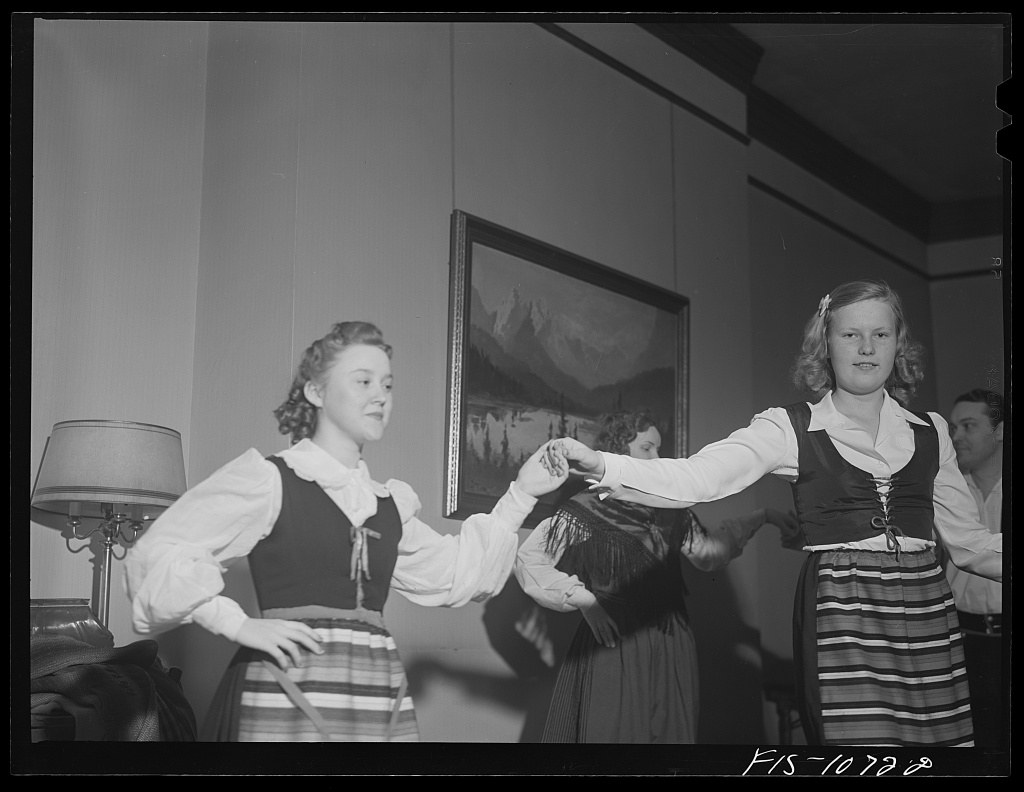
A Swedish folk dancing group in Minnesota
Unknown artist
- Collection:
- Prints & Photographs
- Source:
- Library of Congress
- Rights:
- Rights vary by item — check the source record before reusing this image. Source record ↗
- Recorded as:
- Library of Congress — no known restrictions (verify per item)
The photograph is significant as a document of living folk dance tradition in early 20th-century America, showing how Swedish communities maintained their cultural practices through dance. It provides visual evidence of the costume, grouping, and social context of folk dance practice outside its original geographic setting, illustrating the complex relationship between diaspora, cultural preservation, and assimilation in immigrant communities.
What you are looking at
This black-and-white photograph captures an indoor folk dancing scene, likely in a Minnesota community space in 1942. Three young women in traditional Swedish folk costume are visible, wearing long skirts with horizontal striped patterns and white blouses with dark vests or bodices. The woman on the right, dressed more formally in a black dress with striped skirt trim, extends her arm in a partnering gesture toward the center figure. The left figure wears a similar traditional ensemble. A floor lamp with a pleated shade stands to the left, and a landscape painting hangs on the wall behind them, establishing an intimate domestic or community hall setting. A fourth figure is partially visible in the background. The photograph captures a moment of social folk dancing, with the figures positioned as if mid-movement or demonstration.
The dancing
Three women are positioned in close proximity, suggesting a group dance formation or demonstration. The rightmost dancer extends her arm outward in a clear partnering or invitational gesture. The bodies are upright and poised rather than in active movement; this appears to be a posed moment or a held position within the dance. The women's arm positions suggest a side-by-side or circle formation typical of traditional European folk dances. The weight distribution and stance suggest a readiness to move rather than mid-step action.
The dance depicted
This appears to be Swedish folk dancing (halling, springar, or similar regional forms), evidenced by the traditional Scandinavian costume—long skirts with horizontal stripes, embroidered vests, and white blouses—which are characteristic of Swedish regional dress. The formal, upright posture and the apparent group formation suggest a traditional folk dance from the Nordic tradition. Without clearer footwork or a dynamic capture of movement, the specific dance style cannot be definitively identified, but the costume and formation are consistent with early 20th-century Swedish folk dance practice as preserved in immigrant communities.
How it was made
This is a black-and-white photograph, likely documentary or archival in nature, capturing a folk dance practice or demonstration. The image quality and photographic technique suggest professional or semi-professional documentation, possibly from a WPA or similar public documentation program of the 1940s. The composition and lighting indicate studio or indoor community space photography, emphasizing clarity of costume and gesture over artistic arrangement.
About this work
This photograph documents Swedish folk dancing within a Minnesota immigrant community in 1942, preserving a moment of cultural practice during a period of active folk dance transmission. The image records not only the dance itself but the specific regional costume and social context of how ethnic folk traditions were maintained in American communities. The formal pose and staged quality suggest this was created for documentary purposes—possibly to record immigrant cultural practices for archival or cultural preservation projects that were active during the Depression and World War II era.
How to look at it
Notice the formality of the pose and the precision of the costume—this is a moment staged for the camera rather than candid movement. Observe how the rightmost dancer's extended arm and the spacing of the three women suggest a formation or line characteristic of traditional Nordic folk dances. The upright carriage and balanced stance of all three figures reflect the postural discipline of folk dance technique. The photograph freezes what would be a continuous flowing movement into a single held moment, emphasizing the structured, patterned nature of folk dance rather than its dynamic qualities.
The period
In 1942, Swedish and other Scandinavian immigrant communities in Minnesota maintained active folk dance traditions as expressions of ethnic identity and cultural continuity. The 1930s and 1940s saw increasing institutional interest in documenting American folk culture, with government programs like the WPA documenting regional and ethnic traditions. Simultaneously, folk dancing experienced a revival of interest in mainstream American culture through organizations like country dancing associations and community cultural programs, making ethnic folk dance both a private cultural practice and an object of broader public interest.
Where it lives
This photograph is held in the Prints & Photographs collection of the Library of Congress, one of the major repositories of American documentary photography from the Depression and World War II eras. The catalogue notation suggests it is part of a broader documentation project of American folk culture and immigrant communities.
Dance in this work
Questions about this work
What is Swedish folk dancing?
Swedish folk dancing encompasses a range of traditional dances from different regions of Sweden, often performed at celebrations, social gatherings, and cultural events. These dances typically feature structured formations, specific footwork patterns, and are usually accompanied by traditional music. Common Swedish folk dances include the springar, halling, and polska, each with regional variations in costume, music, and movement.
Why would Swedish immigrants in Minnesota be dancing in 1942?
Swedish communities in Minnesota maintained active cultural traditions through social organizations, churches, and community gatherings. Folk dancing served both as entertainment and as a way to preserve ethnic identity and transmit cultural knowledge to younger generations. These practices were especially important during periods of immigration and assimilation, when communities sought to maintain connections to their heritage.
Is this a formal performance or a community practice?
The staged, posed quality of the photograph and the indoor community hall setting suggest this was documented for archival or informational purposes rather than being a formal theatrical performance. The women appear to be demonstrating or practicing the dance, possibly for a photographer documenting folk culture in immigrant communities.
More dance artwork





