49 works in this view — arrow keys or swipe to move between them.
Dance in Art
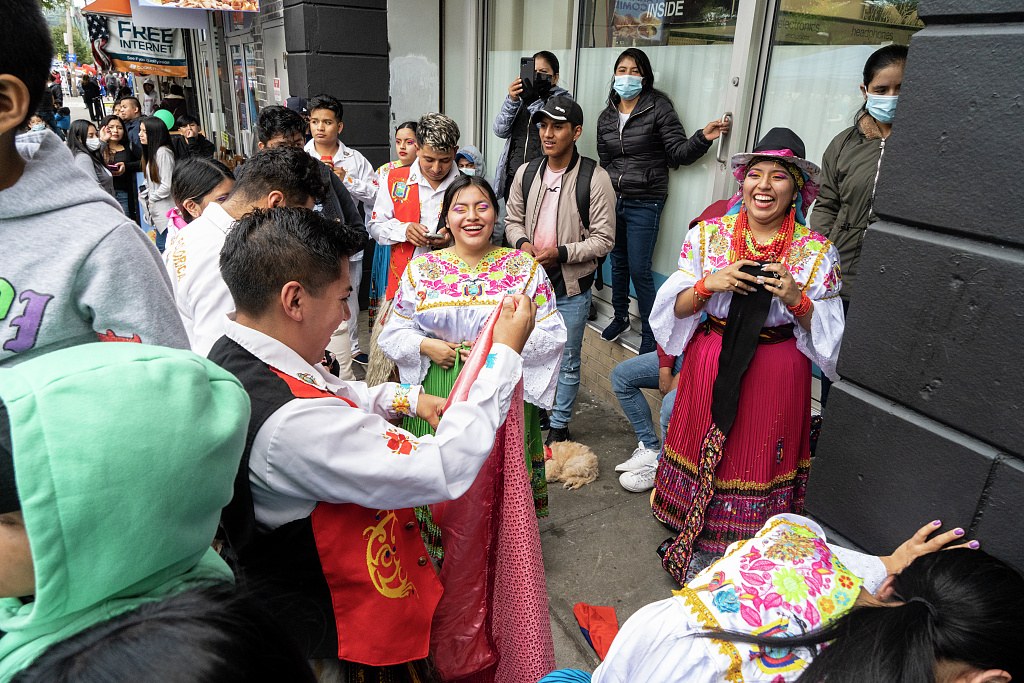
Ecuadorian folk dancers relaxing after the dance, 103-14 Roosevelt Ave., Queens
Unknown artist
- Collection:
- Prints & Photographs
- Source:
- Library of Congress
- Rights:
- Rights vary by item — check the source record before reusing this image. Source record ↗
- Recorded as:
- Library of Congress — no known restrictions (verify per item)
This image records diaspora and cultural continuity. The Ecuadorian traditional dress and the New York street corner represent both the persistence of ancestral knowledge and its active living presence in diaspora communities; the casual, unguarded moment shows dance not as exhibition but as genuine cultural practice and social cohesion.
What you are looking at
A street celebration in Jackson Heights, Queens, captured in bright daylight outside a storefront with white-framed windows. Two dancers in elaborate Ecuadorian traditional dress occupy the center: one wears a white embroidered blouse with a red skirt trimmed in contrasting colors, and the other wears a similar white blouse with hot pink and purple banded skirt and a matching fuchsia knit hat. Both garments feature dense geometric embroidery in yellows, greens, blues, and reds. They are captured in a relaxed moment, smiling and engaged with each other rather than performing in formal position. Around them stands a crowd of onlookers—some masked, some in casual contemporary dress—watching from the storefront edge. The lighting is natural and even, with the building's white wall and window frames creating a clean backdrop. The atmosphere is informal and celebratory rather than staged.
The dancing
The two central figures stand loosely, weight distributed comfortably rather than in a dance frame or formal posture. Neither dancer is in an active movement phrase; instead they face each other in conversation or rest, smiling. Their arms are relaxed and natural rather than shaped for dance positions. The photograph captures the body language of people between dances or after performance—chest open, shoulders dropped, attention on their immediate social exchange rather than on an audience or movement sequence.
The dance depicted
These are Ecuadorian folk dancers, identifiable from the distinctive regional dress: the embroidered white huipil (blouse), the wrapped and banded pollera skirt, and the knit hat typical of highland Andean communities. The photograph documents not a dance moment but the social life around it—what happens when performers rest. Ecuadorian traditional dance encompasses many regional styles including sanjuanito and pasillo, but this image records neither the movement nor the music; instead it preserves the human moment of ease and community connection that surrounds performance.
How it was made
This is a color photograph, likely digital or high-quality film stock given the saturation and clarity of the embroidery detail. The snapshot aesthetic—natural light, candid moment, uncropped abundance of bystanders—places it in the documentary or community-record tradition rather than studio portraiture. The format suggests newspaper or archival photography, capturing evidence of Ecuadorian cultural presence in Queens for the historical record.
About this work
This photograph documents Ecuadorian folk dancers in a moment of social rest during a street celebration in Jackson Heights, Queens in 2021. The image preserves not choreography but community: the embroidered dress, the public gathering, the casual joy of cultural celebration in an immigrant neighborhood. It belongs in a gallery about dance because it shows what dancers do when they are not dancing—the social fabric and place-making that gives performance its meaning.
How to look at it
Look at the faces and posture rather than the footwork: the genuine smiles, the direct eye contact between the dancers, the comfort in their bodies. Notice the density and precision of the embroidery—the work invested in this garment. Observe the crowd: people stopping, watching, the public space claimed for cultural expression. The photograph's value lies in what it shows about why people dance together, not what steps they know.
The period
Photographed in 2021, this documents contemporary diaspora practice. The Jackson Heights neighborhood of Queens has been home to large Ecuadorian and Latin American communities since the late 20th century. Street celebrations and public performances in ethnic neighborhoods are a well-established form of cultural assertion and community continuity in American cities, particularly in the decades following immigration reform.
Where it lives
This photograph is held in the Library of Congress Prints & Photographs collection. It is catalogued as a documentary photograph from a street location in Queens, suggesting it may have been acquired as part of a community documentation project or local history collection.
Dance in this work
Questions about this work
What are these dancers wearing?
Traditional dress from Ecuador's highland Andean communities, known as indígena or campesino dress. The white embroidered huipil (blouse) and wrapped pollera skirt with horizontal bands are characteristic of specific regional and ethnic communities in Ecuador. The heavy geometric embroidery in bright colors—yellows, greens, blues—and the knit hat are all hand-made or artisanal elements that carry meaning about the wearer's community of origin.
Where is Jackson Heights?
Jackson Heights is a neighborhood in the Queens borough of New York City. Since the 1970s it has been a center of Latin American immigration and settlement, particularly for people from Ecuador, Colombia, Mexico, and Central America. The neighborhood is known for its street fairs, murals, restaurants, and cultural celebrations that maintain immigrant community traditions.
Are they in the middle of dancing?
No. The photograph captures a moment of rest or social interaction between dances, or perhaps after a performance. The dancers' posture, facial expression, and relaxed arms indicate they are in conversation or recovery rather than executing choreography. This is actually the image's strength: it shows the human and social context of dance rather than only the movement itself.
What dance tradition do they represent?
Ecuadorian folk dance encompasses many regional styles including sanjuanito, pasillo, and danza, each connected to specific communities and occasions. The dress and context here suggest a celebration of Ecuadorian cultural identity in diaspora, but the photograph does not document a specific choreography or dance form. The focus is on cultural presence and continuity rather than technical dance content.
More dance artwork





